
Quick answer: Starting a hot shot business means picking an entity, getting a USDOT number (and an MC number if you'll haul for others across state lines), filing a BOC-3, carrying the right insurance, registering for UCR, checking whether IRP and IFTA apply to your rig, then booking and invoicing your first loads. Most of this can be done in a few weeks if you handle the paperwork in the right order — entity and USDOT first, insurance before your MC number activates, loads last.
Key takeaways
- A truck under 26,001 lbs GVWR towing a trailer rated 10,000 lbs or less needs no CDL — that's the standard non-CDL hot shot setup, though USDOT and medical card rules can still apply.
- You need an MC number, not just a USDOT number, if you'll haul freight that belongs to others across state lines for compensation.
- IFTA and IRP only kick in for a "qualified motor vehicle": two axles over 26,000 lbs, three-plus axles at any weight, or a combination over 26,000 lbs.
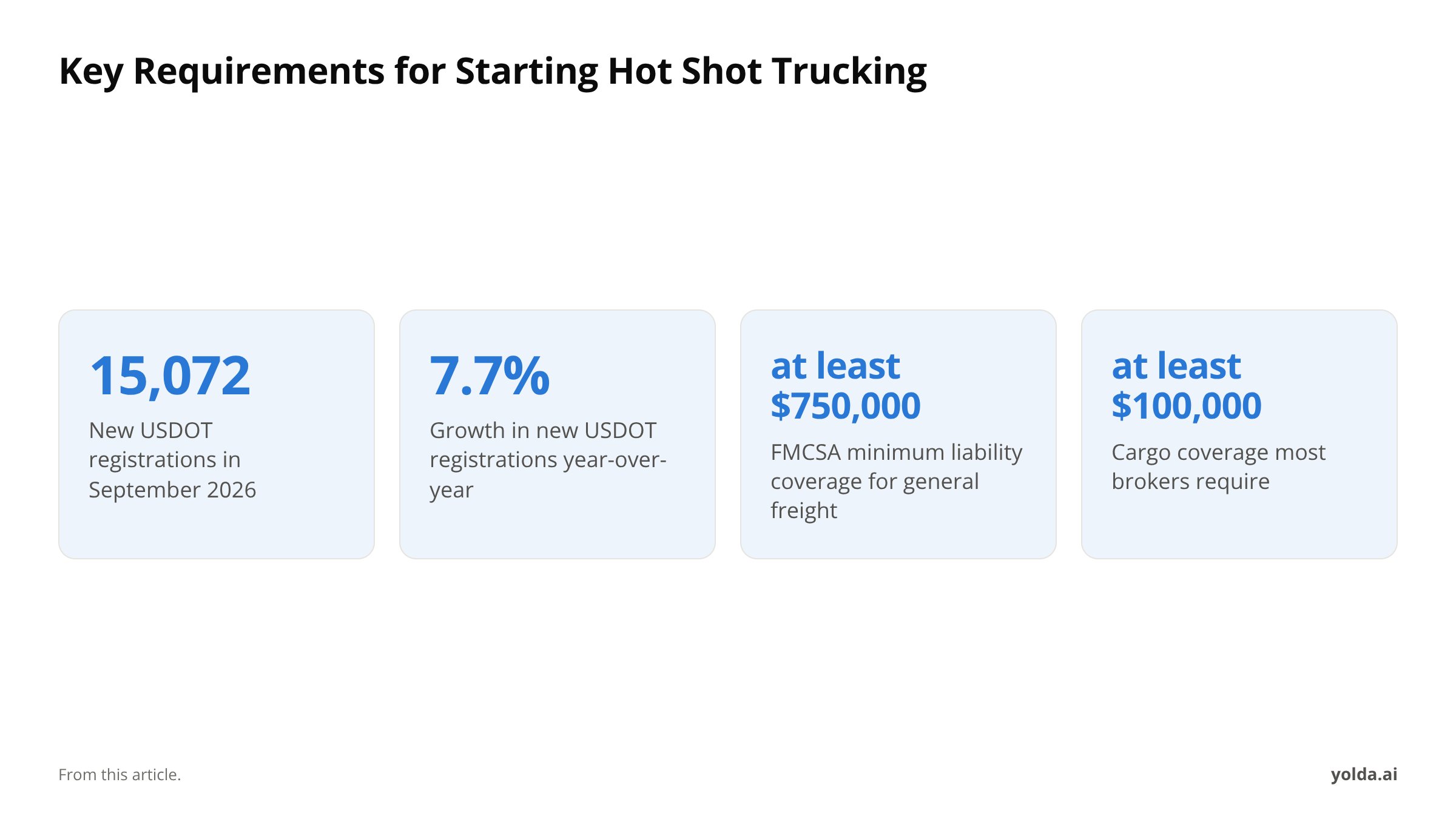
- New USDOT registrations hit 15,072 in September 2026, up 7.7% from a year earlier, according to the Federal Motor Carrier Safety Administration's Company Census File — new entrants are still flowing into the industry.
This guide goes deep on the setup mechanics. For the broader picture of equipment, routes, and whether hot shot is right for you, see our hot shot trucking overview.
By the numbers
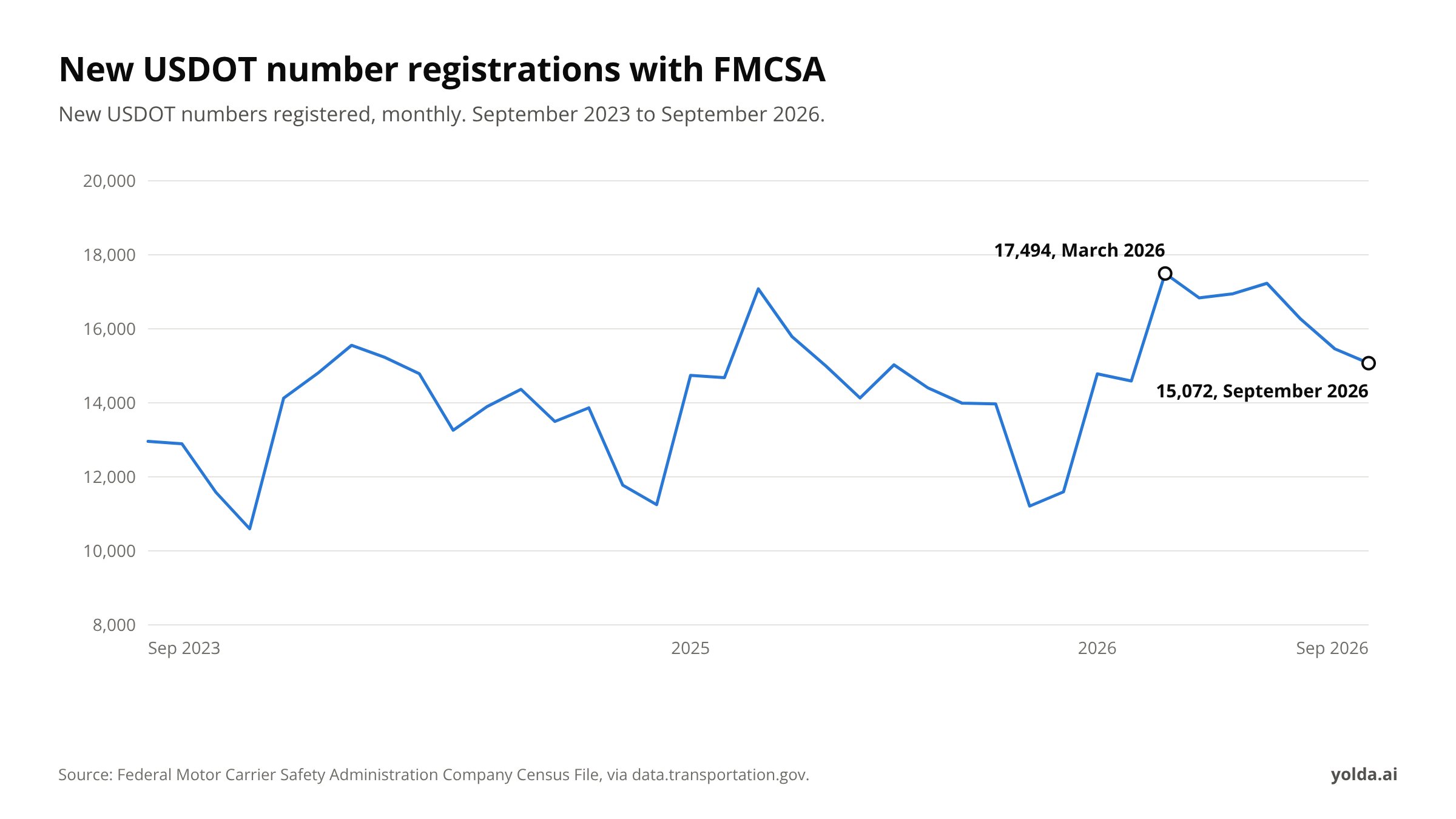
- New USDOT number registrations with FMCSA totaled 15,072 in September 2026, up 1,077 (7.7%) from a year earlier. Source: Federal Motor Carrier Safety Administration Company Census File, DOT open data.
Latest official data as of Nov 2, 2026.
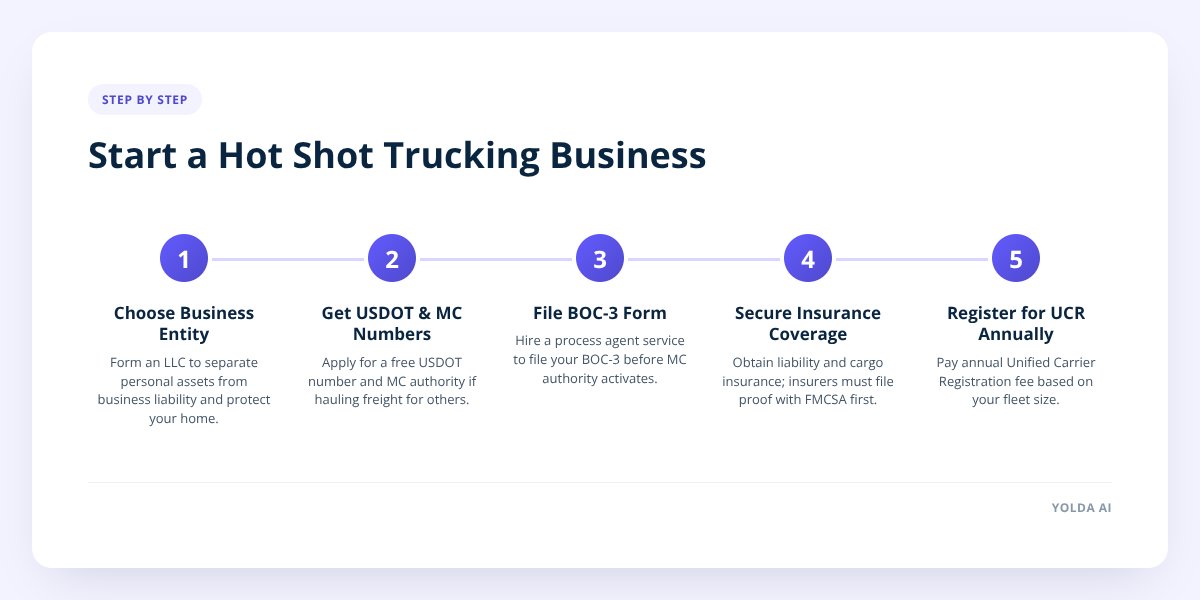
Step 1: Choose your business entity
Most new hot shot operators form an LLC, not a sole proprietorship, to separate personal assets from business liability. A sole proprietorship is simpler to set up, but if a loaded trailer causes an accident, your personal bank account and home equity are exposed along with the business. An LLC puts a legal wall between the two in most states.
Here's what to decide before you file anything else:
- Pick a state — usually the state where you live and will register your truck, since that's where you'll also handle IFTA and IRP if they apply.
- Choose LLC vs. sole proprietorship vs. corporation — an LLC is the common middle ground for a one-truck or small fleet operation.
- Get an EIN from the IRS — you'll need this for your USDOT application, bank account, and tax filings.
- Open a dedicated business bank account — mixing personal and business funds undermines the liability protection an LLC is supposed to give you.
This is also the point to talk to an accountant about how you'll track income and expenses per load. Clean books from day one make tax season and loan applications far less painful.
Step 2: Get your USDOT number and MC number
Every hot shot operator running in interstate commerce needs a USDOT number, issued by the Federal Motor Carrier Safety Administration (FMCSA), which identifies your business for safety and compliance purposes. You apply through the FMCSA's Unified Registration System (URS), and the number is free. We've covered what this number actually does and who needs one in what a USDOT number is.
An MC number is a separate authority you need if you'll transport freight that belongs to someone else, across state lines, for payment — which describes nearly every hot shot carrier hauling for brokers or shippers. If you're only ever moving your own company's goods, you may not need one. There's a filing fee for operating authority, and FMCSA has a mandatory waiting period after you apply before authority goes active, so don't book your first load expecting to run the same week.
We go through exactly who needs this authority and who doesn't in what is an MC number, and do you need one?
Don't skip this: FMCSA will not activate your MC authority until your insurance company has filed proof of coverage electronically on your behalf. Order your policy as soon as you apply for authority — not after — or you'll sit in limbo waiting on a carrier you haven't even contacted yet.
Step 3: File your BOC-3
A BOC-3 is a form naming a process agent in every state you operate in, who can accept legal documents on your company's behalf if you're ever sued. You can't do this yourself — you have to hire a process agent service, which typically charges a modest one-time or annual fee. Most insurance brokers or compliance services can point you to one, and many file it for you as part of your authority setup.
This form has to be on file with FMCSA before your MC number goes active. It's a small line item that's easy to forget when you're focused on insurance and equipment.
Step 4: Line up insurance before you apply for authority
Insurance isn't optional, and the amount of coverage you need depends on what you haul. FMCSA requires carriers hauling general freight to carry at least $750,000 in combined bodily injury and property damage liability coverage — higher minimums apply for hazmat and other specialized cargo. Beyond the federal minimum, most brokers won't tender a load to you without cargo insurance, and many require at least $100,000 in cargo coverage as a condition of working with you.
Shop this early, because the insurance company has to file your proof of coverage with FMCSA before your authority activates — it's the single biggest bottleneck new carriers hit. For a full breakdown of which coverages you actually need and which are optional add-ons, see hot shot trucking insurance: coverages you actually need.
Step 5: Register for UCR every year
The Unified Carrier Registration (UCR) is an annual fee paid by motor carriers that operate in interstate commerce, and it's separate from your MC number and insurance filings. The fee is based on the size of your fleet, and you register through your base state's UCR system once your USDOT number is active. Miss the renewal and you risk fines during roadside inspections, even if every other part of your operation is in order.
Mark the renewal date on a calendar the moment you register — UCR runs on an annual cycle and doesn't send a friendly reminder.
Step 6: Check if IRP and IFTA apply to your truck
This is where hot shot trucking diverges from standard CDL trucking, and it's worth getting exactly right. IRP (apportioned registration) and IFTA (fuel tax reporting) only apply to a qualified motor vehicle, defined the same way for both programs:
| Condition | Qualifies for IRP/IFTA? |
|---|---|
| Two axles, gross or registered gross weight over 26,000 lbs | Yes |
| Three or more axles, any weight | Yes |
| Combination (truck + trailer) with combined weight over 26,000 lbs | Yes |
| Truck under 26,001 lbs GVWR towing a trailer rated 10,000 lbs or less | No |
A lot of hot shot operators run exactly the setup in that last row — a one-ton pickup under 26,001 lbs GVWR pulling a gooseneck or deckover rated 10,000 lbs or less. That combination needs no CDL and, importantly, doesn't trigger IRP or IFTA either, even though you're still crossing state lines for pay.
But plenty of hot shot rigs do cross the 26,000-lb combination threshold once you add a loaded trailer, and the moment you do, IRP and IFTA apply regardless of whether a CDL is required. We've laid out the exact numbers for the non-CDL setup in non-CDL hot shot trucking: requirements by the numbers, and what an IFTA audit actually looks like in what happens in an IFTA audit, step by step.
If IFTA does apply to your rig, tracking fuel purchases and miles by state by hand gets tedious fast — our free IFTA calculator is a quick way to estimate what you'll owe before you file.
Step 7: Book your first loads
Once your authority is active, your insurance is filed, and your UCR is current, you're legally allowed to haul — but getting a broker to actually give you a load is a different problem. New carriers often sit on a "new entrant" status with brokers and factoring companies for the first few months, which can mean smaller loads or more paperwork up front.
A few things that speed this up:
- Set up a factoring relationship if you need cash flow before your 30-day broker payment terms kick in.
- Build a short carrier packet — your MC number, insurance certificate, W-9, and a reference or two — so you're not scrambling when a broker asks.
- Start with load boards and direct broker relationships, and read every rate confirmation carefully before you accept; we cover what to check first in rate confirmation: what's in one and what to check first.
- Learn to spot a good load from a bad one before you're three hours into a lane that doesn't pay — see how to find hotshot loads and pick the good ones.
A free rate confirmation template and bill of lading template are useful if the broker doesn't hand you their own paperwork.
Step 8: Invoice promptly and track what you're actually earning
Getting paid on time starts with sending a clean, accurate invoice the day a load delivers — not a week later when details have gone fuzzy. Your invoice should reference the rate confirmation number, show the agreed rate, list any accessorials like detention, and attach the signed bill of lading or proof of delivery. A free trucking invoice template gets you started if you're not using software yet.
The bigger issue most new operators run into isn't invoicing itself — it's not knowing which loads actually made money once fuel, tolls, and time are factored in. Turning a delivered load into an invoice without re-entering data, and seeing which lanes are actually profitable, is exactly what Yolda's accounting tools are built for: one click converts a delivered load into an invoice, and you can ask in plain English which lanes made money last month instead of building a spreadsheet report by hand. We also wrote about keeping your books and your TMS in sync in QuickBooks and your trucking software: getting them to match.
What to do next
The order above matters more than the speed — filing your MC number before insurance is locked in, or skipping UCR because you're focused on finding loads, are the two most common ways new hot shot operators lose weeks they didn't need to lose. Work through entity, authority, insurance, and UCR in sequence, confirm whether IRP and IFTA apply to your specific rig, and only then start chasing loads.
Once loads start coming in, Yolda can handle dispatch, invoicing, settlements, and compliance tracking from one login as your operation grows past a single truck. Book a demo or start a free trial to see it running against your own loads.
Checklist: Start a hot shot trucking business
- Form your LLC and get an EIN from the IRS.
- Open a dedicated business bank account.
- Apply for your USDOT number through FMCSA's Unified Registration System.
- Apply for MC authority if you'll haul freight for others across state lines.
- Shop and bind liability and cargo insurance before authority is filed.
- Confirm your insurer has filed proof of coverage electronically with FMCSA.
- File your BOC-3 process agent form.
- Register for UCR in your base state.
- Check your truck and trailer weights against the IRP/IFTA thresholds.
- Build a carrier packet and book your first load.


