
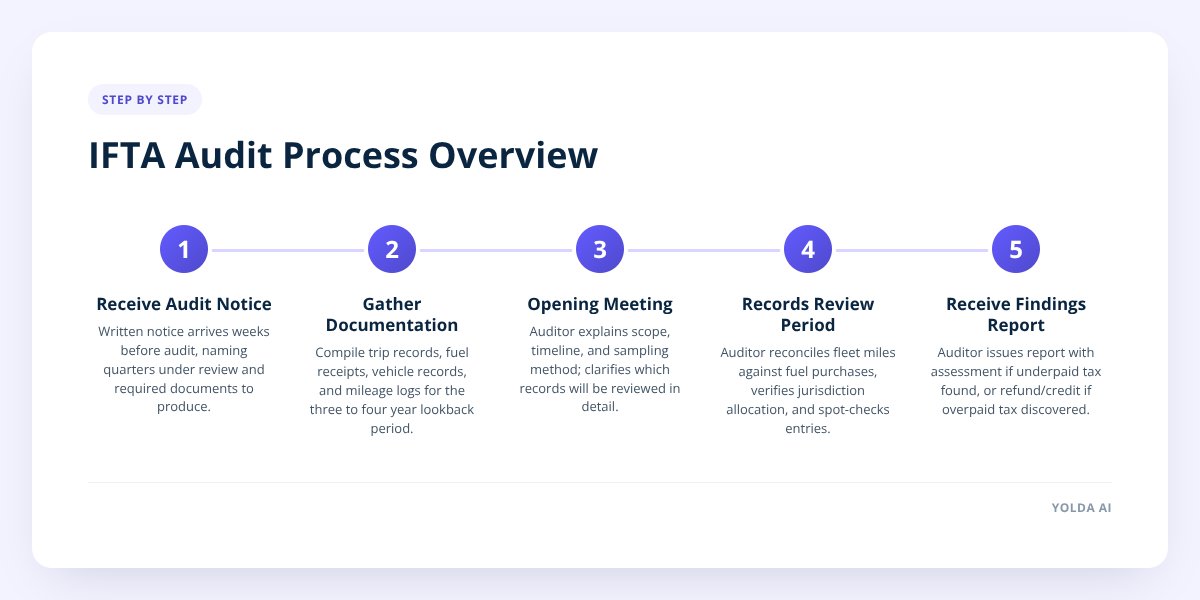
Quick answer: An IFTA audit is a records review where your base jurisdiction checks your quarterly fuel tax filings against your actual trip records, fuel receipts, and mileage logs, usually covering a three to four year window. You'll get written notice, a request for specific documents, an opening meeting, a records review period, and a findings report — the whole process typically runs several weeks to a few months depending on how organized your records are. Most audits are routine and based on things like your fleet size, not suspicion of wrongdoing.
Key takeaways
- The International Fuel Tax Agreement (IFTA) requires member jurisdictions to audit a percentage of carriers each year, and selection is often random or based on risk factors, not an accusation.
- Auditors typically request individual trip records, fuel receipts, and vehicle mileage for a three- to four-year lookback period, per standard IFTA audit guidelines used by member jurisdictions.
- A finding of underpaid tax results in an assessment plus interest; a finding of overpaid tax can result in a refund or credit.
- Poor or missing records — not an honest mistake on the return itself — are the single biggest driver of large assessments in IFTA audits.
What Triggers an IFTA Audit in the First Place?
Most carriers never find out exactly why they were picked, and that's normal. The IFTA Audit Manual, which guides how member jurisdictions conduct these reviews, directs each jurisdiction to audit a set percentage of its IFTA-licensed carriers annually, and jurisdictions commonly use a mix of random selection and risk scoring to decide who that is.
Factors that can raise a carrier's audit likelihood include:
- A pattern of amended returns or late filings over several quarters
- Mileage or fuel numbers that swing sharply from one quarter to the next with no clear reason
- A reported miles-per-gallon figure that falls outside a plausible range for the truck type
- Zero-mile or zero-tax quarters filed repeatedly
- Simply being due for audit under your base jurisdiction's rotation schedule
None of these guarantee an audit, and plenty of audits happen to carriers with clean, boring numbers. If your base jurisdiction runs a four-year audit cycle, as many do, you may simply be up.
How Much Notice Will I Get Before the Audit Starts?
You'll typically get written notice from your base jurisdiction several weeks before the audit begins, naming the quarters under review and the records you'll need to produce. This isn't a surprise visit — IFTA's governing agreement requires advance notice, and most jurisdictions send a letter that spells out the audit period, the auditor's contact information, and a proposed start date.
That notice period is your real window to get organized. Once the clock starts, you're reacting instead of preparing. If your fuel tax reporting habits have been loose — guessed mileage, receipts tossed after filing, no per-truck trip logs — this is the moment to go back and tighten up before anyone asks to see anything, something we cover in more detail in Fix IFTA Reporting Errors Before Audit Season Hits.
What Documents Does the Auditor Actually Ask For?
An IFTA auditor will ask for the source documents behind every number on your quarterly returns — not just the returns themselves. That means individual trip reports, fuel purchase receipts, and vehicle records for each truck in the fleet, usually spanning the three to four most recent tax years.
Here's what that breaks down to in practice:
| Record type | What it needs to show |
|---|---|
| Trip records | Date, origin and destination, route, jurisdictions traveled, total miles per trip |
| Fuel receipts | Date, seller name and location, gallons purchased, fuel type, unit number |
| Vehicle records | VIN, make/model, registered weight, fleet additions and disposals |
| IFTA returns | All quarterly returns filed during the audit period, including amendments |
| Mileage summaries | Total fleet miles and taxable miles by jurisdiction, by quarter |
If any of this lives in a shoebox of paper receipts or scattered spreadsheets, the audit is where that catches up with you. Auditors reconcile reported miles against fuel purchased and expect the math to hold together truck by truck, trip by trip.
Don't skip this: if your trip records don't support the miles you reported, most IFTA jurisdictions are permitted to apply a standard mileage-per-gallon rate — often a flat default like 4 MPG — to estimate your tax liability instead of using your numbers. That default is rarely in your favor, so inadequate records can cost you more than a reporting mistake would have.
What Happens During the Opening Meeting and Review Period?
The audit itself usually opens with a meeting — in person or virtual — where the auditor explains the scope, the timeline, and how they'll sample your records. Many audits don't review every single trip; auditors often pull a representative sample of trips or a specific time block (like one quarter in detail) and extrapolate the findings across the full audit period if the sample checks out.
After that meeting, the review period starts. This is where the auditor works through:
- Reconciling total fleet miles reported against fuel receipts and trip logs
- Checking that mileage was allocated to the correct jurisdictions
- Verifying fuel tax paid at the pump matches what was claimed as a credit
- Confirming vehicles were properly added to or removed from your IFTA fleet when bought or sold
- Spot-checking unusual entries — a sudden drop in miles, a quarter with no taxable miles, or a jump in a specific jurisdiction
This phase can take anywhere from a few weeks to a couple of months, largely driven by how quickly you can produce clean records and how many discrepancies the auditor finds along the way. Carriers who can hand over organized digital records tend to move through this stage much faster than carriers digging through paper files.
What Comes Out of an IFTA Audit — and What If I Owe Money?
The audit ends with a written findings report that either confirms your filings were accurate, finds you underpaid, or finds you overpaid. If the audit finds you underpaid, you'll receive a billing for the additional tax owed plus interest; if you overpaid, you're entitled to a refund or credit, something covered in more depth in IFTA Fuel Tax Credits: How to Claim Your Refund.
A few things to know about what happens next:
- You'll usually have the right to appeal. Most jurisdictions outline a formal appeal or protest process with a specific deadline — often 30 to 60 days from the assessment notice, but confirm the exact window with your base jurisdiction since it varies.
- Interest accrues from the original due date, not the audit date. A finding covering four years back can carry years of accumulated interest, which is often a bigger shock than the base tax owed.
- Penalties can apply separately from interest if the audit finds a pattern of late filing or non-filing, on top of any underpayment.
- A clean audit doesn't mean no future audits. Being selected once, especially randomly, doesn't exempt or re-flag you either way for next cycle.
If the numbers in the findings report don't match what you expected, go back to your own trip-by-trip records before assuming the auditor made an error — the gap is usually in a receipt that got lost or a load that was logged to the wrong state.
Why Fleets With Messy Records Struggle Most — and How to Fix That Before Audit Season
The carriers who come out of an IFTA audit cleanly aren't the ones who made zero mistakes over four years — they're the ones who can produce a complete, trip-by-trip paper trail on demand. A single missing fuel receipt or an estimated mileage entry doesn't sink an audit by itself, but a pattern of them across hundreds of trips is exactly what pushes an auditor toward that default mileage-per-gallon assumption mentioned earlier.
This is where manual recordkeeping — spreadsheets built after the fact, receipts stuffed in a glovebox, mileage estimated from memory — tends to fall apart under audit scrutiny. Yolda's IFTA reporting feature calculates your quarterly fuel tax from mileage and fuel data already tied to each load and each truck, so the trip-level detail an auditor asks for is sitting in the system rather than reconstructed from memory months or years later. If you're newer to IFTA altogether, Preparing for Your First IFTA Filing walks through the basics before audit season is even a concern.
Getting ahead of this doesn't require waiting for an audit notice, either. Running your own internal review each quarter — before you file, not after a letter shows up — catches the same gaps an auditor would find, which is the approach laid out in Audit Your IFTA Numbers Before the Quarter Closes, Not After.
If you want to see how automated IFTA tracking fits into the rest of your back office, you can book a demo with Yolda and walk through it with your own fleet's numbers.
Checklist: Getting Audit-Ready Before the Notice Arrives
- Pull trip records for every truck covering the last four tax years.
- Match fuel receipts to the trips they belong to, truck by truck.
- Confirm every receipt shows date, seller, location, gallons, and fuel type.
- Reconcile each quarter's reported miles against your trip logs for gaps.
- Flag any quarter with unusually high or low mileage and document why.
- Check that vehicles added or sold mid-year were updated on your IFTA account.
- Store digital copies of receipts and logs so nothing depends on paper surviving four years.
- Review your last several quarterly returns for amendments or late filings that might raise your audit risk.


