
Quick answer: You can legally run a non-CDL hot shot setup when your truck's GVWR is 26,000 lbs or less and your trailer's GVWR is 10,000 lbs or less, per the CDL classifications in 49 CFR 383.91. Go over either number, or exceed 26,001 lbs GCWR with a trailer rated above 10,000 lbs, and you've crossed into Class A CDL territory. You'll still likely need a USDOT number, possibly an MC number, and — depending on weight and routes — a DOT medical card, even if you never touch a CDL.
Key takeaways
- A truck under 26,001 lbs GVWR towing a trailer rated 10,000 lbs GVWR or less needs no CDL, regardless of combined weight — this is the standard legal non-CDL hot shot configuration under 49 CFR 383.91.
- A trailer rated over 10,000 lbs GVWR combined with a GCWR of 26,001 lbs or more pushes the driver into Class A CDL territory.
- IFTA and IRP apply to any vehicle used across state lines with two axles over 26,000 lbs, three or more axles at any weight, or a combination over 26,000 lbs — separate from the CDL question entirely.
- A USDOT number is required for interstate commerce regardless of CDL status; an MC number depends on what you haul and for whom.
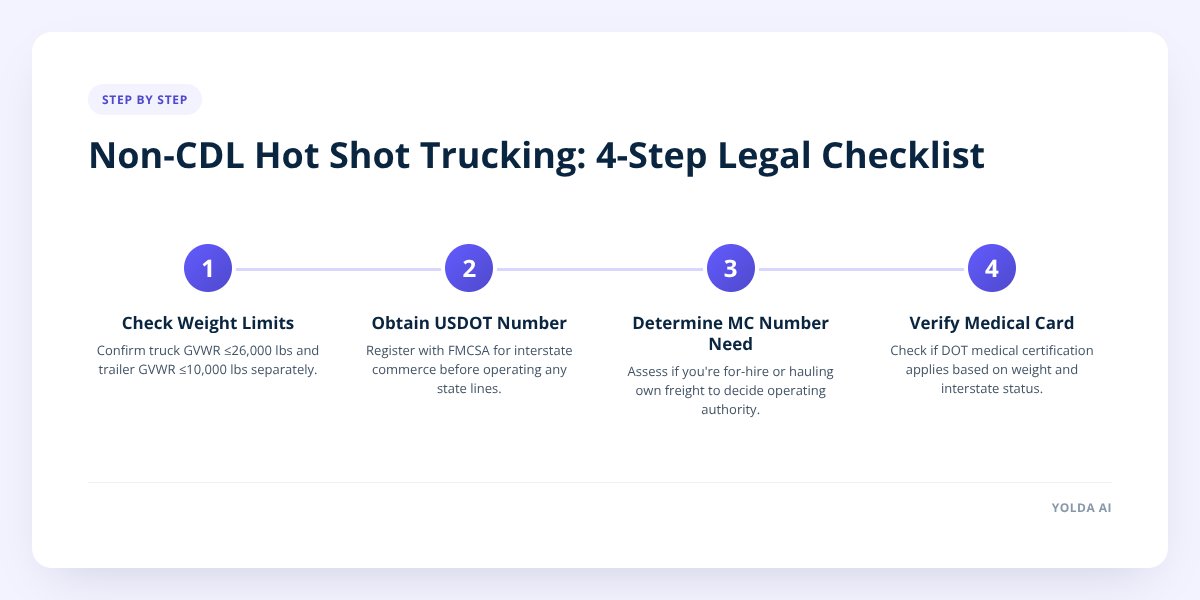
Step 1: Confirm your truck and trailer actually fit the non-CDL weight limits
This is the step people get wrong most often, because they look at combined weight instead of each vehicle's rating separately. Under 49 CFR 383.91, the federal rule that defines CDL license classes, the weight of the truck and the weight of the trailer are judged on their own terms — not just added together.
Here's the breakdown:
| Setup | Truck GVWR | Trailer GVWR | CDL required? |
|---|---|---|---|
| Legal non-CDL hot shot | 26,000 lbs or less | 10,000 lbs or less | No |
| Class A required | Any | Over 10,000 lbs, with GCWR 26,001+ lbs | Yes, Class A |
| Class B required | 26,001 lbs or more (single vehicle) | 10,000 lbs or less (if towing) | Yes, Class B |
The detail that trips up new operators: a combination over 26,000 lbs does not by itself require a CDL. What matters is whether the trailer is rated above 10,000 lbs GVWR. A one-ton dually under 26,000 lbs GVWR pulling a gooseneck trailer rated at 10,000 lbs or less stays non-CDL even if the combined weight on paper looks heavy.
Flip the trailer rating past 10,000 lbs while the combination's GCWR hits 26,001 lbs or more, and you now need a Class A license. This exact weight math — and which trailers on the market fall on which side of it — is covered in more detail in Gooseneck vs Bumper Pull: Which Hotshot Trailer Needs a CDL? if you're still shopping for a trailer.
Don't skip this: check the trailer's GVWR on its data plate or title, not just what the dealer calls it. A "10K gooseneck" sold with a 12,000-lb axle package may actually be plated higher than 10,000 lbs GVWR — and that single number decides whether you need a CDL.
Step 2: Get your USDOT number before you hit the road
You need a USDOT number if you're operating in interstate commerce, period — CDL or no CDL. The Federal Motor Carrier Safety Administration (FMCSA) requires this registration for any commercial vehicle crossing state lines, and it's separate from the CDL threshold entirely. A non-CDL hot shot truck running loads from Ohio into Indiana needs a USDOT number just like a semi does.
The process itself is straightforward but easy to get wrong on the first try — picking the right entity type, choosing the correct operation classification, and knowing what triggers a biennial update are the parts people stumble on. We walked through the full registration process, including common filing mistakes, in What Is a USDOT Number, and Do You Need One?
A few things to confirm before you apply:
- Verify you're actually operating in interstate commerce, not strictly within one state.
- Check whether your home state also requires intrastate authority if you stay local.
- Have your business structure (sole proprietor, LLC, corporation) decided first — it affects the application.
- Know your vehicle's GVWR and GCWR before you file, since FMCSA asks for them.
Step 3: Figure out if you also need an MC number
Not every non-CDL hot shot operation needs a Motor Carrier (MC) number — it depends on what you haul and who you haul it for. An MC number, issued by FMCSA, is generally required when you're transporting regulated commodities for hire across state lines as a for-hire carrier, separate from the USDOT number that just identifies the vehicle and operation.
If you're running your own freight — say, hauling your own company's equipment between job sites — you may need a USDOT number without needing operating authority. But if you're picking up loads from shippers or brokers as a for-hire carrier, operating authority is typically required. What Is an MC Number, and Do You Need One? breaks down exactly which scenarios require it.
This is one area where it pays to check your specific situation rather than assume. The line between "exempt" and "needs authority" depends on cargo type, for-hire status, and whether you cross state lines — confirm your exact case against current FMCSA guidance before you book your first load.
Step 4: Don't assume non-CDL means no medical card
A DOT medical card can still be required even when you're driving without a CDL. The medical certification requirement in 49 CFR 391.41 applies based on the vehicle's weight and the nature of interstate commerce, not based on license class. Many non-CDL hot shot drivers are surprised to learn they still need to carry a current medical certificate.
Whether you need one depends on your specific GVWR, GCWR, and whether you're operating in interstate commerce — the thresholds are separate from the CDL cutoff you just confirmed in Step 1. Because this trips up so many new operators, we laid out exactly when the medical card requirement kicks in in DOT Medical Card: What It Is and When It Expires.
Keep in mind the medical card isn't a one-time box to check. It expires — typically on a schedule your medical examiner sets based on your health — and running past that expiration date puts you out of compliance even if every other number on your truck is legal.
Step 5: Know which weight rule governs IFTA, separate from your CDL status
IFTA and IRP — the fuel tax and registration agreements that apply across state lines — use their own weight threshold, and it's not tied to CDL class at all. A vehicle qualifies as a "qualified motor vehicle" under IFTA if it has two axles and a gross or registered gross weight over 26,000 lbs, three or more axles at any weight, or a combination over 26,000 lbs.
This catches some non-CDL hot shot operators off guard. You can run a fully legal non-CDL setup — truck under 26,000 lbs, trailer under 10,000 lbs — and still trip the IFTA three-axle rule if your trailer configuration adds a third axle, regardless of total weight. Three axles at any weight pulls you into IFTA and IRP obligations even when your CDL question was already settled in Step 1.
Check your actual axle count and registered weight against the IFTA threshold separately from your CDL math. The two rules exist for different reasons — one is about who can hold the wheel, the other is about who owes fuel tax across state lines — and a setup legal under one can still owe filings under the other.
Step 6: Know what loads you can legally haul in a non-CDL setup
A non-CDL hot shot rig can haul most general freight, equipment, and machinery that fits within its GVWR and GCWR limits — the load itself isn't restricted by CDL status, the weight is. What changes your eligibility is cargo weight pushing you over the truck or trailer's rated capacity, or hazmat quantities that trigger placarding requirements under Class C rules, which apply regardless of your truck's size.
Realistic examples that fit a legal non-CDL hot shot setup:
- Compact construction equipment like skid steers or mini excavators under the trailer's rated capacity.
- Palletized freight, building materials, or landscaping supplies within GVWR limits.
- Farm equipment attachments and smaller agricultural machinery.
- LTL freight for brokers running expedited, time-sensitive loads.
What pushes a load out of non-CDL territory:
- Equipment heavy enough to require a trailer rated above 10,000 lbs GVWR.
- Hazmat in quantities requiring placards, which triggers Class C or higher licensing needs.
- Oversize or overweight loads requiring permits that often assume a CDL-rated combination.
For a deeper look at sourcing loads that fit this niche — and telling a solid load from a time-waster — How to Find Hotshot Loads and Pick the Good Ones is worth a read once you've got your setup locked in. And if you're still deciding whether hot shot is the right business model at all, the overview in What Is Hot Shot Trucking? covers the broader picture.
What to Do Next
Once your weight math, USDOT number, MC number status, and medical card are all squared away, the ongoing work shifts to staying compliant — tracking when your medical card expires, when your registration renews, and whether a new load pushes you over a weight threshold you didn't plan for. That's the part that catches even careful operators off guard months into running loads.
Yolda built its safety and compliance module to watch exactly these dates — medical card, registration, insurance, and inspection deadlines — and flag them before they lapse, instead of you finding out at a roadside inspection. If you're running a non-CDL hot shot operation and want fewer compliance surprises, book a demo or start a free trial to see how it fits your setup.
Checklist: Setting up a legal non-CDL hot shot operation
- Confirm your truck's GVWR is 26,000 lbs or less on the data plate.
- Confirm your trailer's GVWR is 10,000 lbs or less on its data plate or title, not just the dealer's listing.
- Count your axles and check registered weight against the IFTA threshold separately from your CDL math.
- Apply for your USDOT number if you'll operate in interstate commerce.
- Determine whether you need an MC number based on for-hire status and cargo type.
- Schedule a DOT medical exam and confirm whether your setup requires a current medical card.
- Check hazmat placarding rules before accepting any load involving regulated materials.
- Verify any oversize or heavy equipment load against your trailer's rated capacity before booking it.


