
Quick answer: Hotshot load boards work the same way general freight boards do — brokers and shippers post loads, you search by lane and equipment type, and you book through the board or by calling the broker directly. The difference is filtering: you're looking for loads that fit a 3/4-ton or 1-ton truck pulling a gooseneck or flatbed trailer, usually under 26,000 lbs combined, with tighter deadlines than van freight. Pick good loads by checking rate per mile against your deadhead, confirming the broker's payment history, and never rolling before you have a signed rate confirmation in hand.
Key takeaways
- A load's real value is rate minus deadhead miles, not the posted rate per mile — a $900 load with 80 deadhead miles can pay worse than a $700 load with none.
- Most hotshot freight runs on open deck equipment (flatbed, gooseneck, step deck), so you need broker credit and payment history checked before you book, not after you deliver.
- Non-CDL hotshot rigs — a truck under 26,001 lbs GVWR towing a trailer rated 10,000 lbs GVWR or less — can run most of these loads without a Class A license.
- The rate confirmation is the contract that actually matters; verbal agreements over the phone or in board chat don't protect you if a broker disputes the rate later.
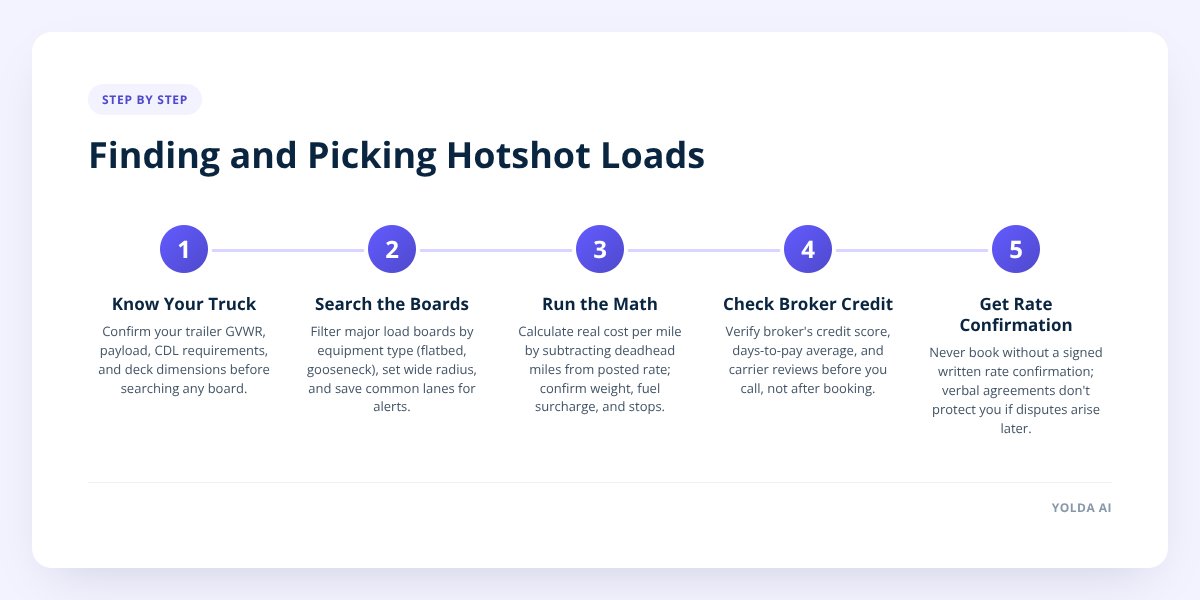
Step 1: Know What You're Looking For Before You Open a Board
A hotshot load is freight small enough and urgent enough to move on a pickup-and-trailer rig instead of a full tractor-trailer — machinery parts, construction equipment, pipe, steel, farm equipment, and anything a shipper needs moved fast on a short notice. We go into the setup, equipment, and licensing side of this in our hot shot trucking overview; this guide goes deeper into the one piece that trips people up most: finding and vetting the loads themselves.
Before you search a board, know your truck's real capacity. That means:
- Your trailer's GVWR and your truck's actual payload rating, not the sticker number
- Whether your combination needs a CDL — under 49 CFR 383.91, a truck under 26,001 lbs GVWR towing a trailer rated 10,000 lbs GVWR or less does not require one, but a heavier trailer pushing your GCWR to 26,001 lbs or more does
- Your deck length and width if you're running flatbed or gooseneck, since most hotshot freight is open-deck
Searching without these numbers in hand means you'll waste time opening loads you can't legally or physically haul.
Step 2: Search the Load Boards That Actually List Hotshot Freight
Hotshot loads show up mixed in with general flatbed and van freight on major load boards, so you filter by equipment type rather than hunting for a "hotshot-only" board. On most boards, the equipment filter will include options like flatbed, step deck, gooseneck, and sometimes a specific hotshot or "straight truck" category. Set your search radius wide at first — 150 to 200 miles from your current location — since hotshot freight is often spread thinner than van freight in any single metro area.
A few practical habits make the search faster:
- Save your common lanes so you get alerts instead of re-searching every morning
- Filter by weight, not just equipment type, since a board listing "flatbed" doesn't tell you if the load is 3,000 lbs or 15,000 lbs
- Check posted pickup and delivery windows first — hotshot freight is often booked same-day or next-day, so a load posted three days ago may already be gone
- Call the broker if the listing is vague on weight or dimensions rather than guessing
Many hotshot owner-operators also build direct relationships with a handful of brokers who post consistently in their lane, and skip the public board search for those loads entirely. That takes time to build but tends to produce steadier freight than cold-searching a board every day.
Step 3: Run the Numbers Before You Call
A posted rate per mile means nothing until you subtract your deadhead and add up your real cost to run the load. Here's a worked example:
A load posted at $2.10 per mile for a 400-mile run looks like $840. But if you're sitting 70 miles from pickup with no backhaul lined up, that's 470 total miles for $840 — which is really $1.79 per mile once you spread the rate across the miles you actually drive. If your all-in cost per mile (fuel, maintenance, insurance, truck payment) runs around $1.50, that load clears about 29 cents a mile in profit. Run the same load with a 150-mile deadhead instead, and the math turns negative before you've even loaded the trailer.
Our cost per mile calculator is a free way to find your real per-mile cost so you're comparing apples to apples on every load, instead of just eyeballing the posted rate.
Beyond deadhead, check:
- Weight and dimensions against your trailer's rating — an overweight load can mean permits, fines, or a trailer you're not insured to pull at that weight
- Fuel surcharge — some posted rates include it, some don't, and the difference matters more on longer hauls
- Multiple stops — a load with two pickups and two drop-offs takes more time and adds risk of detention, even if the total miles look the same
- Tarping or securement needs — a flatbed load that needs tarps adds labor time that isn't reflected in the rate
Don't skip this: never book a load based on a board listing alone. The listing is an advertisement; the rate confirmation is the contract. Treat anything you haven't seen in writing as unconfirmed.
Step 4: Vet the Broker Before You Vet the Load
A good rate from a broker who pays slow — or doesn't pay at all — isn't a good load. Most load boards show a broker's credit score, days-to-pay average, and sometimes a count of carrier reviews or complaints. Check all three before you call, not after you've already said yes.
Things worth checking on a broker before booking:
- Credit score or rating shown on the board — a low score is a signal to ask more questions, not necessarily a dealbreaker, but it should change how you handle payment
- Average days to pay — if a broker's average is 45 days and you need cash flow weekly, that load may not be worth the rate even if the per-mile number looks good
- Carrier reviews or complaint history, if the board shows them — a pattern of short-pay complaints or detention disputes is worth more than one bad review
- Whether they're bonded and the bond amount, if listed — brokers are required to carry a surety bond, and the amount on file can tell you something about their operating history
- How long they've been in business — a broker with years of posted loads and a track record carries less risk than one that appeared on the board last month
If a broker's numbers look thin and you still want the load, ask for a deposit or consider running it through a factoring company rather than waiting on net-30 terms from an unknown shipper. For loads you do decide to run, our guide on what a freight broker is and how they help carriers covers how the broker relationship works from the other side of the phone.
Step 5: Get the Rate Confirmation Right Before You Roll
A rate confirmation is the written document — usually a PDF faxed, emailed, or sent through the load board — that spells out the agreed rate, pickup and delivery locations, load details, and any accessorial terms. It's the document that protects you if a broker tries to change the rate after delivery or disputes detention time. Never load freight on a verbal agreement, even from a broker you've worked with before.
Before you sign and before you roll, check the rate confirmation against what was discussed on the phone:
| Check this | Why it matters |
|---|---|
| Rate matches what was quoted | Brokers sometimes send a confirmation with a different number than the phone call — catch it before you load |
| Pickup and delivery addresses and appointment windows | Wrong address or time window can mean a missed appointment and a detention dispute later |
| Weight and commodity description | Mismatched weight can affect permits, insurance, and whether your trailer is rated to carry it |
| Detention and layover terms | Know the free time allowed and the rate after that, in writing, before you're sitting at a dock |
| Fuel surcharge, if any | Confirm it's included or added separately so your real rate per mile is accurate |
| Broker's MC number and contact | Matches what you found when you vetted them — a mismatch is a red flag |
We cover what belongs on this document line by line, and what to flag before you sign, in Rate Confirmation: What's In One and What to Check First. A free rate confirmation template is also available if you're working with a broker who doesn't send a standard one.
This is also the point where paperwork starts piling up fast if you're running several loads a week — rate cons, BOLs, and PODs for each one. Yolda's dispatch feature reads a rate confirmation when you drop it in and builds the load draft automatically, with the rate, stops, and reference numbers pulled out for a dispatcher to review, so loads don't get booked off a half-read PDF.
Step 6: Deliver, Document, and Get Paid
Getting paid on time depends on what you capture at delivery, not just what's in the rate confirmation. A clean proof of delivery with a legible signature, timestamp, and any noted damage or shortage is what turns a completed load into an invoice a broker can't dispute.
Checklist items most owner-operators skip under time pressure:
- Photograph the load before and after, especially on flatbed freight where shifting or damage claims are common
- Get the POD signed and dated clearly, not just initialed
- Note any detention time with a timestamp as it happens, not from memory later
- Submit the POD and invoice promptly — some brokers tie payment terms to how fast you submit paperwork, not just the delivery date
What to Do Next
Once you've run a handful of loads, patterns show up fast: certain brokers always pay on time, certain lanes deadhead you every time, certain shippers load slow and eat your day. Track that from the start rather than relying on memory. A simple spreadsheet works for a few loads a week; once you're running multiple trucks or multiple drivers, a dispatch system that keeps rate confirmations, PODs, and load notes attached to each load makes the broker-vetting and paperwork side of this far less manual.
If you're ready to stop re-keying rate confirmations and chasing paperwork across three apps, Yolda is built to handle dispatch, documents, and driver communication on hotshot and other short-haul freight from one place. Book a demo or start a free trial to see how it fits your operation.
Checklist: Find and Book a Good Hotshot Load
- Confirm your truck and trailer's real GVWR, GCWR, and whether your setup needs a CDL.
- Set your load board search radius to 150–200 miles and filter by equipment type and weight.
- Calculate your real per-mile rate after subtracting deadhead miles, using your actual cost per mile.
- Check the broker's credit score, average days to pay, and carrier reviews before calling.
- Confirm the broker's MC number and bond status match what's listed on the board.
- Request a written rate confirmation and check it against the phone quote before accepting.
- Verify pickup and delivery addresses, appointment windows, and detention terms on the rate con.
- Photograph the load at pickup and delivery, and get a clearly signed, dated POD.
- Submit your POD and invoice promptly to avoid payment delays.

