
Quick answer: An MC number is an operating authority number issued by the Federal Motor Carrier Safety Administration (FMCSA) that lets a carrier legally haul regulated freight or passengers for hire across state lines. Not every carrier needs one — if you only haul your own goods, operate under someone else's authority, or run exempt commodities, your USDOT number alone may be enough. Whether you need one depends on what you haul, for whom, and whether money changes hands for interstate transportation.
Key takeaways
- An MC number stands for "Motor Carrier number" and is separate from a USDOT number — most for-hire interstate carriers need both.
- FMCSA issues MC numbers under 49 CFR Part 365 for carriers transporting regulated property or passengers for compensation across state lines.
- Private carriers hauling only their own freight, and carriers hauling exempt commodities like unprocessed agricultural goods, typically don't need an MC number.
- You can look up any carrier's MC number and authority status for free using the FMCSA SAFER system or the Licensing & Insurance (L&I) portal.
By the numbers
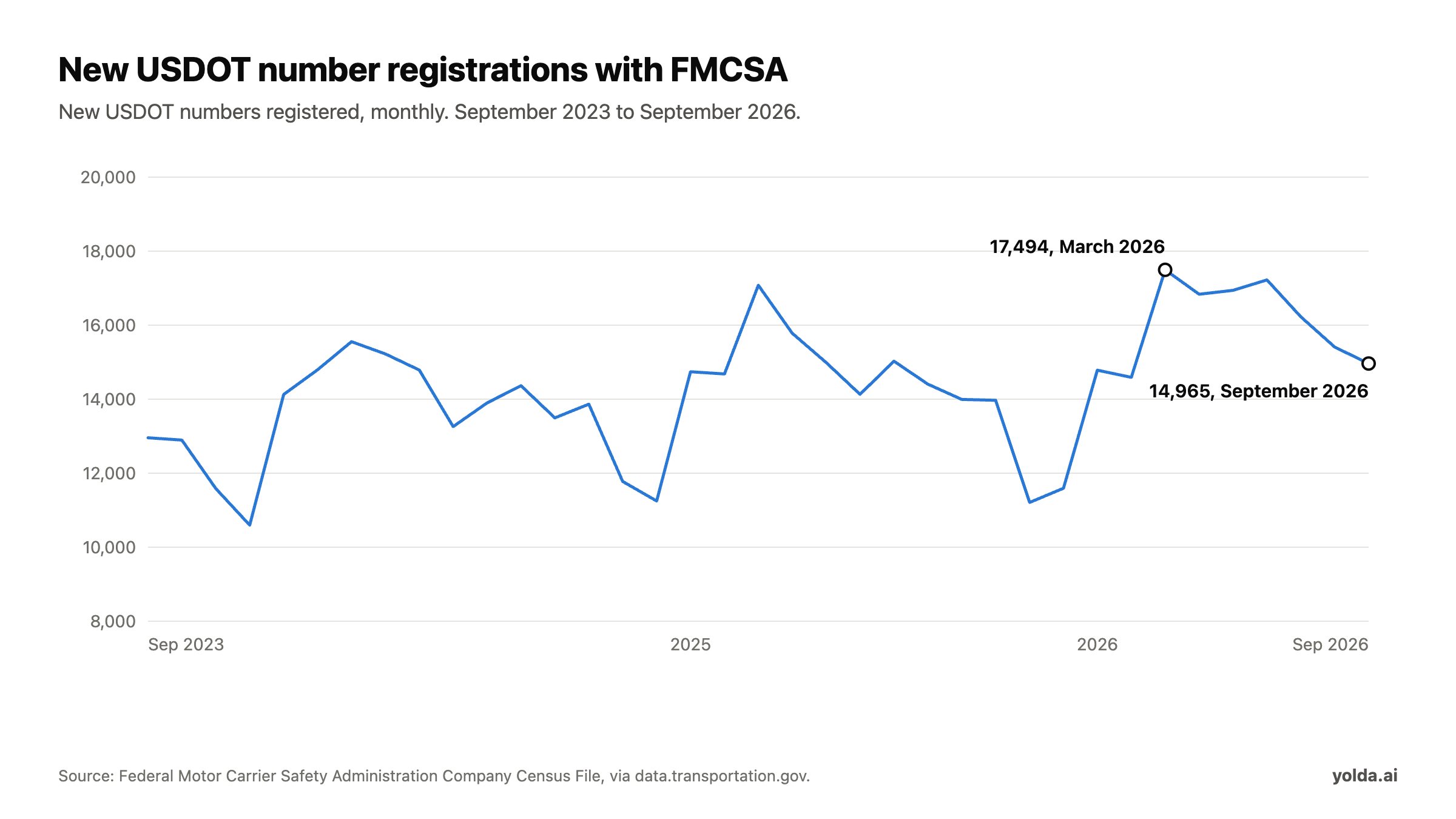
- New USDOT number registrations with FMCSA totaled 14,965 in September 2026, up 970 (6.9%) from a year earlier. Source: Federal Motor Carrier Safety Administration Company Census File, DOT open data.
Latest official data as of Oct 25, 2026.
What exactly is an MC number?
An MC number is FMCSA's way of tracking who has permission to haul freight or passengers for hire in interstate commerce. The letters stand for "Motor Carrier," and the number is assigned when FMCSA grants a carrier operating authority under 49 CFR Part 365.
Think of it this way: your USDOT number identifies your company and its safety record. Your MC number is the permission slip that says you're allowed to charge someone else money to move their freight across state lines. We cover the identity side of this in detail in what a USDOT number is — read that first if you're not sure which number does what.
A single company often holds one USDOT number and one MC number, both tied to the same business. But they serve different legal purposes, and FMCSA can suspend one without touching the other. A carrier with a revoked MC number can still be registered and exist on paper; it just can't legally broker or haul for-hire interstate freight until that authority is reinstated.
Do you need an MC number, or just a USDOT number?
It depends on whether you haul freight for compensation across state lines, or just move your own goods. Here's the breakdown:
| Situation | USDOT number needed? | MC number needed? |
|---|---|---|
| For-hire carrier hauling regulated freight across state lines | Yes | Yes |
| Private carrier hauling only your own company's goods interstate | Yes | No |
| Carrier hauling only within one state (intrastate) | Often, per state rules | No (state authority may apply instead) |
| Hauling exempt commodities (e.g., unprocessed agricultural products) for hire | Yes | Usually no |
| Operating entirely under another carrier's authority (owner-operator leased to a carrier) | Yes, in most cases | No — you run under their MC number |
| Household goods movers (interstate) | Yes | Yes, plus additional FMCSA requirements |
A few situations worth calling out directly:
- Owner-operators leased to a carrier usually don't need their own MC number — they operate under the authority of the carrier they're leased to, though they still need their own USDOT number in many cases.
- Private fleets — a bakery that trucks its own bread between states, for example — need a USDOT number because they're operating commercial vehicles interstate, but they're not "for hire," so no MC number applies.
- Brokers need their own type of authority (a broker authority, filed similarly through FMCSA) rather than a standard carrier MC number, even though the process looks similar.
- Exempt commodities — raw agricultural products, livestock, and a handful of other categories defined by FMCSA — can often move for compensation without MC authority, though the carrier still needs a USDOT number.
Don't skip this: Operating as a for-hire interstate carrier without active MC authority isn't a paperwork technicality — FMCSA can put your vehicles out of service, and your freight broker or shipper almost certainly won't dispatch a load to a carrier whose authority shows as inactive or revoked.
How do you get an MC number?
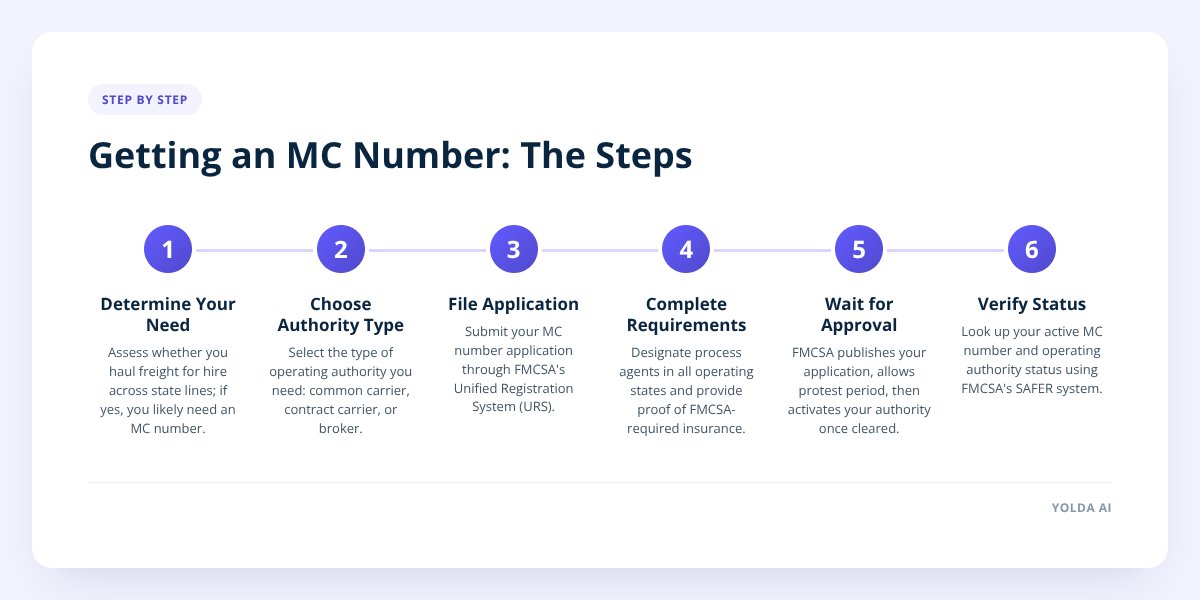
You apply through FMCSA's Unified Registration System (URS), the same portal used for USDOT number registration, and the agency assigns your MC number once your application for operating authority is processed. The application asks what type of authority you're requesting — common carrier, contract carrier, or broker — and what commodities you plan to haul.
After you file, a few things happen before you're cleared to operate:
- FMCSA publishes your application in a public register, opening a protest period during which other parties can formally object.
- You must designate process agents in every state you operate in — these are people or companies who can accept legal documents on your behalf.
- You need to show proof of insurance that meets FMCSA's minimum financial responsibility requirements for your type of operation.
- Your authority typically won't show as "active" until all three steps are complete, which can take several weeks.
Fees and exact processing times change from time to time, so confirm the current numbers directly on FMCSA's website before you file rather than relying on a figure you saw somewhere else.
How do you look up an MC number?
You can look up any carrier's MC number for free through FMCSA's SAFER System or the Licensing & Insurance (L&I) system, both public tools run by the agency. This is useful whether you're checking your own status, vetting a carrier you're about to haul for, or verifying a broker's authority before you sign a contract.
To look one up:
- Go to FMCSA's SAFER Company Snapshot and search by company name, USDOT number, or MC number.
- Confirm the "Operating Authority Status" field shows Active — anything else means that carrier currently can't legally operate for hire.
- Cross-check the MC number against the USDOT number on the same page; they should belong to the same legal entity.
- Use the L&I system if you specifically need to see insurance filings or pending authority applications.
This same lookup is worth doing periodically on your own authority too. Carriers sometimes discover their MC number has lapsed — often because an insurance filing dropped or a biennial update was missed — only when a broker's system rejects them at the worst possible moment.
What happens if your MC number and compliance records don't line up?
Your MC number only matters if the rest of your compliance picture backs it up — an active authority doesn't protect you from an out-of-service order triggered by an expired insurance filing, a lapsed CDL, or a missed inspection. Brokers and shippers increasingly check both your authority status and your safety record (CSA scores, recent inspection results) before booking a load, not just whether the MC number exists.
This is where a lot of small and mid-size carriers get caught off guard. The MC number itself doesn't expire on a calendar — it lapses because something feeding into it lapsed, like the insurance company failing to file a required form or a biennial update (Form MCS-150) not getting filed on time.
Keeping your authority active really comes down to tracking a handful of dates that have nothing to do with the MC number itself: your insurance filings, your biennial update window, your drivers' CDLs and medical cards, and your vehicle inspection schedule. Missing any one of them can put your authority — and your trucks — on hold. Yolda's safety and compliance tools watch those dates automatically and send alerts before a CDL, medical card, registration, insurance filing, or inspection date lapses, so an expired document doesn't quietly take down an active MC number.
If you're setting up a new operation and want to understand the full sequence — USDOT number, MC number, insurance, IRP plates — our guide on how to start a trucking company walks through the order these pieces typically come together in.
Running loads under an owner-operator agreement instead of your own authority? The same compliance tracking still matters, since your USDOT number and driver qualifications follow you regardless of whose MC number you're dispatched under.
If you're ready to get your operation's compliance tracking off spreadsheets, Yolda pairs DOT compliance alerts with dispatch, driver settlements, and IFTA reporting in one login — book a demo or start a free trial to see it with your own fleet's data.
Checklist: Confirming your MC number is active and in good standing
- Search your company on FMCSA's SAFER Company Snapshot by USDOT or MC number.
- Confirm "Operating Authority Status" reads Active, not Revoked or Pending.
- Check that your MC number and USDOT number are linked to the same legal entity.
- Verify your insurance filing is current in the FMCSA L&I system.
- Confirm your biennial MCS-150 update is filed on schedule.
- Review driver CDL and medical card expiration dates tied to your fleet.
- Check recent inspection and CSA score records for anything that could trigger a hold.
- Re-run this lookup every few months, not just when you first get authority.


