
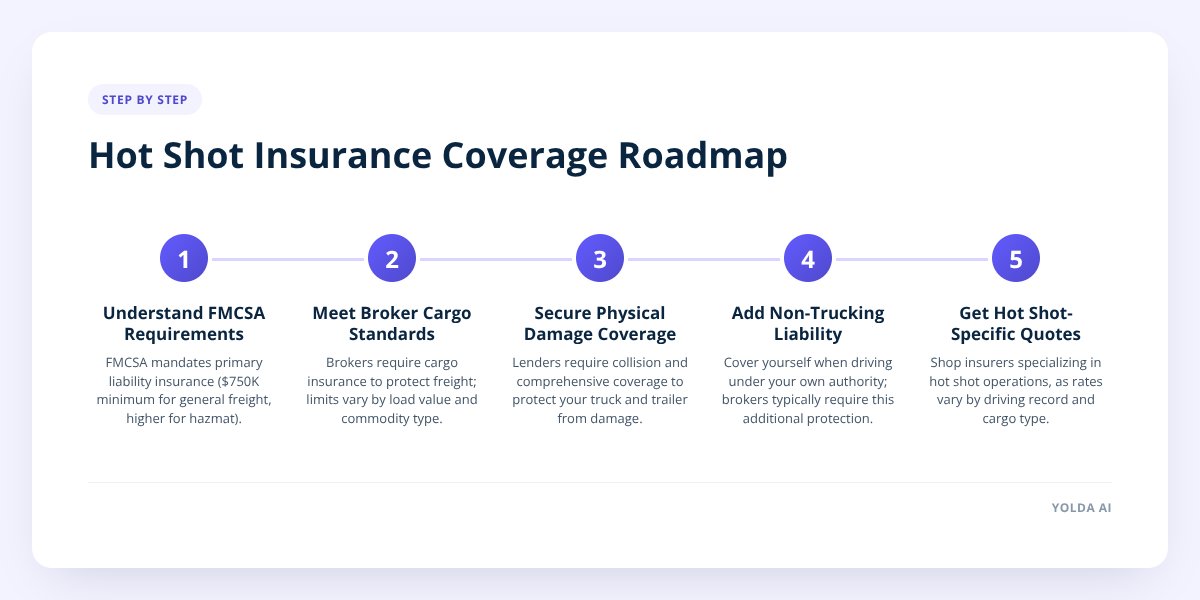
Quick answer: A hot shot operation needs four coverages at minimum: primary auto liability, cargo insurance, physical damage coverage on the truck and trailer, and non-trucking liability (also called "bobtail" in some policies) for when you're driving under your own authority but not under dispatch. The Federal Motor Carrier Safety Administration sets minimum liability limits based on what you haul and your vehicle's weight — $750,000 is the base federal minimum for most for-hire freight, with higher limits for hazmat and other designated cargo. Brokers almost always ask for cargo coverage above that federal floor before they'll tender a load to you.
Key takeaways
- The Federal Motor Carrier Safety Administration (FMCSA) requires a minimum of $750,000 in combined bodily injury and property damage liability for most general-freight interstate for-hire carriers; oil, certain hazardous materials, and other designated cargo carry higher minimums, up to $5 million in some categories.
- Primary liability insurance is a federal requirement tied to your operating authority; cargo insurance, physical damage, and non-trucking liability are not federally mandated but are typically required by brokers, lenders, or your own common sense.
- Non-CDL hot shot setups (truck under 26,001 lbs GVWR towing a trailer rated 10,000 lbs or less) still need insurance — weight class affects licensing, not your liability exposure on the road.
- Insurance costs for hot shot operations vary by driving record, radius of operation, cargo type, and claims history — there's no single "normal" premium, so get quotes from carriers that specifically write hot shot policies rather than general trucking policies.
What coverage does FMCSA actually require for hot shot trucking?
FMCSA requires primary liability insurance, called BMC-91 or BMC-91X financial responsibility filing, as a condition of holding operating authority. This covers bodily injury and property damage you cause to other people on the road — it does not cover your truck, your trailer, or the freight you're hauling.
The minimum limits depend on what you're hauling and the vehicle's gross weight rating, per FMCSA's financial responsibility regulations at 49 CFR 387:
| Cargo type | Vehicle weight | Minimum liability |
|---|---|---|
| General freight | Over 10,001 lbs GVWR | $750,000 |
| Household goods | Over 10,001 lbs GVWR | $750,000 |
| Oil (as defined by FMCSA) | Any weight | $1,000,000 |
| Hazardous materials (certain classes) | Any weight | $5,000,000 |
| Non-hazardous freight | 10,000 lbs or less GVWR | $300,000 |
If you're running a non-CDL hot shot setup — a truck under 26,001 lbs GVWR pulling a trailer rated 10,000 lbs or less — your vehicle weight class doesn't exempt you from these liability rules once you're operating in interstate commerce under your own authority. We laid out the full weight and licensing breakdown for non-CDL setups in Non-CDL Hot Shot Trucking: Requirements by the Numbers, and it's worth reading before you shop insurance, since your DOT filing status and vehicle class both affect what an insurer will ask for.
Don't skip this: confirm your exact required limit with FMCSA's own guidance or your insurance agent before you bind a policy. The $750,000 figure is the common baseline, but hazmat, oil, and certain other cargo categories carry limits far above it, and carrying less than the required minimum can get your operating authority revoked.
Why do brokers ask for more cargo insurance than the law requires?
Brokers ask for higher cargo limits because FMCSA doesn't set a federal minimum for cargo insurance at all — that part is purely contractual, and brokers set their own bar to protect the freight they're placing with you. Cargo insurance pays out if the freight you're hauling is lost, damaged, or destroyed while in your care, custody, and control.
Most brokers working with hot shot carriers will ask to see a certificate of insurance showing cargo coverage in a specific range before they'll tender a load — the exact figure varies by broker and by the type of freight. Some brokers hauling heavier equipment or higher-value loads will require more.
A few things that commonly come up when a broker reviews your coverage:
- Cargo limit per load — brokers typically want coverage sufficient to cover the most expensive single load you might carry, not just an average.
- Exclusions — some cargo policies exclude certain commodities (livestock, refrigerated goods, high-value electronics) unless you add an endorsement.
- Certificate holder listing — brokers often want to be listed as a certificate holder or additional insured so they're notified if your policy lapses.
- Deductible — a lower cargo deductible usually costs more in premium but matters less to the broker than the coverage limit itself.
If you haul flatbed freight — steel, machinery, building materials, the kind of loads that fit a hot shot trailer — ask your agent specifically about named-peril versus all-risk cargo policies. Flatbed freight is exposed to weather, shifting, and strapping failure in ways enclosed freight isn't, and a generic cargo policy written for van freight may not cover it the same way.
Do I need physical damage coverage on my truck and trailer?
Physical damage coverage is not federally required, but if you financed your truck or trailer, your lender almost certainly requires it as a loan condition. Physical damage insurance — split into collision and comprehensive — pays to repair or replace your own truck and trailer after an accident, theft, fire, or weather event, regardless of who caused it.
This is the coverage owner-operators most often skip to save money, and it's the one that causes the most financial damage when skipped. A gooseneck trailer totaled in a highway accident, or a diesel pickup with a blown engine from a collision, can represent tens of thousands of dollars you'd otherwise pay out of pocket.
A few scenarios where this matters more than owners expect:
- You're leased to a carrier but own your equipment. The carrier's policy typically covers liability to others, not damage to your own truck — you need your own physical damage policy.
- You're running older equipment. Insurers may offer "actual cash value" coverage instead of full replacement cost on trucks past a certain age, which pays out less than what it costs to replace the unit.
- You park outside at night. Comprehensive coverage (theft, vandalism, weather) matters more if your truck and trailer don't sit in a secured yard.
What is non-trucking liability, and when do I actually need it?
Non-trucking liability (sometimes called bobtail insurance) covers you when you're driving your truck for personal use or between loads, but not dispatched or under a load for a motor carrier. This gap matters specifically for owner-operators leased to a carrier, because the carrier's primary liability policy typically only covers you while you're operating under their dispatch, hauling their load.
Drive your truck to get fuel, run it home for the night, or take it to a shop for maintenance when you're not under dispatch, and you may have no liability coverage at all unless you carry non-trucking liability separately. This is different from bobtail coverage in some policies (driving the tractor without a trailer attached at all), so ask your agent to clarify exactly what triggers each type of coverage in the policy you're being offered.
If you run under your own authority rather than leased to a carrier, you may not need non-trucking liability at all — your primary liability policy likely covers you any time the truck is on the road, loaded or not. This is a question worth asking your agent directly rather than assuming either way, since the answer changes based on how your policy is written.
What drives the cost of hot shot trucking insurance?
Several factors push your premium up or down, and none of them are fixed numbers — get quotes from more than one carrier that specifically writes hot shot or owner-operator policies, since general commercial auto insurers sometimes price hot shot risk differently than dedicated trucking insurers. Rather than listing invented premium figures, here's what actually moves the number:
- Driving record and experience. A clean CDL or non-CDL driving history with several years of commercial experience typically prices better than a new operator.
- Radius of operation. Local and regional hauling (shorter radius) often prices differently than long-haul interstate work.
- Cargo type and value. Hauling flatbed equipment, machinery, or specialized freight carries different risk than hauling general dry freight.
- Claims history. Prior claims, even ones that weren't your fault, can affect pricing depending on the carrier.
- Vehicle age and value. Newer trucks and trailers cost more to insure for physical damage, even though they may be mechanically more reliable.
- Safety and compliance record. Your CSA score, inspection history, and DOT compliance standing factor into underwriting for many insurers.
That last point is worth taking seriously, because it's one of the few cost drivers you can actually improve. A clean inspection history and no open compliance violations put you in a better underwriting position than a record full of out-of-service orders. Staying ahead of CDL, medical card, and inspection expirations — tracked automatically through a tool like Yolda's safety and compliance tracking — keeps those dates from lapsing unnoticed and showing up against you at renewal time.
How do I know which policy limits are right for my operation?
Start with what FMCSA requires for your cargo type and vehicle weight, then layer on what your brokers actually ask for in practice — the federal minimum is a floor, not a target. If you're brand new to hot shot trucking and haven't settled on your operating structure yet, the overview on what hot shot trucking actually is covers how the business model, equipment, and authority setup fit together before insurance even enters the picture.
A practical way to work through it:
- Pull your MC authority paperwork and check what cargo classification it lists.
- Call two or three brokers you want to run freight for and ask what cargo and liability limits they require to tender a load.
- Compare that number against the FMCSA minimum for your cargo type — brokers often ask for more, never less.
- Decide on physical damage coverage based on whether you own or lease your equipment, and whether a lender requires it.
- Ask explicitly whether you need non-trucking liability based on whether you're leased to a carrier or running under your own authority.
Checklist: getting hot shot trucking insurance in place
- Confirm your required liability minimum with FMCSA based on your cargo type and vehicle GVWR.
- Gather your MC authority number, USDOT number, and vehicle titles before calling agents.
- Call at least two insurance agents who specifically write hot shot or owner-operator policies.
- Ask each broker you plan to haul for what cargo insurance limit they require.
- Decide whether you need non-trucking liability based on your dispatch arrangement.
- Check your loan or lease agreement for required physical damage coverage minimums.
- Request your MVR and CSA score review before quoting, so you know what underwriters will see.
- Keep your certificate of insurance current and share it promptly whenever a broker asks.
Running a hot shot operation means juggling insurance renewals alongside CDL and medical card expirations, inspection dates, and registration — all on different timelines. Yolda is an AI-native TMS built to run a trucking company's dispatch, compliance, and back office from one login; the safety and compliance tracking feature watches those dates automatically and alerts you before something lapses, instead of leaving you to track it across spreadsheets. Book a demo to see it running against your own fleet's dates.


