
Quick answer: IRP (International Registration Plan) is the system that lets a truck register once and legally run in every member state and province by paying registration fees split, or "apportioned," based on the miles run in each one. If your truck crosses state lines and weighs over 26,000 lbs (or has three or more axles), you likely need an apportioned plate instead of separate registrations in every state you drive through. You apply through your base state's IRP office, report your fleet's mileage by jurisdiction, and renew annually.
Key takeaways
- IRP applies to a qualified motor vehicle: two axles over 26,000 lbs gross or registered gross weight, three-plus axles at any weight, or a combination over 26,000 lbs — the same threshold used for IFTA.
- You register through your base jurisdiction (where the fleet is based, not every state you drive in), and that one plate — called an apportioned plate — covers all IRP member jurisdictions.
- Fees are split by the percentage of total miles driven in each jurisdiction, using mileage records from your prior reporting period.
- IRP and IFTA are separate programs that both use interstate mileage data, but IRP is about vehicle registration while IFTA is about fuel tax — confusing the two is a common mistake.
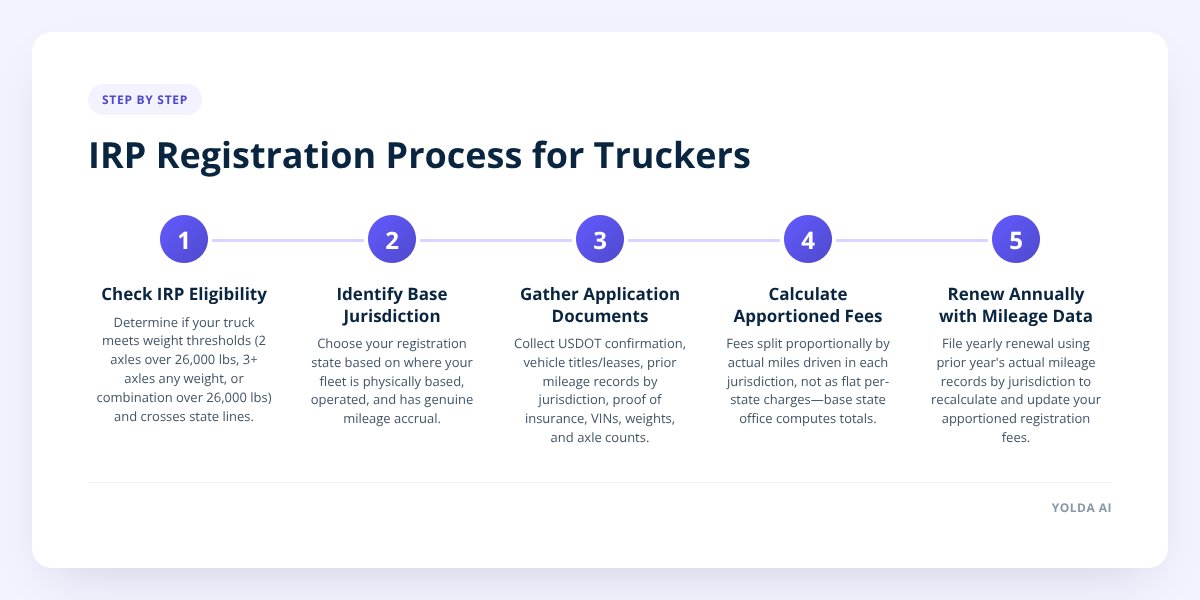
Step 1: Figure out if your truck actually needs IRP
Your truck needs IRP registration if it's used in interstate commerce and meets the same weight test used for IFTA. According to the American Association of Motor Vehicle Administrators (AAMVA), which administers the International Registration Plan, a qualified motor vehicle is:
- A vehicle with two axles and a gross or registered gross weight over 26,000 lbs.
- A vehicle with three or more axles, regardless of weight.
- A combination (truck plus trailer) with a combined gross weight over 26,000 lbs.
If your rig meets any one of those, and you cross state or provincial lines, you need apportioned registration instead of (or in addition to) a regular state plate. Pure intrastate haulers — trucks that never leave their home state — don't need IRP at all, even if they're heavy.
One thing to watch: meeting the IRP weight threshold doesn't automatically mean a driver needs a CDL. CDL requirements run on a different test tied to GVWR and GCWR under 49 CFR 383.91. A truck and trailer combination can trigger IRP and still not require a Class A license, depending on how the trailer is rated. Don't assume one rule implies the other.
Step 2: Identify your base jurisdiction
Your base jurisdiction is the state or province where your fleet is registered for IRP purposes, and it's usually where the truck is physically based, where you keep operating records, and where you've accrued some actual mileage. You don't pick a jurisdiction because its fees look lower — IRP rules require a genuine operational tie, such as a physical establishment, mileage accrued there, and the vehicle's registration under your USDOT number.
This matters because all your paperwork flows through one office from here forward. You file your application with your base state's IRP office (often housed in the same department that handles IFTA and standard vehicle titling), and that state collects and distributes the apportioned fees to every other jurisdiction you report mileage in.
Step 3: Gather what you'll need to apply
Before you sit down to apply, get your documents together. Most base jurisdictions ask for a similar packet, though exact forms vary by state:
- Confirm your USDOT number is active and matches the legal business name on the application. If you're not sure what this number is for, see what a USDOT number is.
- Gather proof of vehicle ownership — title or lease agreement for each truck.
- Pull your fleet's mileage records for the prior reporting period, broken out by jurisdiction.
- Confirm your base state address and that it matches your operational records (lease, utility bill, or similar).
- Have your vehicle identification numbers (VINs), gross weights, and axle counts ready for each unit.
- Check whether your base state requires proof of insurance filed before IRP registration is issued.
- Set aside funds for the apportioned fee — this isn't a flat registration cost, so budget based on estimated miles per jurisdiction.
Step 4: Understand how apportioned fees are calculated
Apportioned fees aren't a flat per-state charge — they're calculated as a percentage of your total registration fee based on where you actually drove. If your fleet ran 100,000 total miles last year and 20,000 of those were in Illinois, Illinois gets roughly 20% of your registration fee for that vehicle, not a full separate registration.
Here's a simplified breakdown of how that split might look for a single truck:
| Jurisdiction | Miles Driven | % of Total Miles | Share of Registration Fee |
|---|---|---|---|
| Base state | 40,000 | 40% | 40% |
| Illinois | 20,000 | 20% | 20% |
| Indiana | 15,000 | 15% | 15% |
| Ohio | 15,000 | 15% | 15% |
| Michigan | 10,000 | 10% | 10% |
The actual dollar fee per jurisdiction also depends on that state's own fee schedule, which factors in the vehicle's declared weight. Your base state's IRP office calculates the final numbers and issues one combined invoice — you don't pay each state separately.
New carriers with no mileage history yet are usually assigned an estimated mileage percentage based on average distances for similar fleets, and that estimate gets trued up once real mileage data is available at renewal.
Step 5: Renew every year — and keep your mileage records clean
IRP registration is renewed annually, and your renewal fee is recalculated using the mileage your fleet reported for the most recent full year. This is where good recordkeeping pays off. If your mileage-by-jurisdiction numbers are sloppy, inconsistent, or estimated rather than tracked, you either overpay on your renewal or risk a discrepancy that draws attention in an audit.
Don't skip this: IRP auditors and your base jurisdiction can request your underlying mileage and trip records, not just your summary report — keep source documents (ELD logs, trip sheets, fuel receipts) for as long as your base state requires, typically several years.
This is also where IRP and IFTA renewal cycles tend to collide on a carrier's calendar. Both programs want accurate state-by-state mileage, and if your tracking is manual, you're often rebuilding the same mileage breakdown twice a year for two different filings. If you want a closer look at keeping IFTA numbers clean before they're due, see how to forecast your quarterly IFTA bill before it's due.
How is IRP different from IFTA?
IRP and IFTA both use interstate mileage, but they cover two completely different obligations: IRP is vehicle registration, IFTA is fuel tax. Carriers new to interstate hauling often assume they're the same program because the paperwork process feels similar and the qualifying weight threshold is identical.
| IRP | IFTA | |
|---|---|---|
| What it covers | Vehicle registration across states | Fuel tax reporting across states |
| Who administers it | Your base state's IRP office (per AAMVA's International Registration Plan) | Your base state's revenue department |
| How often you file | Annually (renewal) | Quarterly |
| What you report | Mileage by jurisdiction for the year | Miles driven and fuel purchased by jurisdiction, each quarter |
| What you get | An apportioned plate and cab card | A fuel tax license and decals |
| Qualifying vehicle | Same threshold: over 26,000 lbs, or 3+ axles | Same threshold: over 26,000 lbs, or 3+ axles |
Both programs exist so a trucking company doesn't have to register and pay fuel tax separately in every single state it touches. But they're filed with different offices, on different schedules, using mileage data that needs to match across both filings — which is exactly where carriers run into trouble if the two aren't tracked from the same source.
If your IFTA numbers and IRP mileage records don't agree with each other, that mismatch is one of the first things an auditor flags. We walked through what that audit process actually looks like in what happens in an IFTA audit, step by step.
Keeping your fleet's paperwork airtight beyond IRP
IRP and IFTA are just two of the recurring deadlines a DOT-regulated fleet has to track — CDL renewals, medical cards, vehicle registration, insurance filings, and inspection dates all run on their own clocks. Missing any one of them can put a truck out of service or trigger a compliance review, and manually tracking all of it across a growing fleet gets harder every time you add a truck.
Yolda's safety and compliance management watches CDL, medical card, registration, insurance, and inspection dates automatically and sends alerts before anything lapses, so a dispatcher isn't relying on a spreadsheet or a sticky note to catch an expiring apportioned plate. It's one piece of how Yolda runs a fleet's back office — dispatch, accounting, IFTA, safety, and driver pay — on one login instead of five separate systems.
Ready to see it on your own fleet's data? You can book a demo or start a free trial with Yolda.
Checklist: Getting IRP registration set up and renewed clean
- Confirm your vehicle meets the qualified motor vehicle threshold — over 26,000 lbs, or 3+ axles.
- Identify your true base jurisdiction using your operational address and USDOT number.
- Gather titles, VINs, weights, and axle counts for every vehicle in the fleet.
- Pull mileage records by jurisdiction for the prior reporting period.
- Apply through your base state's IRP office with your full document packet.
- Review your apportioned fee breakdown before paying to confirm the mileage split looks right.
- Keep source mileage records (ELD logs, trip sheets) for the retention period your base state requires.
- Set a renewal reminder well ahead of your annual IRP deadline.


