
Quick answer: Freight factoring is when a carrier sells an unpaid invoice to a factoring company for a cash advance — usually most of the invoice value upfront — and the factor collects payment from the broker or shipper later. It's worth the fee when slow-paying customers are the actual bottleneck and you need cash now to cover fuel and payroll; it's not worth it if your real problem is invoices going out late or full of errors, because factoring speeds up collection, not the paperwork that happens before it.
Key takeaways
- Factoring advances are commonly 90–97% of invoice value depending on the agreement; the factor holds the remainder as a reserve until the invoice is paid in full.
- Recourse factoring costs less but puts you on the hook if the broker never pays; non-recourse factoring costs more but shifts that credit risk to the factor, within the terms of that specific contract.
- Factoring doesn't fix invoices that go out three days late or with a missing BOL — that's a process problem, not a cash-flow problem, and no factor can solve it.
- Yolda sends a factoring packet by email, SFTP, or ZIP file; it does not connect directly to factoring companies, and it does not track chargebacks automatically.
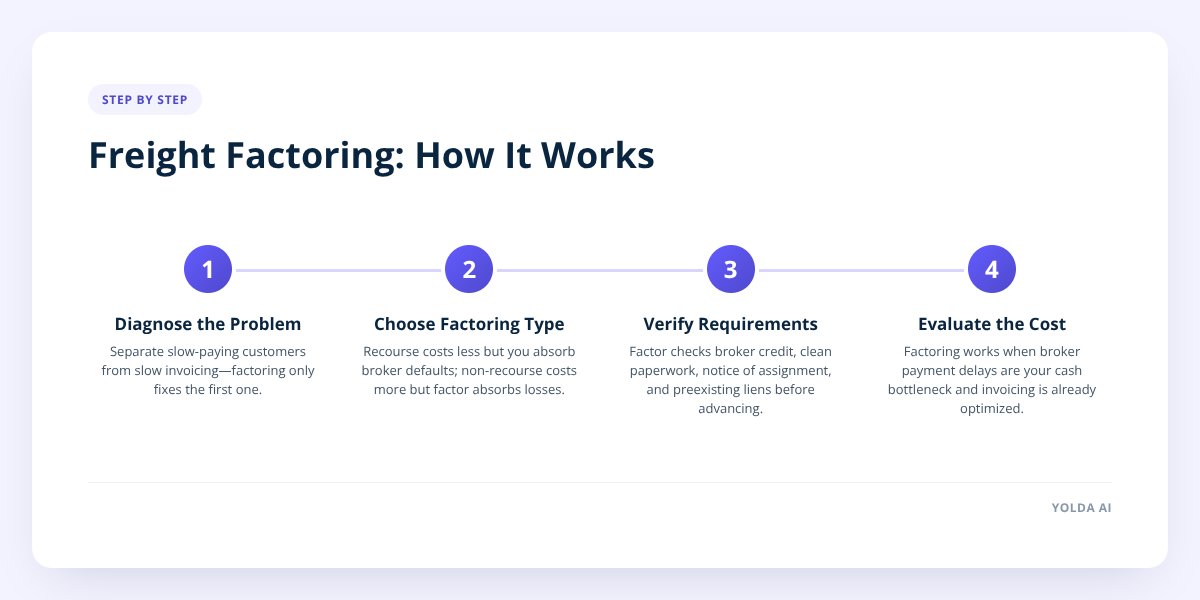
Step 1: Figure Out If Slow Pay Is Actually Your Problem
Before you call a factoring company, separate two issues that feel identical from the driver's seat but have completely different fixes: slow-paying customers and slow invoicing.
Freight factoring solves the first one. If your broker pays net-30 or net-45 like clockwork, and you've confirmed that in writing, factoring exists to close that gap — you get paid in a day or two instead of waiting a month.
But if invoices sit on someone's desk for four days before they even go out, or get kicked back for a missing signature or a mismatched rate confirmation, factoring won't touch that. You'll just be paying a fee to advance cash on a bill you delayed sending yourself. We walked through this exact distinction in What Slows Down Freight Invoicing and How to Fix It — worth a read before you sign anything.
A quick gut check: pull your last 10 invoices and note two dates for each — the date the load delivered, and the date you actually sent the invoice. If that gap averages more than a day or two, you have an invoicing speed problem first.
Step 2: Understand the Two Basic Structures
Every factoring agreement falls into one of two categories, and the difference matters more than the headline rate.
| Feature | Recourse Factoring | Non-Recourse Factoring |
|---|---|---|
| Who absorbs non-payment | You, if the broker never pays | The factor, within contract terms |
| Typical fee | Lower | Higher |
| Underwriting on your customers | Lighter | Stricter — factor vets broker credit closely |
| Best fit | Fleets with reliable, vetted brokers | Fleets working new or unverified brokers |
| Contract length | Often month-to-month or short-term | Often requires longer commitment |
With recourse factoring, if the broker goes bankrupt or disputes the load, the factor can charge that invoice back to you — you refund the advance. It's the cheaper option because the factor is taking on less risk.
With non-recourse factoring, the factor absorbs the loss if the broker simply can't pay (not if the load was damaged or disputed — those exclusions are written into the contract, so read them carefully). That protection costs more, and most non-recourse agreements still exclude disputes over freight damage, short pay, or paperwork issues. Confirm the exact exclusions with the factoring company before you assume you're covered.
Step 3: Know What a Factoring Company Will Actually Check
Factors don't just hand over cash against any invoice — they underwrite the broker, not just you.
- Broker credit history — factors maintain internal credit files on brokers and will often reject an invoice or offer a lower advance rate on an unfamiliar or poorly-rated broker.
- Clean paperwork — a signed rate confirmation, a proof of delivery, and a matching invoice are typically required before they'll advance funds.
- Notice of assignment — most factors require the broker be notified in writing that payment now goes to the factor, not to you directly.
- Preexisting liens — if your invoices are already pledged against a bank line of credit or another factor, that can disqualify them.
- Contract terms on your end — minimum volume requirements, monthly minimums, or early-termination fees are common in longer agreements; confirm these before signing.
Don't skip this: Read the termination clause before anything else. Some factoring contracts include minimum volume commitments or early-termination fees that can cost more than the factoring fees themselves if you want out after a slow month. Ask the factor to show you that clause in writing before you sign.
Step 4: Decide If the Fee Is Worth It for Your Fleet
Here's the actual trade-off: factoring costs you a percentage of every invoice, permanently, in exchange for not waiting 30-plus days for cash. Whether that's a good trade depends on your situation, not a universal rule.
Factoring tends to make sense when:
- You're running thin on cash for fuel, payroll, or truck payments and the wait for broker payment is the direct cause.
- Your brokers are reliable payers on net-30 or net-45 terms, so the gap is purely about timing, not whether you'll get paid at all.
- You're scaling fast and can't front the working capital for new loads while old invoices are still outstanding.
- You've already fixed your invoicing process, so you're not paying a fee to speed up paperwork that should've gone out faster anyway.
Factoring tends to be the wrong move when:
- Your invoices go out late because of a manual process — fix that first, since it's free and solves the root cause.
- Your margins are already thin enough that a factoring fee on every load would eat most of your profit per mile.
- You only have the occasional slow-paying customer rather than a systemic cash-flow gap — a reserve fund or a line of credit might cost less over time.
A useful comparison here is the real cost of each path. Clean accounting that tracks what you've invoiced, what's outstanding, and what's actually been paid — the kind handled through Yolda's accounting tools — gives you the visibility to know which of these two problems you actually have before you commit to a factoring contract.
Step 5: Get Your Paperwork Factoring-Ready
Whether or not you factor, clean, complete invoices move faster through any process — your own books, a broker's accounts payable department, or a factoring company's underwriting.
A factoring-ready invoice typically includes:
- Load number matching the rate confirmation and BOL exactly
- Pickup and delivery dates, addresses, and reference numbers
- Agreed rate, plus any accessorials itemized separately
- Broker or shipper's correct legal billing name and address
- Signed proof of delivery attached
- Your company's remit-to information, updated if a factor is now the payee
If you're assembling these by hand, Yolda's free trucking invoice template covers all the fields a factor or broker will expect to see, so nothing bounces back for a missing field.
Step 6: Know What Yolda Does — and Doesn't — Do With Factoring
Yolda sends a factoring packet — the invoice, supporting documents, and load details — by email, SFTP, or ZIP file, so you can hand off what your factor needs without re-keying anything. That's the extent of it: Yolda has no direct connection to factoring companies, and it does not automatically track chargebacks if a broker disputes a factored invoice later.
That matters practically: if you factor, you're still the one reconciling what the factor advanced against what eventually settles, especially under a recourse agreement where a chargeback lands back on your books. Keeping that reconciliation clean — invoices sent, amounts advanced, reserves released — is exactly the kind of bookkeeping that gets messy fast without a system behind it. Our post on getting QuickBooks and your trucking software to match covers how to keep that reconciliation from drifting.
What to Do Next
Start by timing your own invoicing — the gap between delivery and when the invoice actually goes out. If that gap is the problem, fix it before you pay a factoring fee to work around it. If your brokers are simply slow and reliable, get quotes from two or three factoring companies, compare recourse versus non-recourse terms side by side, and read the termination clause before you sign anything.
Yolda won't connect you to a factor, but it will get a clean, complete invoice out the door the day a load delivers — which is the one thing that makes every option downstream, factored or not, work better. Book a demo or start a free trial to see how it fits your invoicing process.
Checklist: Deciding Whether to Factor Your Freight Invoices
- Pull your last 10 invoices and measure the gap between delivery date and invoice-sent date.
- Confirm your brokers' actual payment terms in writing, not from memory.
- Separate "slow to pay" customers from "slow to invoice" problems before pricing out factoring.
- Request recourse and non-recourse quotes from at least two factoring companies.
- Read the termination clause and any minimum-volume requirements before signing.
- Confirm exactly what's excluded under a non-recourse agreement — damage and disputes are usually not covered.
- Standardize your invoice format so load numbers, dates, and rates match the rate confirmation exactly.
- Set up a simple reconciliation process to track advances, reserves, and any chargebacks.


