
Quick answer: It depends entirely on the truck's Gross Vehicle Weight Rating (GVWR). A single box truck rated 26,001 lbs or more needs a Class B commercial driver's license, according to the Federal Motor Carrier Safety Administration's CDL classification rules at 49 CFR 383.91. A box truck under that weight needs no CDL at all, even if it's used for commercial hauling. Towing a trailer changes the math — the combined weight and the trailer's own GVWR decide whether the driver needs Class A, Class B, or nothing.
Key takeaways
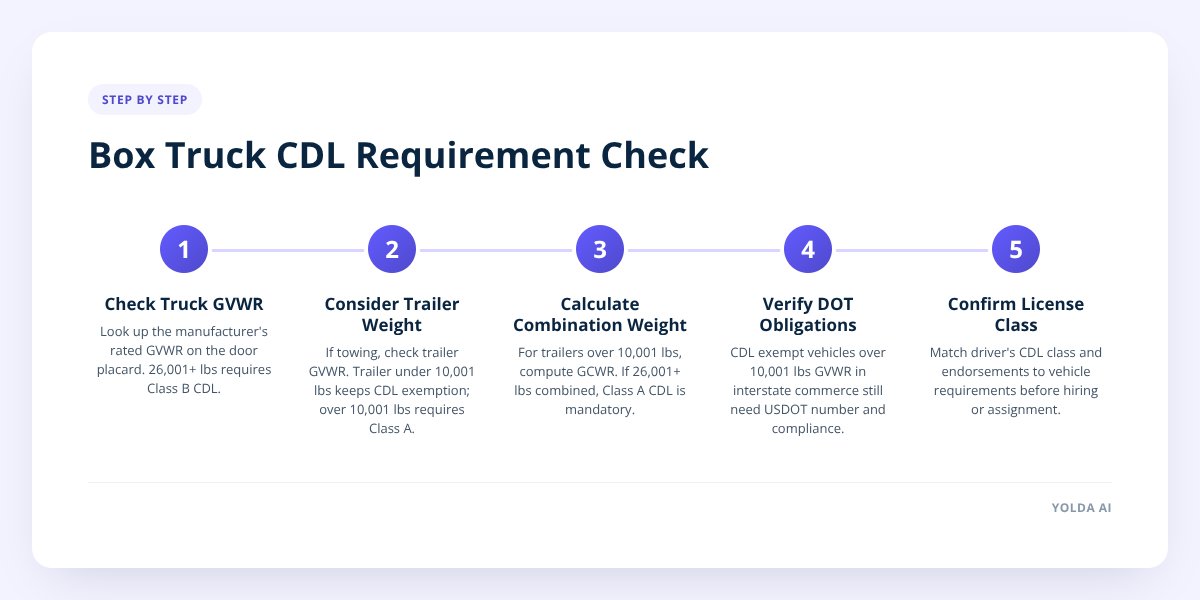
- A box truck with a GVWR of 26,001 lbs or more requires a Class B CDL, per 49 CFR 383.91.
- A box truck under 26,001 lbs GVWR needs no CDL, regardless of what it's hauling or how far it travels.
- Towing a trailer rated 10,000 lbs GVWR or less keeps a driver CDL-exempt even if the combined weight passes 26,000 lbs — this is the setup many non-CDL hot shot operations use.
- A trailer over 10,000 lbs GVWR combined with a Gross Combination Weight Rating (GCWR) of 26,001 lbs or more bumps the requirement up to a Class A CDL.
What determines whether a box truck needs a CDL?
The deciding number is the truck's GVWR — the weight the manufacturer rates it to carry fully loaded, not the weight it's actually carrying on a given day. This trips up a lot of new owners who assume CDL status depends on cargo weight or trailer presence. It doesn't. FMCSA's CDL rules at 49 CFR 383.91 look at what the vehicle is rated for, stamped on the door placard, not what's in the back.
Here's how the single-vehicle (no trailer) rule breaks down:
| Box truck GVWR | CDL required? | Class |
|---|---|---|
| 26,001 lbs or more | Yes | Class B |
| 10,001–26,000 lbs | No | None |
| 10,000 lbs or less | No | None |
A lot of popular box trucks sit right at this line. Many 26-foot box trucks used for moving and freight are built right around 25,999 or 26,000 lbs GVWR specifically so the owner can avoid a CDL requirement — that's an intentional manufacturing choice, not a loophole. Always check the actual door placard or spec sheet rather than assuming based on the truck's size or length.
Don't skip this: GVWR is a rating, not a measurement of what's currently loaded. A truck rated at 26,001 lbs still needs a Class B CDL to drive empty — the requirement attaches to the vehicle, not the load.
Does towing a trailer behind a box truck change the CDL requirement?
Yes, and this is where most confusion happens. Under 49 CFR 383.91, towing adds a second set of numbers to check: the trailer's own GVWR and the combination's Gross Combination Weight Rating (GCWR).
The rule works like this:
- Trailer GVWR of 10,000 lbs or less: The combination stays in whatever class the straight truck alone would need — even if the combined weight tops 26,000 lbs. A box truck under 26,001 lbs towing a small trailer under 10,000 lbs needs no CDL at all.
- Trailer GVWR over 10,000 lbs, GCWR 26,001 lbs or more: This bumps the driver up to a Class A CDL, regardless of what the straight truck alone would have required.
- Trailer GVWR over 10,000 lbs, GCWR under 26,001 lbs: No CDL required, since the combination doesn't cross the weight threshold.
This is the legal basis for what's often called the non-CDL hot shot setup — a pickup or smaller box truck under 26,001 lbs GVWR towing a gooseneck or flatbed trailer rated 10,000 lbs or less. As long as both numbers stay under their thresholds, the driver doesn't need a CDL of any class. We cover this setup and the rest of the startup basics in how to start a box truck business.
Does a non-CDL box truck still have to follow DOT rules?
Often yes — CDL status and DOT regulation are two separate questions, and a lot of owners conflate them. A box truck can be completely exempt from CDL licensing and still be subject to USDOT registration, hours-of-service rules, drug and alcohol testing, and roadside inspections if it's used in interstate commerce.
The weight threshold that triggers general DOT/FMCSA regulation is lower than the CDL threshold. A vehicle with a GVWR over 10,000 lbs operating across state lines for business generally needs a USDOT number, separate from any CDL requirement. We go through what that number means and when it applies in what is a USDOT number.
IFTA and IRP registration follow yet another rule. Per the International Fuel Tax Agreement, a "qualified motor vehicle" operating across state lines is one with two axles and a gross or registered gross weight over 26,000 lbs, three or more axles at any weight, or a combination over 26,000 lbs. A box truck can clear the CDL threshold without triggering IFTA, or vice versa — they're calculated on slightly different criteria, so check both independently rather than assuming one answer covers both.
A driver who never needs a CDL may still need a medical certification (DOT physical) if the truck crosses 10,001 lbs GVWR and operates in interstate commerce. None of these obligations disappear just because the CDL box is unchecked.
What should a small fleet check before hiring a box truck driver?
Confirm the actual CDL status required for every truck in the fleet before writing the job post — not after an applicant shows up with the wrong license. Here's the practical checklist for a small fleet owner or dispatcher:
- Pull the GVWR off the door placard or spec sheet for every truck, not the advertised payload capacity.
- Check whether any truck tows a trailer regularly, and get that trailer's GVWR too.
- Calculate GCWR for any truck-trailer combination that might cross 26,000 lbs combined.
- Confirm which CDL class (if any) each vehicle legally requires under 49 CFR 383.91.
- Verify any CDL-holding applicant's license class and endorsements match what the truck needs.
- Check whether the role also requires a DOT medical certificate, even if no CDL applies.
- Note which trucks trigger IFTA/IRP registration separately from CDL status.
Mixing CDL and non-CDL trucks in one small fleet is common — a 24-foot box truck under the weight limit next to a 26-foot truck that's over it — and it means the hiring bar isn't the same for every seat. Posting the wrong requirement either scares off qualified non-CDL drivers or lets through someone unlicensed for the actual truck.
This is also where compliance tracking starts to matter the moment you have more than one or two trucks. Yolda's safety and compliance module watches CDL, medical card, registration, insurance, and inspection dates automatically and sends alerts before any of them lapse — useful once a fleet mixes license classes and can't rely on memory to keep them straight.
How does this affect writing job postings and running background checks?
State the exact license requirement in the posting itself, because "box truck driver, CDL preferred" is vague enough to draw unqualified applicants. If the truck is under 26,001 lbs GVWR and tows nothing over 10,000 lbs, say plainly that no CDL is required — this widens the applicant pool and is accurate. If it's 26,001 lbs or more, state Class B specifically, or Class A if the trailer combination requires it.
A hiring pipeline built around the actual requirement saves time on both ends. Yolda's driver hiring tool moves applicants from job post to application to a seated driver in one pipeline, so job requirements and applicant qualifications get matched up front rather than discovered at orientation. We also laid out the full process from offer to first load in truck driver onboarding checklist, which covers the paperwork steps beyond just the license check.
One more hiring wrinkle: a driver with an active CDL who's been placed out of service doesn't become eligible just because the truck is non-CDL-eligible on paper. Out-of-service orders and license suspensions follow the driver, not the vehicle class, and that's worth checking regardless of which truck they'd be assigned. We cover how those orders affect hiring decisions in how FMCSA out-of-service orders affect hiring and compliance.
If you're building out a small box truck fleet and want the weight thresholds, DOT numbers, and hiring pipeline working off the same system instead of three separate spreadsheets, Yolda runs dispatch, compliance tracking, and driver hiring from one login. Book a demo to see how it tracks license class against each truck automatically, or start a free trial to try it with your own fleet.
Checklist: Confirm whether your box truck needs a CDL driver
- Check the GVWR on the truck's door placard, not the advertised payload.
- Compare that number against the 26,001 lbs Class B threshold.
- Identify any trailer the truck tows regularly and pull its GVWR too.
- Calculate the combination's GCWR if the trailer exceeds 10,000 lbs GVWR.
- Determine the correct CDL class, if any, using 49 CFR 383.91.
- Confirm whether a USDOT number and medical certificate apply separately.
- Check IFTA/IRP qualified-vehicle status against the truck's actual weight and axle count.
- State the exact license requirement in every job posting for that truck.


