
Quick answer: There's no single hotshot trucking salary — pay depends entirely on what's left after fuel, truck and trailer payments, insurance, maintenance, and deadhead miles come out of revenue. A hotshot hauler running a non-CDL setup might gross $120,000 to $180,000 a year, but a realistic net profit after every expense often lands much lower once fixed costs and empty miles are counted honestly. The only way to know your real number is to build it from your own costs, not a quoted "average salary."
Key takeaways
- Gross revenue and take-home pay are two different numbers — most online "hotshot salary" figures describe gross, not what actually lands in the owner-operator's pocket.
- Deadhead miles (driving empty between loads) are unpaid but still cost fuel, so they quietly eat into profit on every lane.
- Fixed costs — truck payment, trailer payment, insurance — keep accruing whether the truck runs 3,000 miles a month or 10,000.
- The U.S. Bureau of Labor Statistics tracks wages for heavy and tractor-trailer truck drivers as employees, but owner-operator hotshot income isn't a category it measures — so any "salary" figure for an independent hotshot hauler is an estimate, not a government statistic.
Why There's No Official "Hotshot Trucking Salary" Number
There isn't one because most hotshot haulers are owner-operators, not employees, and owner-operator profit isn't a wage the government tracks. The U.S. Bureau of Labor Statistics publishes median pay for "heavy and tractor-trailer truck drivers" as a wage-and-salary occupation, but that figure describes someone drawing a paycheck from an employer — not someone who owns the truck, pays for the fuel, and keeps (or loses) whatever is left after expenses.
An owner-operator's income is a business profit, not a salary. It moves with freight rates, fuel prices, how many miles you run empty, and how well you control fixed costs. Two haulers running identical lanes with identical gross revenue can end the year with very different take-home pay depending on their truck payment, insurance premium, and how much deadhead they accept.
That's why any number you see quoted as "hotshot trucking salary" should be read as someone's estimate of gross revenue, not verified net income. If you want our full explanation of what hotshot trucking is and how the business model works, that's covered in our hot shot trucking overview. This post goes deeper into the one question that overview doesn't answer in detail: what's actually left after costs.
What Does Gross Revenue Look Like for a Hotshot Hauler?
Gross revenue is simply rate per mile times miles run, and it varies widely by equipment, lane, and freight type. A non-CDL setup — a one-ton dually pulling a bumper-pull or smaller gooseneck trailer rated at 10,000 lbs GVWR or less — typically hauls lighter, time-sensitive freight at a different rate structure than a CDL gooseneck rig pulling heavier equipment loads.
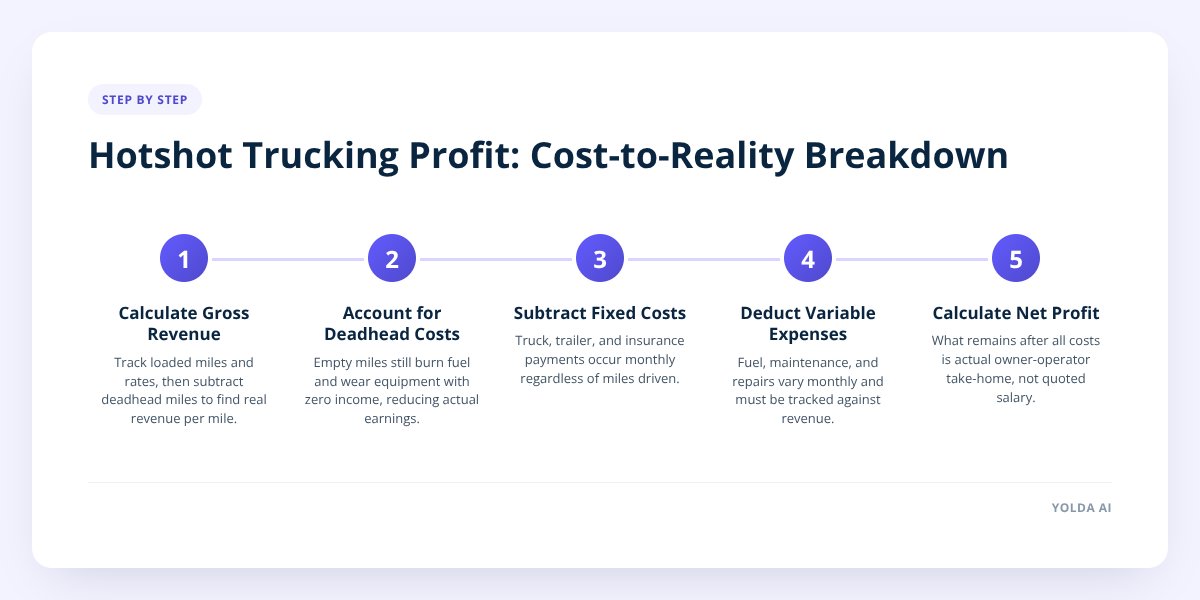
Rate per mile on hotshot loads fluctuates with freight demand, fuel costs, and how far in advance a load is booked. Rather than quote a specific rate (which changes by lane and season), the method that actually holds up is:
- Track your loaded miles and the rate paid for each one over a full month.
- Track your deadhead miles separately — miles driven with no paying freight.
- Add up total revenue, then divide by total miles (loaded plus deadhead) to get your real revenue per mile, not your quoted rate per mile.
That last number — revenue per total mile driven — is almost always lower than the rate per mile you negotiated on any single load. The gap between the two is deadhead, and it's the first place most new hotshot haulers underestimate their actual earnings.
Don't skip this: Calculating profit from "rate per mile" alone, without factoring in deadhead and fixed costs, is the single most common reason new hotshot haulers think they're making money when they're actually breaking even or losing ground.
How Much Does Deadhead Actually Cost You?
Deadhead costs you fuel, time, and wear on the truck — with zero revenue to offset it. If you run 2,000 loaded miles in a month at a strong rate but also run 500 deadhead miles finding your next load, those 500 miles still burn diesel and put hours on the engine while earning nothing.
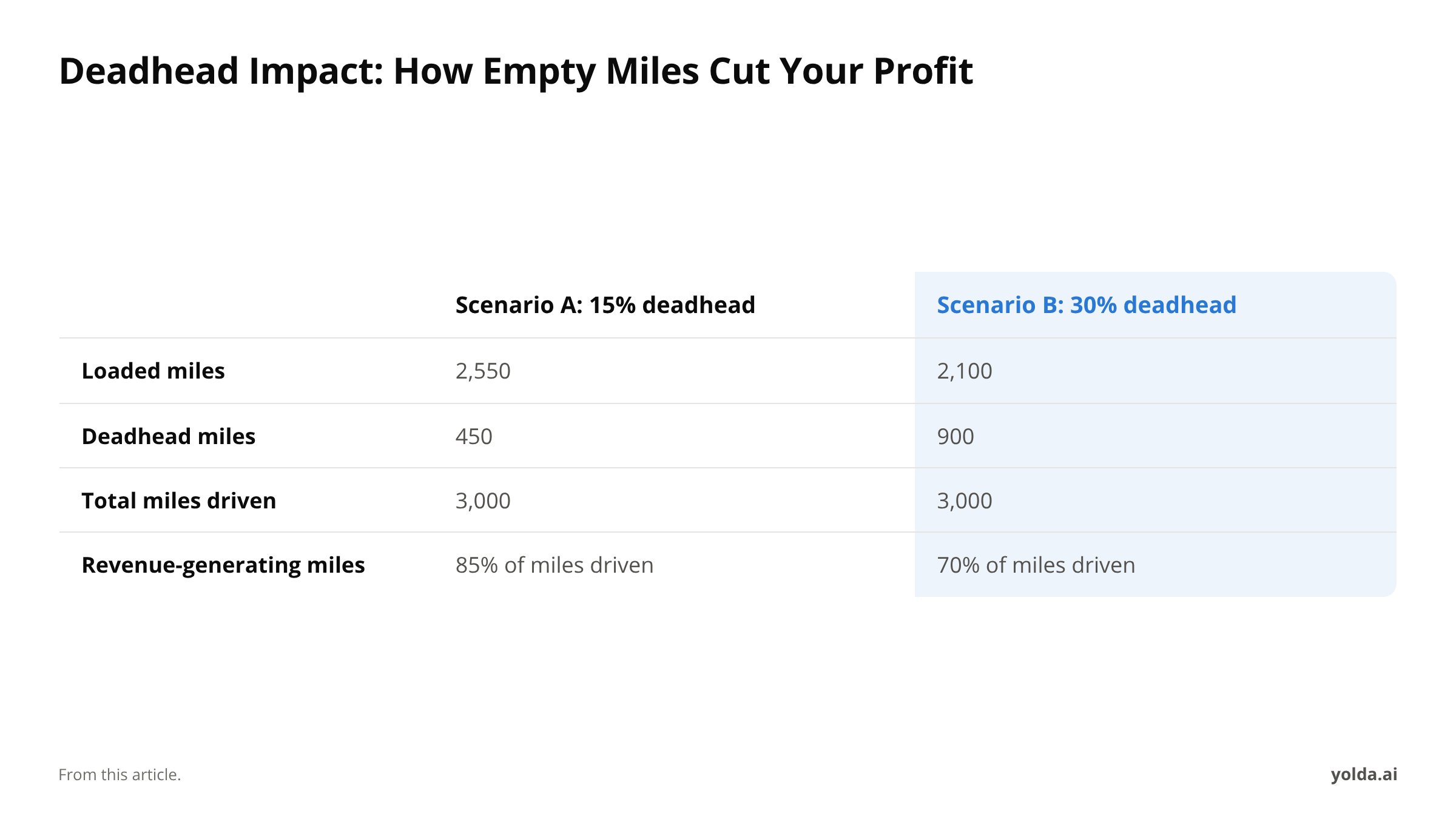
Here's a simplified way to see the effect, using round numbers to show the method rather than claim them as typical:
| Scenario A: 15% deadhead | Scenario B: 30% deadhead | |
|---|---|---|
| Loaded miles | 2,550 | 2,100 |
| Deadhead miles | 450 | 900 |
| Total miles driven | 3,000 | 3,000 |
| Fuel cost (same per-mile rate) | Lower total fuel spend relative to revenue | Higher total fuel spend relative to revenue |
| Revenue-generating miles | 85% of miles driven | 70% of miles driven |
Both trucks drove the same total distance and burned roughly the same fuel budget, but Scenario A earned revenue on far more of those miles. Cutting deadhead from 30% to 15% doesn't just save a little fuel — it changes how much of every tank of diesel is actually working for you.
This is also where load selection matters more than rate alone. A lower-paying load that keeps you in a freight-dense lane and sets up a short deadhead to your next pickup can beat a higher-paying load that strands you somewhere with nothing to haul back. We cover how to evaluate loads for exactly this tradeoff in how to find hotshot loads and pick the good ones.
What Fixed Costs Come Out Before You See a Dollar?
Fixed costs are the expenses that show up every month whether the truck runs or sits — and they're the ones new haulers most often underestimate. The core fixed costs for a hotshot operation are:
- Truck payment — the monthly note on a one-ton dually or heavier pickup, if financed rather than owned outright.
- Trailer payment — a separate note if the gooseneck or bumper-pull trailer was financed.
- Insurance — commercial auto liability, physical damage, and cargo coverage; premiums vary by driving record, cargo type, and whether you're running CDL or non-CDL. We break down what coverage a hotshot operation actually needs in hot shot trucking insurance: coverages you actually need.
- Permits and registration — IRP/IFTA registration if the rig qualifies as a qualified motor vehicle, plus any state-specific permits.
- Phone, dispatch tools, or load board subscriptions — ongoing costs of finding and managing freight.
On top of fixed costs sit variable costs — expenses that scale with miles driven: fuel, tires, oil changes, DOT inspections, and routine maintenance. A truck running 10,000 miles a month will spend far more on fuel and tires than one running 4,000, even though the truck payment and insurance premium stay flat either way.
The math that actually tells you what's left is:
Gross revenue − variable costs (fuel, maintenance, tires) − fixed costs (truck/trailer payment, insurance, permits) = net profit before taxes.
That net number — not gross revenue, not rate per mile — is the closest thing to a real "hotshot trucking salary." It's also the number most haulers never calculate with any rigor, because it requires tracking every expense category separately rather than eyeballing bank balance.
What About Maintenance and Unexpected Repairs?
Maintenance costs are easy to underbudget because they're irregular — a truck can run fine for months and then need a $2,000 transmission repair in one week. Routine maintenance (oil changes, brakes, tires) is predictable enough to budget as a per-mile cost. Unplanned repairs are not, which is why many experienced owner-operators set aside a fixed amount per mile into a maintenance reserve rather than spending whatever's left over each month.
A few things that affect how much maintenance actually costs a hotshot operation:
- Truck tonnage matters. A half-ton or three-quarter-ton truck pressed into hotshot work wears faster under repeated heavy towing than a properly rated one-ton dually. We compare the real differences in a 1-ton vs. half-ton hotshot truck: what actually changes.
- Trailer type affects tire and brake wear. A gooseneck distributes weight differently than a bumper-pull, which changes wear patterns and, in some cases, whether a CDL is required — covered in gooseneck vs bumper pull: which hotshot trailer needs a CDL?
- Deferred maintenance compounds. Skipping a $150 brake job because cash is tight this month can turn into a $1,500 rotor-and-caliper replacement two months later, plus downtime that costs you loads.
The honest way to treat maintenance in your profit math is to budget it as a cost per mile, reviewed and adjusted every quarter against what you actually spent — not as a surprise that shows up and eats into a month you thought was profitable.
Tracking Revenue and Costs Without Losing Your Weekends
Doing this math by hand in a spreadsheet works for a month or two, then it stops, because most owner-operators don't have time to log every fuel receipt and maintenance invoice while also driving, finding loads, and handling paperwork. That's the gap a dedicated system is built to close: pulling revenue and cost data into one place automatically instead of asking you to rebuild it from receipts every tax season.
Yolda's accounting tools let a trucking company see profit per truck or per lane without building a separate spreadsheet — turning a delivered load into an invoice with one click and letting you ask, in plain English, which lanes actually made money last month. For a hotshot operator trying to answer "what did I really take home this year," that's the difference between a guess and a number you can trust.
If you're still building your cost baseline from scratch, start with the free cost per mile calculator to get your per-mile cost structure in front of you before you plug in a month of real revenue and expenses.
Ready to see your real numbers instead of estimating them? Yolda runs dispatch, accounting, and compliance on one platform built for hotshot and small fleet operators — book a demo or start a free trial to see your profit per truck without building a spreadsheet.
Checklist: Calculate Your Real Hotshot Take-Home Pay
- Log every loaded mile and its rate for a full month, not just a few trips.
- Log every deadhead mile separately from loaded miles.
- Add up total fuel spend for the month, loaded and deadhead combined.
- List every fixed cost — truck payment, trailer payment, insurance, permits — as a monthly total.
- Estimate a per-mile maintenance reserve based on recent repair history, not hope.
- Subtract variable and fixed costs from gross revenue to get net profit before taxes.
- Repeat the calculation for at least three months before trusting the average.
- Compare your revenue per total mile (not rate per loaded mile) month over month to catch deadhead creep.


