
Quick answer: A bumper pull (tag-along) trailer rated 10,000 lbs GVWR or less, pulled by a truck under 26,001 lbs, needs no CDL at all. A gooseneck is usually rated well over 10,000 lbs, and once it's paired with a truck that puts your GCWR at 26,001 lbs or more, federal rule 49 CFR 383.91 requires a Class A CDL. The trailer's rated weight and the combined weight of truck plus trailer — not the trailer style by itself — decide which license you need.
Key takeaways
- Per 49 CFR 383.91, Class A applies when GCWR is 26,001 lbs or more AND the towed unit's GVWR is over 10,000 lbs.
- A truck under 26,001 lbs GVWR towing a trailer rated 10,000 lbs GVWR or less needs no CDL — the common "non-CDL hot shot" setup.
- Gooseneck trailers typically run 20–40 feet and carry higher GVWR ratings, which is why most gooseneck hotshot rigs end up needing a Class A.
- IFTA and IRP apply separately, based on weight and axle count, regardless of which license the driver holds.
Gooseneck vs Bumper Pull: What Actually Changes
The hitch location changes stability, turning radius, and how much weight you can legally carry — not whether you need a CDL by itself. That comes down to the numbers, which we'll get to. But the trailer type still shapes which loads you can realistically take.
A gooseneck trailer hitches inside the bed of the truck, over or near the rear axle. That placement moves more of the trailer's weight onto the truck itself, which is why goosenecks can carry heavier, longer loads more stably than a bumper pull of the same length. Most equipment haulers, flatbed hotshot rigs, and car haulers running heavier freight use a gooseneck for this reason.
A bumper pull trailer (also called a tag-along) hitches at the rear bumper or frame, behind the rear axle. It's simpler to hook up, easier to maneuver in tight yards, and cheaper to buy, but the hitch point outside the wheelbase means less stability at highway speed with a heavy or long load.
Here's the practical tradeoff:
| Factor | Gooseneck | Bumper pull |
|---|---|---|
| Typical GVWR range | 14,000–40,000+ lbs | 3,000–10,000 lbs (common hotshot range) |
| Typical length | 20–40 ft | 16–24 ft |
| Stability at speed | Higher — weight sits over the axle | Lower — more sway with heavy loads |
| Backing/maneuvering | Tighter turning radius | Easier for beginners |
| Usual CDL outcome | Often requires Class A | Often no CDL needed |
| Common freight | Equipment, machinery, heavier flatbed loads | Smaller loads, LTL pallets, light equipment |
None of this is a hard rule — you can buy a bumper pull trailer rated over 10,000 lbs, and some smaller goosenecks stay under it. The rating on the trailer's VIN plate is what counts, not the hitch style.

When Does a Hotshot Setup Need a Class A CDL?
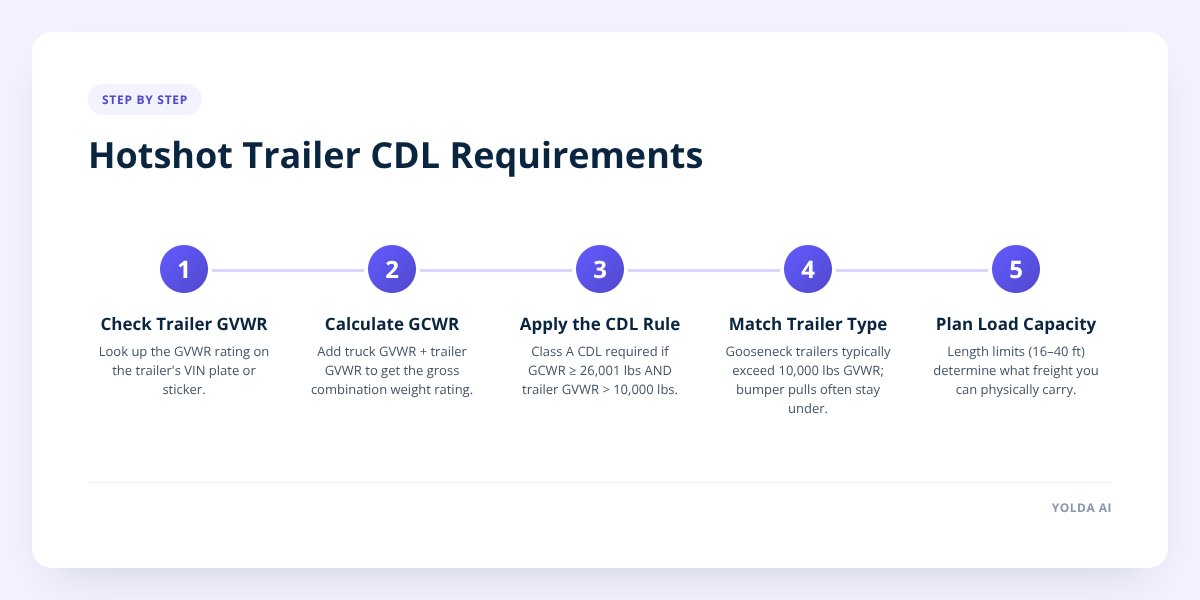
A Class A CDL is required when your gross combination weight rating (GCWR) is 26,001 lbs or more and the trailer you're towing is rated over 10,000 lbs GVWR, according to 49 CFR 383.91. Both conditions have to be true at the same time — meet only one, and you're still non-CDL.
Walk through two real setups:
Setup 1 — the common non-CDL hotshot rig: A Ram 3500 dually rated at 14,000 lbs GVWR, towing a bumper pull trailer rated at 9,990 lbs GVWR. Combined GCWR is under 24,000 lbs, and the trailer itself is under the 10,000-lb threshold. No CDL required.
Setup 2 — the common CDL-required gooseneck rig: The same Ram 3500 at 14,000 lbs GVWR, now towing a 20-foot gooseneck trailer rated at 14,000 lbs GVWR. GCWR comes to 28,000 lbs — over 26,001 — and the trailer is rated well over 10,000 lbs. Per 49 CFR 383.91, that's a Class A combination, full stop.
Notice what didn't change: the truck. The trailer rating is what flipped the requirement. That's the detail a lot of new operators miss when they upgrade from a bumper pull to a gooseneck expecting to haul heavier freight on the same license — the trailer they buy decides the license they need, not the other way around.
Don't skip this: Check the GVWR sticker or VIN plate on the trailer before you buy or rent it. A trailer rated at 10,001 lbs — one pound over the line — puts you in Class A territory if your GCWR also clears 26,001 lbs. There's no rounding down.
A couple of things that don't change the CDL answer:
- A combination over 26,000 lbs with a trailer rated 10,000 lbs or less still needs no CDL — weight alone doesn't trigger it.
- Driving interstate instead of intrastate doesn't change the CDL threshold; 49 CFR 383.91 applies either way.
- A heavier hitch (gooseneck vs. bumper pull) doesn't trigger Class A on its own — only the trailer's GVWR rating combined with GCWR does.
This is the same combined-weight logic covered from the box truck side in Do You Need a CDL to Drive a Box Truck? — different vehicle, same federal rule.
How Trailer Length Limits Which Loads You Can Take
Length restricts what you can physically load long before weight does, and it varies by trailer style more than most new operators expect.
- 16–20 ft bumper pull: Fits small equipment, ATVs, single-pallet LTL, short machinery. Common starter size for non-CDL hotshot work.
- 20–24 ft gooseneck: The sweet spot for a lot of hotshot flatbed freight — pipe, steel, small equipment, panels.
- 30–40 ft gooseneck: Needed for longer equipment (skid steers with attachments, long structural steel, modular pieces) but adds length restrictions on some state roads and tighter turning in city delivery.
Length also interacts with the cargo-securement rules a driver has to follow regardless of CDL status — flatbed loads over a certain length need additional tie-down points under FMCSA's securement regulations. That's a separate rule from the CDL threshold, and it applies whether you're running a 20-foot bumper pull or a 40-foot gooseneck.
If you're not sure how much deck length you actually need for a given load, a linear foot calculator is a quick way to check before you commit to a trailer purchase or a load that won't fit.
Does the Truck or the Trailer Decide My GCWR?
Both — GCWR is the combined weight rating of truck and trailer together, and it's usually set by the truck manufacturer, not the trailer seller. You'll find it in the truck's owner's manual or on the door-jamb sticker, listed separately from the truck's own GVWR.
Here's where people get tripped up: a truck's GVWR tells you how much the truck itself can weigh, loaded. GCWR tells you how much truck plus trailer plus cargo can weigh combined, and manufacturers cap it below what you'd get by just adding GVWR + trailer GVWR together. A 2026 heavy-duty one-ton truck might have a 14,000-lb GVWR but only a 30,000-lb GCWR — not 14,000 plus whatever the trailer weighs.
Checklist before you buy or lease a hotshot trailer:
- Find your truck's GCWR on the door-jamb sticker or in the owner's manual.
- Find the trailer's GVWR on its VIN plate — not the advertised "capacity," the certified rating.
- Add your truck's actual loaded weight to the trailer's loaded weight and confirm it stays under GCWR.
- Check whether the trailer GVWR is over or under 10,000 lbs — that's the CDL trigger point per 49 CFR 383.91.
- Confirm your USDOT and MC number requirements separately — these apply based on interstate commerce and weight, not CDL status.
- Review IFTA/IRP thresholds if you're crossing state lines with a combination over 26,000 lbs, since that's a separate weight test from the CDL one.
If you're still deciding whether hotshot trucking is the right lane for you at all, the Hot Shot Trucking overview covers the business basics; this post is the deeper look at the trailer and licensing math specifically.
What Happens If You Run the Wrong License Class?
Running a Class A combination on a non-CDL license is a roadside violation that can put the truck out of service and the driver out of hours on a load. A DOT officer checks the trailer's GVWR plate and your GCWR at a scale or roadside inspection — if the numbers clear 26,001 lbs GCWR with a trailer over 10,000 lbs GVWR and you're holding a non-CDL license, that's a mismatch that gets flagged on the spot.
Beyond the immediate stop, it shows up on your safety record. Keeping license classes, medical certificates, and trailer ratings matched up before dispatch is exactly the kind of thing that's easy to let slide when you're running solo — which is where a system that tracks CDL class and expiration dates automatically, like Yolda's safety and compliance tools, earns its keep. It flags a mismatch before the truck leaves the yard instead of after a trooper catches it at a scale.
Before accepting a load that might push you over the threshold, it's worth double-checking the rate confirmation too — we cover what to verify in Rate Confirmation: What's In One and What to Check First, since axle weight and trailer specs sometimes show up there.
If hotshot trucking is new to you, book a demo to see how Yolda keeps CDL classes, medical cards, and trailer compliance in one place — or start a free trial and set it up yourself.
Checklist: Matching Your Trailer to the Right License
- Pull the GVWR rating off the trailer's VIN plate before you sign anything.
- Find your truck's GCWR on the door-jamb sticker or owner's manual.
- Add loaded truck weight and loaded trailer weight; confirm the total stays under GCWR.
- Confirm whether the trailer GVWR is above or below 10,000 lbs.
- Hold a Class A CDL if GCWR is 26,001 lbs or more and the trailer is rated over 10,000 lbs.
- Check your state's length and securement rules for the trailer size you're buying.
- Verify your USDOT number and interstate operating authority separately from the CDL question.
- Set up alerts for CDL, medical card, and registration expiration dates before your first load.


