
Quick answer: A 3500-class (1-ton) truck beats a half-ton (1500-class) for hot shot hauling because of payload and gross combination weight rating (GCWR), not horsepower. A typical half-ton tops out around 2,000–3,200 lbs of payload and a GCWR well short of what a loaded gooseneck needs, while a 3500-class truck is built to legally carry the tongue weight and pull the trailer weight that real hotshot freight demands. Most working hotshot outfits run a 3500-class dually for this exact reason.
Key takeaways
- Payload and towing capacity are two separate numbers, and GCWR — the combined weight of truck, trailer, and cargo — is the one that actually determines what you can legally haul.
- A half-ton truck's low payload rating gets eaten up fast by a gooseneck hitch, fuel, tools, and a driver, before a pound of freight gets loaded.
- Exceeding a manufacturer's GCWR or payload rating isn't just unsafe — it can affect insurance claims and roadside inspection outcomes.
- A truck/trailer combination over 26,000 lbs doesn't automatically require a CDL — what matters is the trailer's GVWR, as we detailed in Non-CDL Hot Shot Trucking: Requirements by the Numbers.
If you're still deciding whether hotshot hauling is the right business to get into at all, our overview on what hot shot trucking is covers the basics. This post goes deeper on one question: which truck class actually gets the job done.
Why payload matters more than towing capacity
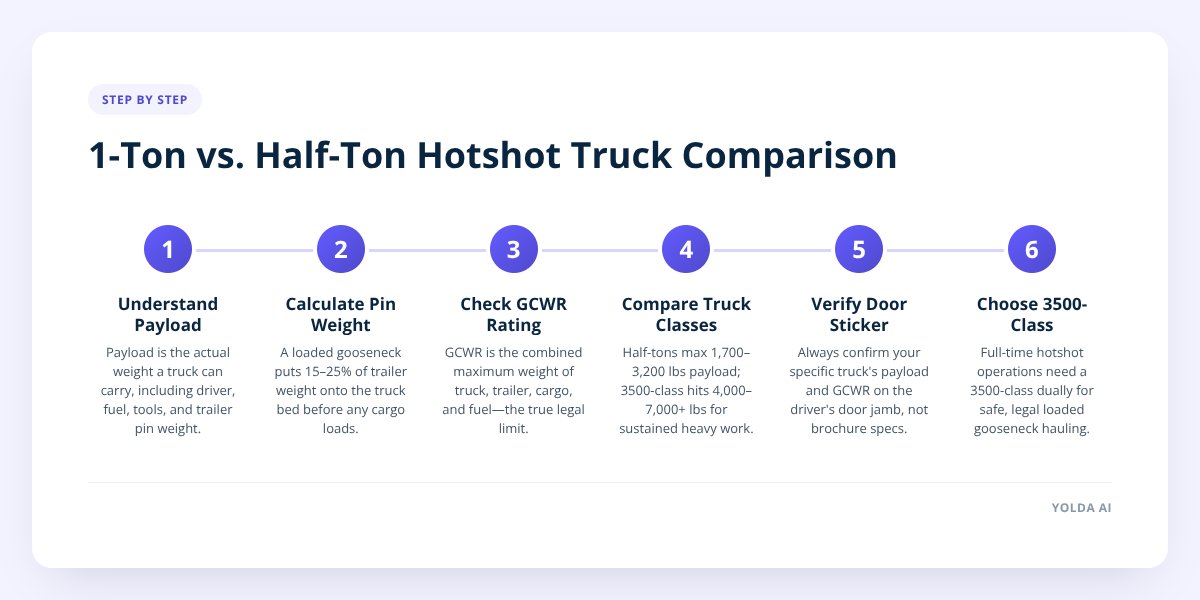
A truck's advertised towing number is almost always the best-case figure — the maximum with a light driver, no cargo, and a bare-bones trailer. Payload is the number that actually constrains a working hotshot rig, because everything you add to the truck bed and hitch subtracts from it.
Payload is the total weight a truck can carry, including passengers, cargo, equipment, and — critically — the pin weight or tongue weight of whatever trailer is hooked to it. That last part catches new hotshot operators off guard constantly.
Here's a worked example. A gooseneck trailer loaded with equipment often puts 15–25% of the total trailer weight onto the truck's bed as pin weight. On a 20,000-lb loaded gooseneck, that's 3,000–5,000 lbs sitting in the truck bed before a single tool box or driver gets in.
- A half-ton truck's payload rating commonly falls in the 1,700–3,200 lb range depending on cab configuration and options — confirm the exact figure on the driver's door jamb sticker, which lists the actual GVWR and payload for that specific vehicle.
- Subtract driver weight, fuel, a toolbox, and tie-down equipment, and there's often little or nothing left for pin weight.
- A 3500-class dually, by contrast, is commonly rated for payloads in the 4,000–7,000+ lb range, which leaves real room after the truck itself is accounted for.
This is why a half-ton "can tow" a gooseneck on paper but can't legally carry one loaded with freight. The towing number was never the limiting factor — the payload number was.
What is GCWR and why does it decide everything?
GCWR (gross combination weight rating) is the maximum total weight the manufacturer allows for the truck, trailer, cargo, fuel, and occupants combined — and it's the single number that determines whether a given truck-trailer pairing is legal. Towing capacity and payload are each one piece of that total; GCWR is the ceiling on all of it added together.
A truck can be under its payload limit and under its advertised towing capacity and still exceed GCWR, because GCWR accounts for the truck's own weight too. This is the number that trips up operators who shopped by towing capacity alone.
Don't skip this: exceeding a manufacturer's GCWR isn't a gray area. It can void warranty coverage, complicate an insurance claim after an accident, and show up as a violation during a roadside weight inspection. Check the GCWR on the truck's door sticker or owner's manual, not the towing number in a sales brochure.
The math works like this: start with GCWR, subtract the truck's actual curb weight (not the advertised base weight — actual, as equipped, with a full tank and driver), and what's left is the maximum combined weight of trailer plus cargo you can legally pull. A 3500-class truck typically has thousands of pounds more headroom in this calculation than a half-ton, because manufacturers engineer the frame, axles, brakes, and cooling systems of a 1-ton specifically for heavier combination work.
1500 vs. 2500 vs. 3500: a side-by-side look
| Truck class | Typical payload | GCWR headroom for hotshot work | Best for |
|---|---|---|---|
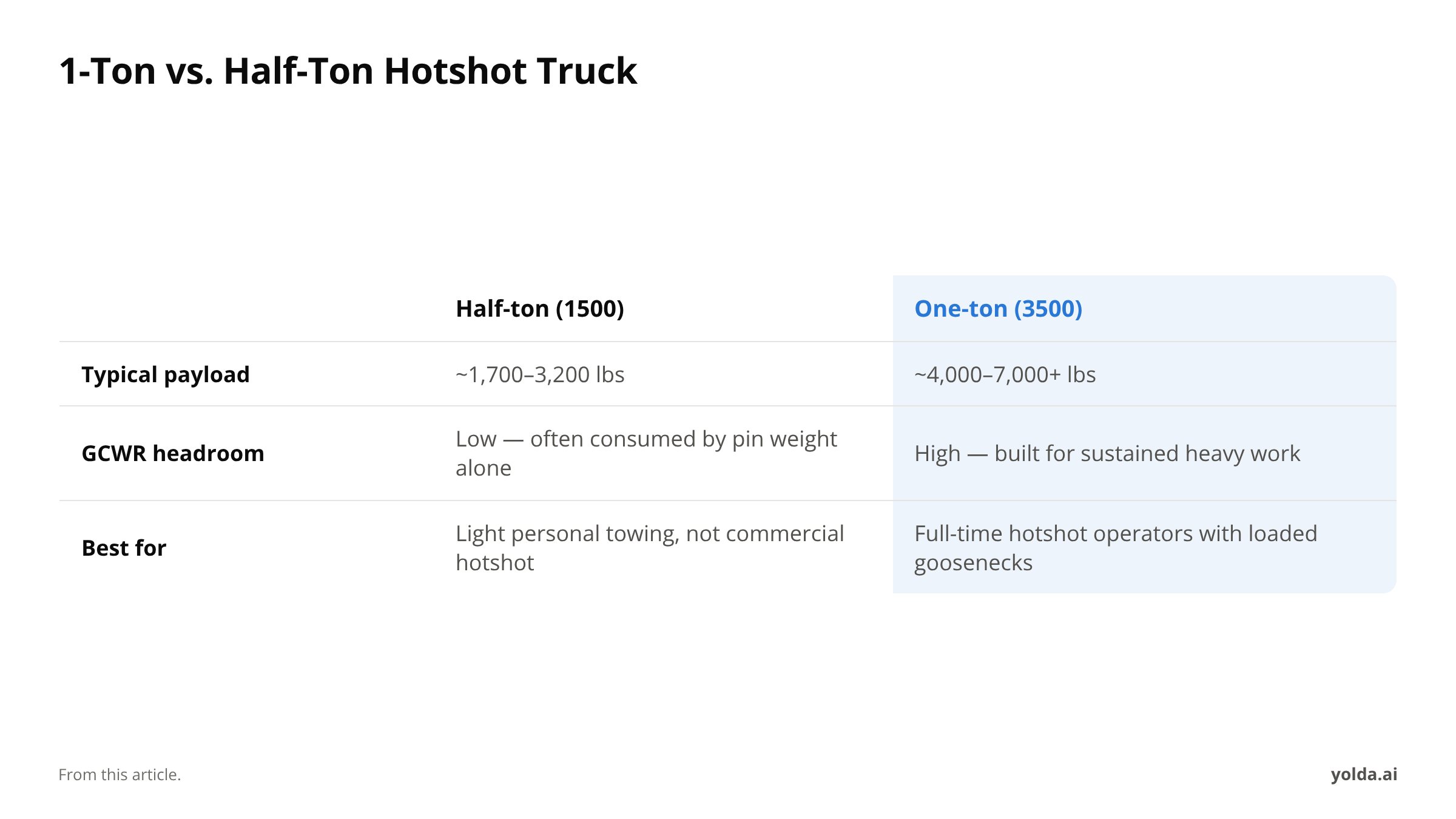
| Half-ton (1500) | ~1,700–3,200 lbs | Low — often consumed by pin weight alone | Light personal towing, not commercial hotshot freight |
| Three-quarter-ton (2500) | ~2,500–4,500 lbs | Moderate — workable for light, occasional loads | Operators hauling light equipment occasionally, not daily max-weight freight |
| One-ton (3500), single or dual rear wheel | ~4,000–7,000+ lbs | High — built for sustained heavy combination work | Full-time hotshot operators running loaded goosenecks regularly |
Exact figures vary by manufacturer, cab configuration, bed length, axle ratio, and options package — always confirm the specific truck's door-sticker rating rather than a class-wide average.
The plain recommendation: if hotshot hauling is your business, not an occasional side job, a 3500-class dually is the practical floor, not the ceiling. A half-ton doesn't have the payload margin to carry pin weight safely once you add fuel, a driver, and tools. A 2500 can work for light, occasional runs, but most operators who try to make a living on one eventually find themselves overloaded on paper even when the trailer "looks" within towing capacity. The 3500-class dominates hotshot fleets for a structural reason, not a brand-loyalty reason: it's the smallest class with enough GCWR headroom to carry real freight weight day after day without constantly flirting with its limits.
Does a bigger truck change your CDL requirement?
Not by itself — the trailer's rating is what decides that, not the truck's class or the combination's total weight. Under 49 CFR 383.91, a Class A CDL is required when the combination's GCWR is 26,001 lbs or more and the towed trailer's GVWR is over 10,000 lbs. A truck and trailer combination that exceeds 26,000 lbs combined does not, by itself, trigger a CDL requirement — the trailer rating is the deciding factor.
That means a 3500-class truck pulling a trailer rated 10,000 lbs GVWR or less can still be driven without a CDL, even if the combination's total weight is well over 26,000 lbs. Step up to a trailer rated above 10,000 lbs GVWR with a combination GCWR of 26,001+ lbs, and Class A applies. We walked through the full breakdown, including the gooseneck-vs-bumper-pull distinction, in Gooseneck vs Bumper Pull: Which Hotshot Trailer Needs a CDL?
Separately, IFTA and IRP registration apply to any qualified motor vehicle used across state lines — defined as two axles with a gross or registered gross weight over 26,000 lbs, three or more axles at any weight, or a combination exceeding 26,000 lbs. That threshold is independent of the CDL question, so a non-CDL combination can still owe IFTA fuel tax reporting if it crosses state lines over that weight.
How truck class affects your cost per mile
A 3500-class truck costs more to buy, fuel, and maintain than a half-ton — but the cost-per-mile comparison isn't as simple as "bigger truck, bigger bill." A truck that's actually rated for the freight you're hauling avoids the hidden costs of running overweight: accelerated tire and brake wear, transmission strain, and the liability exposure of a combination that doesn't match its paperwork.
The real cost-per-mile question isn't which truck class is cheaper to own — it's which one lets you say yes to more loads without turning them down for weight reasons or running them unsafely. A 3500-class truck that can take any gooseneck load in its weight range keeps your truck earning; a half-ton that has to pass on anything heavier than light equipment sits idle or turns away freight.
Run your own numbers rather than guessing — our free cost per mile calculator lets you plug in fuel, maintenance, insurance, and fixed costs for your specific truck to see where the real breakeven sits.
Keeping the truck-and-trailer math straight, load after load
Checking payload and GCWR math by hand for every load gets old fast, especially once you're running multiple trailers or helping a new driver understand what their rig can legally carry. The place this usually breaks down is at dispatch — someone assigns a load without the weight and route details lined up clearly, and the driver finds out there's a problem at the scale house.
Yolda's dispatch tool reads a rate confirmation when you drop it in, builds the load draft with stops and reference numbers for a dispatcher to review, and draws the route on a live map so everyone can see the actual miles and stops before the truck rolls — one less place for a mismatch between paperwork and what's actually on the truck to slip through.
If you're setting up a hotshot operation from scratch — picking a truck, a trailer, and getting your authority in place — How to Start a Hot Shot Trucking Business, Step by Step walks through the full sequence. And once you're hauling, Yolda runs dispatch, driver settlements, IFTA, and DOT compliance from one login, built for carriers from a single truck up to a full fleet. Book a demo to see it against your own loads.
Checklist: choosing the right truck class for hotshot hauling
- Check the door-jamb sticker on any truck you're considering for actual GVWR and payload, not the brochure number.
- Calculate expected pin weight or tongue weight for your typical trailer load — figure 15–25% of total trailer weight for a gooseneck.
- Add driver weight, fuel, and equipment to pin weight, then compare the total against the truck's actual payload rating.
- Confirm GCWR on the specific truck and subtract its actual curb weight to find your real combined towing ceiling.
- Match the trailer's GVWR against the CDL threshold in 49 CFR 383.91 before assuming no CDL is needed.
- Check whether your combination crosses the 26,000-lb IFTA/IRP qualified motor vehicle threshold if you run interstate.
- Run your fuel, maintenance, and fixed costs through a cost-per-mile tool before comparing truck classes on sticker price alone.


