
Quick answer: A bill of lading (BOL) is the legal receipt and contract for a freight shipment — it records what was picked up, where it's going, its condition, and who's responsible for it at every step. Carriers don't get paid without it: the signed BOL proves delivery happened, it backs up the proof of delivery (POD), and brokers or shippers will hold your invoice until both documents match. A sloppy or missing BOL is one of the most common reasons freight payments stall.
Key takeaways
- A bill of lading is both a receipt for the freight and a contract of carriage between shipper, carrier, and consignee.
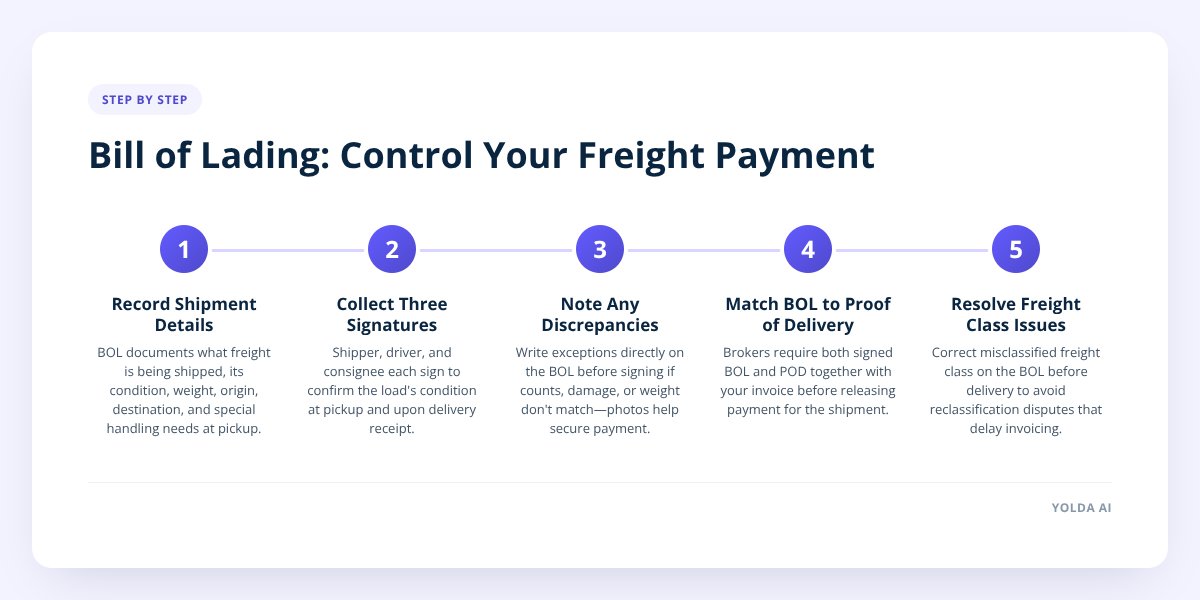
- The BOL typically needs three signatures: the shipper at pickup, the driver at pickup, and the consignee at delivery.
- Freight can't legally move without a BOL, and most brokers won't release payment until the signed BOL and POD are on file.
- Discrepancies between the BOL and the actual freight (weight, count, damage) should be noted in writing at the time — not after the fact.
What exactly does a bill of lading record?
A bill of lading records the full story of a shipment: what it is, how much of it there is, where it came from, where it's going, and who touched it along the way. Think of it as the shipment's passport — it travels with the freight and gets stamped at each checkpoint.
A standard BOL includes:
- Shipper and consignee names and addresses
- Pickup and delivery dates
- A description of the freight — commodity type, packaging, and piece count
- Weight, and sometimes freight class or NMFC code
- Any special handling instructions (hazmat, temperature control, fragile)
- Signatures from the shipper, the driver, and the consignee
This document isn't just paperwork for paperwork's sake. Under federal law, a bill of lading serves as the legal contract of carriage — it's the evidence that freight existed, moved, and arrived, and it assigns liability if something goes wrong along the way.
Who actually has to sign it, and when?
Three signatures matter, and each one locks in a different fact. The shipper signs at pickup to confirm what's being handed off. The driver signs at pickup to confirm they received that freight in that condition. The consignee signs at delivery to confirm what arrived — and if it doesn't match what left, that's where the signature gets interesting.
Here's where carriers get burned. If a driver signs a BOL at pickup without checking the count or inspecting for visible damage, and the load shows up short or damaged at delivery, the carrier can end up holding the liability — because their own signature confirmed the load left in good condition.
Don't skip this: if anything looks off at pickup — wrong piece count, visible damage, a seal that's already broken — write it on the BOL before signing, not after. Phrases like "shrink wrap torn, pallet corner crushed" turn a vague dispute into a documented exception that protects you later.
The same goes at delivery. If the consignee notes a shortage or damage on the BOL when they sign, that notation becomes the basis for any claim — and it's also the first thing a broker or shipper will point to when deciding whether to pay you in full.
How does the BOL connect to the POD and your invoice?
The bill of lading and the proof of delivery (POD) are related but not the same thing, and mixing them up is where a lot of invoicing delays start.
| Document | What it proves | When it's created | Who signs |
|---|---|---|---|
| Bill of lading | What was shipped and its condition at pickup | At pickup, before the truck leaves | Shipper, driver |
| Proof of delivery | That the freight arrived and was accepted | At delivery | Consignee (sometimes the driver too) |
| Invoice | What the carrier is owed for the move | After delivery is confirmed | Carrier |
In practice, the signed BOL often doubles as the POD if the consignee signs and dates it at delivery with no exceptions noted. But many brokers and shippers want both documents submitted together with the invoice — the BOL as the contract, the POD as proof the contract was fulfilled.
If either one is missing, incomplete, or illegible, expect your invoice to sit in a queue instead of getting paid. This is one of the biggest hidden causes of slow freight payments, something we cover in more depth in What Slows Down Freight Invoicing and How to Fix It.
What happens if the BOL has an error or doesn't match the load?
If the bill of lading doesn't match what's actually on the truck, fix it in writing before the truck leaves, not after. Common mismatches include:
- Piece count listed doesn't match what the driver loaded
- Weight on the BOL is an estimate that turns out to be wrong
- Freight class is marked incorrectly, which can trigger a reclassification and a revised invoice from the carrier's side or a short-pay from the broker's side
- Damage exists but wasn't noted before the driver signed
A reclassification dispute is one of the more expensive mistakes here. If a shipper lists a lower freight class than what's actually being hauled, and the carrier catches it during inspection, that correction can change the agreed rate — sometimes after the load has already delivered, which turns into a billing argument nobody wants.
The fix is the same every time: note the discrepancy on the BOL itself, get a signature or initials next to the note if possible, and photograph the freight before it's loaded or after it's unloaded. A timestamped photo next to a written exception on the BOL is hard to argue with.
Do I need a BOL for every load, even short local runs?
Yes — a bill of lading is required for any commercial freight shipment, regardless of distance, because it's the legal record that the shipment happened and under what terms. There's no mileage or load-size exemption that removes the need for one. Even a short drayage move or a same-day local delivery needs a BOL, because without it there's no documented proof of what was picked up, what condition it was in, or who accepted it.
Carriers sometimes skip a formal BOL on short hauls and use a simplified delivery receipt instead. That can work for low-value, repeat freight between parties who trust each other, but it leaves the carrier exposed if a dispute comes up later — there's no paper trail showing what was agreed to at pickup.
If you're hauling for a broker, the rate confirmation sets the financial terms, but the BOL is still the document that proves the physical handoff happened. The two serve different purposes and neither replaces the other.
Where do carriers get a bill of lading from?
Most of the time the shipper provides the BOL, pre-filled with their shipping details, and the driver and shipper fill in the rest at pickup. But if you're hauling for a shipper who doesn't provide one, or you want a backup on hand, Yolda offers a free bill of lading template you can fill in, print, or save as a PDF before you ever get to the dock.
Having a blank BOL ready in the cab matters more than it sounds. A driver who shows up at a shipper with no paperwork and no way to generate it on the spot either delays the pickup or signs whatever's handed to them without a second look — exactly the situation that leads to disputes later.
Once the load delivers and the signed BOL and POD are in hand, the next bottleneck is usually getting that paperwork turned into an actual invoice without re-keying everything by hand. Yolda keeps the rate confirmation, BOL, and POD attached to the load record itself, so when a driver scans the signed POD from the cab through the driver app, the office sees it immediately — and once it's approved, one click turns the delivered load into an invoice with nothing retyped. That's handled through Yolda's accounting tools, built specifically so carriers aren't waiting on paperwork to chase their own money.
If getting paid on time is a recurring headache for your fleet, book a demo or start a free trial to see how documents, dispatch, and invoicing tie together on one platform.
Checklist: Getting a bill of lading right every time
- Fill in shipper, consignee, pickup and delivery details before the truck is loaded.
- Confirm the piece count and weight match what's physically on the truck.
- Inspect the freight for visible damage before signing at pickup.
- Write any discrepancy directly on the BOL — count, weight, damage, or seal issues.
- Get the shipper or consignee to initial next to any written exception.
- Photograph the freight at pickup and delivery as backup documentation.
- Keep a blank BOL template on hand in case the shipper doesn't provide one.
- Attach the signed BOL and POD to the load record before submitting the invoice.
- Confirm both documents are legible before sending them to the broker or shipper.


