
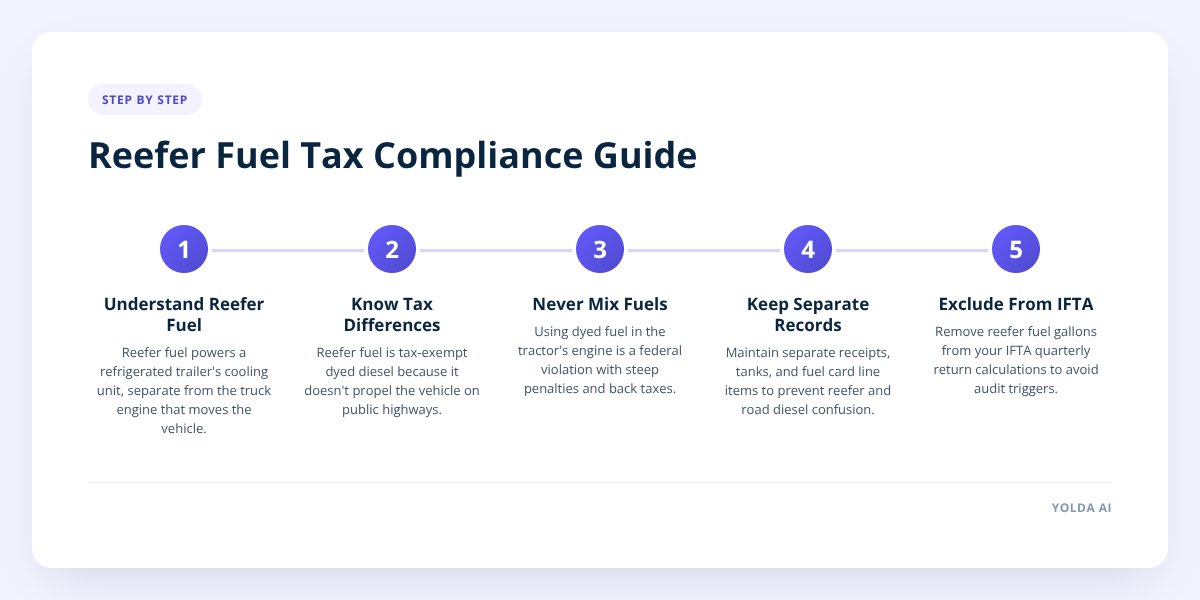
Quick answer: Reefer fuel is diesel burned by a refrigerated trailer's independent cooling unit, not by the truck's engine. Because it never powers a vehicle on a public road, it qualifies for dyed, tax-exempt diesel in most states, while the fuel burned by the tractor is taxed road diesel reported under IFTA. Mixing the two up, or running dyed fuel in the tractor, creates tax liability and can trigger steep penalties from state and federal fuel-tax authorities.
Key takeaways
- Dyed diesel for reefer units is marked red with a federal fuel dye so inspectors can visually confirm it's untaxed, off-road fuel, per the Internal Revenue Service's fuel dye program.
- Running dyed fuel in a truck's main tank is a federal excise tax violation — the IRS and state agencies can assess back taxes plus penalties, even for an honest mistake.
- Reefer fuel purchases are not part of your IFTA fuel tax calculation because that unit never propels the vehicle on the highway.
- Separate receipts, separate tanks, and separate fuel card line items are the three things that keep reefer fuel and road diesel from getting tangled in an audit.
What Exactly Is Reefer Fuel?
Reefer fuel is diesel that runs the generator powering a refrigerated trailer's cooling system, completely separate from the engine that moves the truck down the highway. The term comes from "reefer," the industry's shorthand for a refrigerated trailer. These units — made by companies like Thermo King and Carrier — have their own small diesel engine, fuel tank, and fuel gauge, independent of the tractor pulling the trailer.
A standard reefer tank holds somewhere between 40 and 90 gallons depending on the unit, and it needs refilling separately from the tractor's road diesel tanks. Drivers hauling temperature-controlled freight — produce, meat, pharmaceuticals, frozen goods — check and fill this tank as part of their routine, often at the same truck stop but at a different pump or a dedicated reefer fuel island.
The key distinction: reefer fuel never touches a public road to move a vehicle. It just runs a compressor and fan to keep a trailer cold. That single fact is what separates it, tax-wise, from everything in the tractor's tank.
Why Does the Tax Treatment Differ From Road Diesel?
Road diesel is taxed to fund highway construction and maintenance; reefer fuel isn't moving anything on the highway, so most states exempt it from that tax. Federal and state fuel taxes exist specifically to pay for the roads that trucks wear down. A refrigeration unit sitting on a trailer, running a compressor, contributes nothing to that wear — so the tax logic doesn't apply.
This is why many states allow dyed diesel (sometimes called off-road diesel) to be sold at a reduced price, without the road tax baked in, for uses like:
- Refrigeration units on reefer trailers
- Construction and farm equipment
- Generators and auxiliary power units
- Heating oil in some states
The Internal Revenue Service requires this fuel to be dyed red so it's visually distinguishable from clear, taxed road diesel. State and federal inspectors can pull a fuel sample from any tank — including a reefer tank or, more importantly, a truck's main tank — and check for red dye. If it shows up in the tractor's tank, that's a problem.
Don't skip this: Dyed diesel is legal in a reefer unit's tank and illegal in a truck's engine tank. The IRS imposes penalties on anyone who uses dyed fuel for a taxable purpose, and inspectors test for dye at weigh stations and fuel terminals specifically to catch this.
Can You Put Dyed Fuel in the Truck Itself?
No — using dyed, untaxed diesel to power a truck's engine on a public highway is a federal violation, regardless of whether it was a mistake or a cost-cutting attempt. The IRS fuel dye program exists precisely to catch this. Dyed fuel is cheaper per gallon because it skips the federal and state road tax, which makes it tempting to think "it's just diesel, why not top off the truck with it."
Here's the real risk: if an inspector finds dye residue in a tractor's fuel system during a roadside check or a fuel tax audit, the carrier can be held liable for the full back tax on every gallon suspected of being used improperly — not just the one tank that tested positive. Penalties on top of that back tax are common, and they apply per violation, not per gallon.
This also matters at the pump. Most truck stops keep dyed reefer fuel and clear road diesel on physically separate pumps or islands specifically to prevent a driver from accidentally fueling the wrong tank. A driver in a hurry, using the wrong nozzle, can create a tax problem that takes months to untangle — even if nobody meant to cut corners.
How Does Reefer Fuel Affect IFTA Reporting?
Reefer fuel is excluded from your IFTA fuel tax calculation because the International Fuel Tax Agreement only taxes fuel used to propel a qualified motor vehicle across state lines. Under IFTA, a qualified vehicle is one with two axles and a gross or registered weight over 26,000 pounds, three or more axles at any weight, or a combination over 26,000 pounds. The tax is based on miles driven in each state versus fuel purchased in each state — and a reefer unit doesn't drive anywhere on its own.
That means when you're compiling your quarterly return, reefer fuel purchases should be stripped out of the road-diesel total before you calculate miles-per-gallon by jurisdiction. Including reefer gallons in your IFTA fuel totals will skew your fleet's average miles per gallon and can make your return look inconsistent with your mileage logs — a classic trigger for an audit. We've covered what that audit process looks like in What Happens in an IFTA Audit, Step by Step.
| Fuel type | Used for | Tax status | Counted in IFTA? |
|---|---|---|---|
| Road diesel (tractor) | Powering the truck on public roads | Taxed (federal + state excise) | Yes |
| Reefer fuel (dyed) | Powering the trailer's cooling unit | Untaxed in most states | No |
| Dyed fuel in a truck's tank | N/A — not a legal use | Tax violation if used this way | N/A |
What Records Do You Need to Keep Separate?
Keep reefer fuel receipts physically and digitally separate from road diesel receipts from the day you buy the fuel, not when it's time to file. Most fuel tax authorities and IFTA auditors want to see a clean paper trail showing exactly which gallons went where. If your receipts lump both fuel types together, you're left guessing — or worse, an auditor is left guessing for you.
A few habits make this painless:
- Use a fuel card that codes reefer and road diesel separately. Many fleet fuel cards let drivers select "reefer" or "truck" at the pump, which timestamps and categorizes the purchase automatically.
- Keep the receipt even for small reefer fills. A $40 reefer top-off receipt matters just as much as a $400 road diesel fill when you're reconstructing records for an audit.
- Note the unit number on reefer receipts if your fleet runs multiple trailers, so you can trace fuel costs back to a specific unit for maintenance and cost tracking.
- Reconcile monthly, not quarterly. Catching a miscoded purchase in week two is a five-minute fix; catching it three months later during IFTA prep is a research project.
We've written in more detail about how to track fuel purchases by state without a spreadsheet, which covers the mechanics of organizing receipts once you're separating fuel types correctly.
This is exactly the kind of manual sorting that gets messy fast once a fleet grows past a couple of trucks. Yolda's IFTA reporting tool pulls fuel purchase data automatically and keeps road diesel separate from other fuel categories, so your quarterly miles-per-gallon calculation reflects only the fuel that actually moved a vehicle across state lines.
What Happens If Reefer and Road Fuel Get Mixed Up on Paper?
Mixing reefer fuel into your IFTA fuel totals doesn't just risk an audit — it can also cost you money either way, overstating or understating your fuel tax liability. If reefer gallons get counted as road diesel, your reported miles-per-gallon drops artificially low, which can make your fuel tax credits claim look inflated to an auditor, even if every number was entered in good faith. On the flip side, if you accidentally leave legitimate road diesel receipts out because they were miscoded, you might overpay.
If you've ever claimed a refund for tax-paid fuel used off-road, that process has its own documentation requirements, covered in IFTA Fuel Tax Credits: How to Claim Your Refund — reefer fuel and tax-paid-but-off-road fuel are related but not identical categories, so it's worth confirming which situation applies to you.
The fix isn't complicated, but it does require consistency: code fuel correctly at the pump, store receipts by category, and reconcile before the quarter closes rather than scrambling after.
Running a mixed fleet of reefer and dry van trailers, or just tired of manually sorting fuel receipts by hand every quarter, is a good reason to look at Yolda, an AI-native TMS that keeps dispatch, accounting, and IFTA reporting on one platform. Book a demo or start a free trial to see how it handles fuel tax reporting without the spreadsheet.
Checklist: Keeping Reefer Fuel Records Separate From Road Diesel
- Confirm your fuel card codes reefer and road diesel as separate purchase types.
- Train drivers to use the correct pump or nozzle at every truck stop with a reefer island.
- Keep every reefer fuel receipt, even small top-offs, in its own file or folder.
- Reconcile fuel receipts by category monthly instead of waiting for quarter-end.
- Exclude reefer gallons from your IFTA miles-per-gallon calculation before filing.
- Check your state's fuel tax agency guidance if you're unsure whether a specific use qualifies for dyed fuel.
- Review dyed fuel storage and dispensing rules with your fuel supplier if you store bulk fuel on site.


