
Quick answer: A non-domiciled CDL is a commercial driver's license issued by a state to someone who is lawfully present in the U.S. but doesn't live there permanently — for example, a worker on an H-2B, TN, or E-2 visa, or a lawful permanent resident domiciled in another country. The license itself looks and works like a standard CDL; the difference is tied to the holder's immigration status and documentation, not their driving privileges. Carriers hiring non-domiciled CDL holders must verify the license and work authorization the same way they verify any CDL, and watch for any state or federal action affecting that specific license's validity.
Key takeaways
- A non-domiciled CDL is issued under the same federal CDL standards as any other CDL — the license category (Class A, B, or C) and testing requirements don't change based on domicile status, per 49 CFR Part 383.
- States issue non-domiciled CDLs to people who hold specific visa types or immigration statuses but are not U.S. citizens or permanent residents domiciled in the issuing state.
- Carriers must confirm both the CDL's validity and the driver's current work authorization — these are two separate checks, not one.
- FMCSA has taken public action against non-domiciled CDLs tied to fraudulent issuance or expired work authorization; carriers should check a license's status directly with the issuing state if anything looks inconsistent.
By the numbers
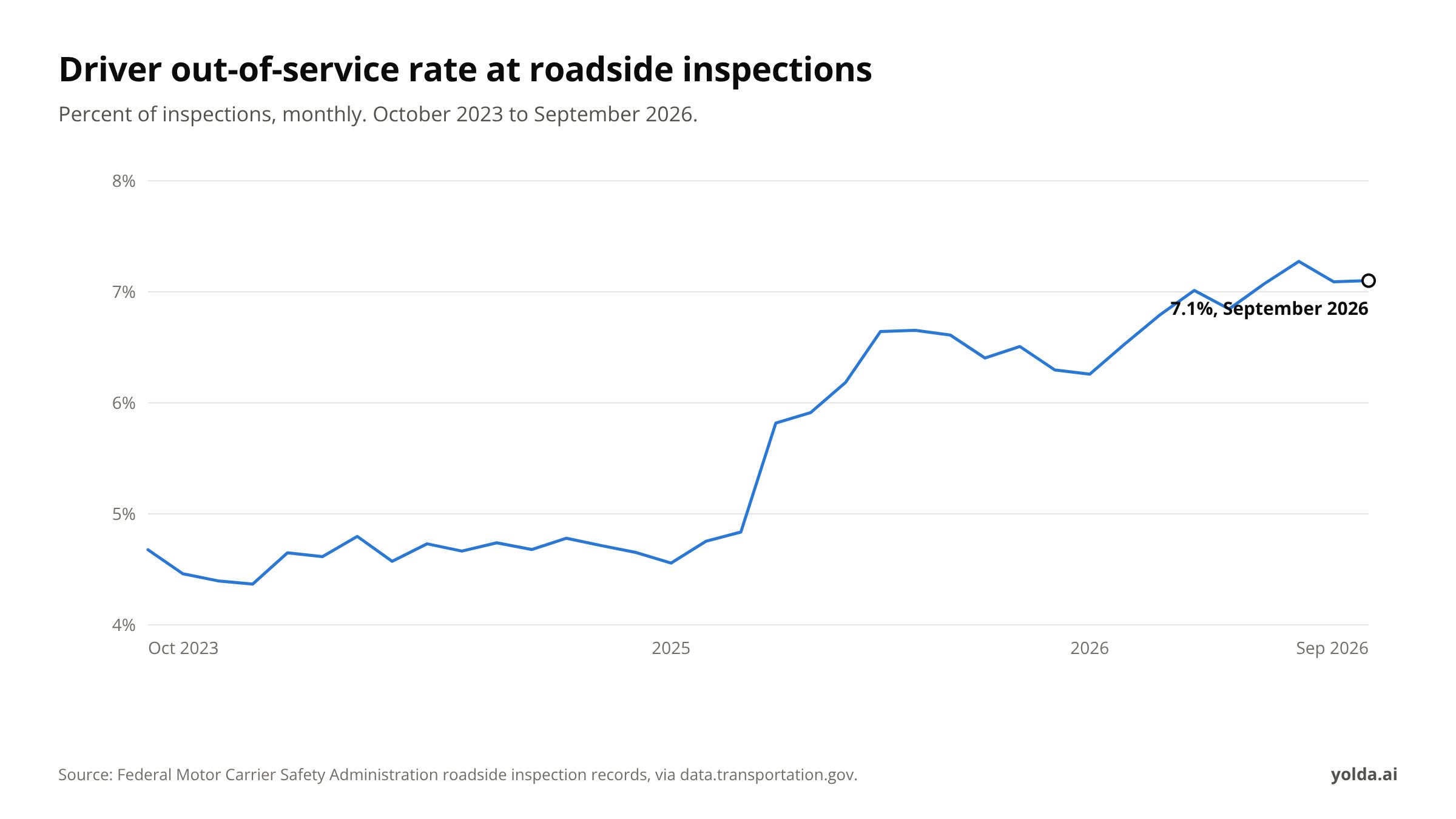
- The driver out-of-service rate at roadside inspections was 7.1% in September 2026, up 0.5 percentage points from a year earlier. Source: Federal Motor Carrier Safety Administration roadside inspection records, DOT open data.
Latest official data as of Oct 26, 2026.
What exactly is a non-domiciled CDL?
A non-domiciled CDL is a commercial driver's license a state issues to a person who is authorized to be in the United States but whose permanent home ("domicile") is in another country. The license category — Class A, B, or C — follows the same federal rules under 49 CFR 383.91 that apply to any CDL holder. A non-domiciled CDL doesn't grant different driving privileges or exempt the holder from any testing or medical certification requirement.
The distinction exists because states normally require a driver to be domiciled in that state to get a CDL there. Federal regulations carve out an exception for people who are lawfully present on certain visa classifications or other authorized statuses but don't meet the domicile test. States issue the non-domiciled version instead, tied to the holder's specific immigration document and its expiration date.
This matters for one practical reason: a non-domiciled CDL's validity is linked to the holder's underlying immigration status. If that status lapses, is revoked, or expires, the license can become invalid even if the physical card hasn't hit its printed expiration date. That's the core thing a hiring carrier has to track that doesn't apply to a standard, domiciled CDL.
Who actually holds one?
Non-domiciled CDLs go to drivers who are lawfully present in the U.S. under a status that doesn't establish permanent domicile — common examples include certain work visa holders and lawful permanent residents who maintain their home address outside the country. The population is relatively small compared to the overall CDL-holding workforce, but it's concentrated in specific carrier segments: companies that recruit internationally for over-the-road and specialized freight.
What a non-domiciled CDL is not:
- It is not a special or lesser license class — Class A, B, and C rules apply identically.
- It is not proof of work authorization by itself — the CDL and the work permit are two different documents issued by two different authorities.
- It is not permanent in the way a standard CDL renewal is — it's generally tied to the expiration of the underlying status document, which may be shorter than a standard multi-year CDL renewal cycle.
- It is not something a carrier can self-certify as valid — the issuing state, not the carrier, determines and confirms validity.
What must a carrier verify before hiring?
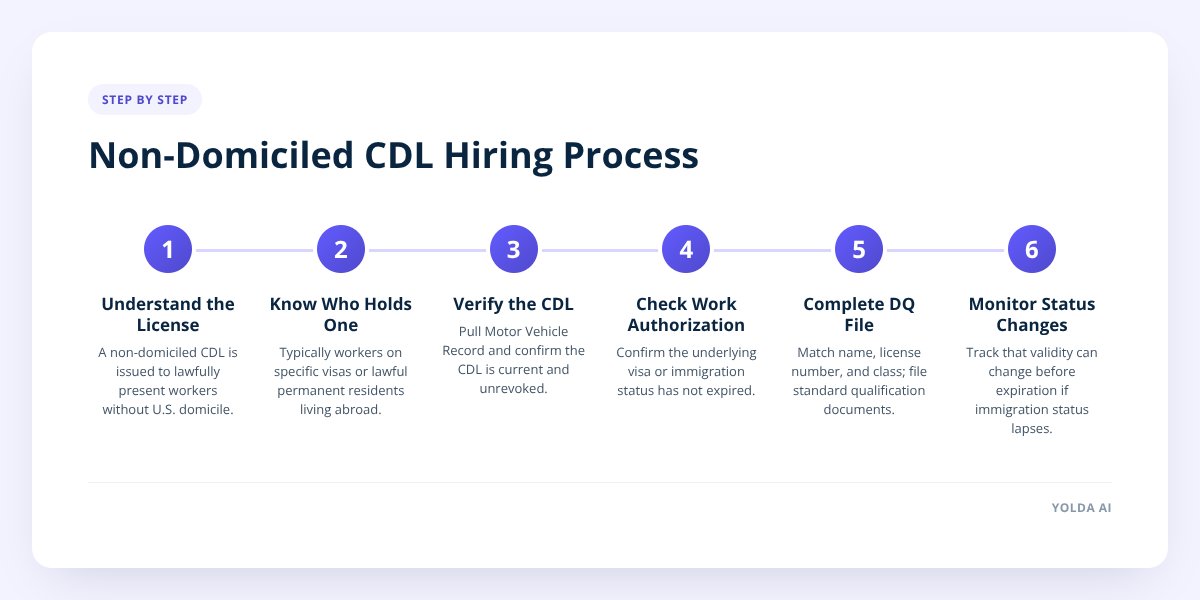
A carrier hiring a non-domiciled CDL holder must verify the same core items required for any CDL driver, plus confirm that the underlying work authorization is current and matches what the state used to issue the license. This isn't a separate hiring track — it's the standard driver qualification process under 49 CFR Part 391, with one added layer of documentation to check.
At minimum, that means:
- Pulling the driver's Motor Vehicle Record (MVR) directly from the licensing state, same as for any driver.
- Confirming the CDL itself is current and has not been suspended, revoked, or disqualified.
- Verifying the driver's medical certification is current and on file, per FMCSA medical certificate requirements.
- Confirming the work authorization document that underlies the non-domiciled CDL (the specific visa or status) has not expired.
- Checking that the name, license number, and class on the CDL match the driver's other identification exactly.
- Completing the standard driver qualification (DQ) file requirements — we cover what belongs in that file in Driver Qualification File.
Don't skip this: a non-domiciled CDL's validity can change before its printed expiration date if the holder's underlying immigration status changes. A carrier that only checks the card's expiration date and not the status behind it can end up with a driver operating on a CDL the state would no longer consider valid.
Has FMCSA published any specific action on non-domiciled CDLs?
Yes — FMCSA has publicly addressed non-domiciled CDLs in the context of license integrity and fraud enforcement, and carriers should check FMCSA's published guidance directly rather than rely on secondhand summaries, since enforcement actions and state-level compliance reviews are updated on FMCSA's own site. Because this is an area where federal and state rules intersect and get revisited, the safest practice for a hiring manager is to check the current status of a specific license with the issuing state's CDL verification system at the time of hire, not rely on what the license looked like at a previous job.
Here's how the verification responsibilities break down in practice:
| Check | Who verifies it | What confirms it |
|---|---|---|
| CDL validity and class | Carrier, via issuing state's MVR system | State-issued MVR record |
| Medical certification | Carrier, per DQ file requirements | Current medical examiner's certificate |
| Underlying work authorization | Carrier, at hire and on renewal | Valid immigration status document |
| CDL issuance standards | State licensing agency, under federal rules | 49 CFR Part 383 compliance |
| Driver safety history | Carrier, before and during employment | FMCSA Pre-Employment Screening Program (PSP) and MVR |
If a license's status is unclear or a state's online verification tool shows something inconsistent with the physical card, the carrier's safest move is to contact the issuing state's licensing agency directly before putting that driver behind the wheel.
What's different about onboarding these drivers versus a standard CDL hire?
The core onboarding steps are identical — the extra work is almost entirely in document tracking and renewal timing, not in the hiring process itself. A standard CDL might be good for four or five years depending on the state. A non-domiciled CDL's effective validity is often shorter, tied to the expiration of the visa or status document it was issued against, which means a carrier may need to recheck and refresh a DQ file more frequently for these drivers than for a typical domiciled hire.
That shorter renewal window is exactly the kind of date that's easy to lose track of in a spreadsheet or a paper file, especially across a fleet with mixed driver types. A missed expiration isn't just a compliance paperwork problem — it can mean a driver is legally unable to operate until the documentation is refreshed, which stops a load.
This is the kind of recurring compliance date that Yolda's safety and compliance tools are built to watch automatically — CDL, medical card, registration, insurance, and inspection dates are tracked with alerts before anything lapses, so a shorter renewal cycle on a non-domiciled CDL doesn't slip through during a busy dispatch week. You can see how that tracking works on the DOT compliance and safety page. For the hiring side itself — building the pipeline from job post through a qualified, seated driver — Yolda's hiring tools walk a candidate through the same qualification steps every driver needs, non-domiciled or not.
Checklist: hiring a non-domiciled CDL holder
- Pull the driver's MVR directly from the state that issued the CDL.
- Confirm the CDL class matches the vehicle and route the driver will run.
- Verify the medical certificate is current and matches FMCSA requirements.
- Confirm the underlying visa or immigration status document has not expired.
- Cross-check the name and license number across the CDL, MVR, and ID documents.
- Complete the standard driver qualification file, including PSP and safety history.
- Set a reminder for the earlier of the CDL expiration date or the status document's expiration date.
- Recheck the license status with the issuing state if anything on the card looks inconsistent.
If any part of a driver's history includes a prior out-of-service order, it's worth reading how FMCSA out-of-service orders affect hiring and compliance before finalizing the hire. And if the vehicle this driver will run falls near the CDL threshold itself, do you need a CDL to drive a box truck is worth checking too.
Ready to put compliance tracking on autopilot instead of a spreadsheet? Book a demo or start a free trial to see how Yolda keeps every driver's dates current.


