
Quick answer: A DOT drug test is a federally mandated urine test required for anyone holding a safety-sensitive commercial driving position, governed by Department of Transportation and Federal Motor Carrier Safety Administration rules under 49 CFR Part 382. Drivers get tested before they're hired, at random throughout the year, after certain accidents, when a supervisor suspects impairment, and before returning to duty after a violation. Every result and refusal gets reported to the FMCSA Drug and Alcohol Clearinghouse, which carriers must check before putting a driver behind the wheel.
Key takeaways
- DOT drug testing applies to anyone who drives a commercial motor vehicle requiring a CDL in interstate or intrastate commerce, per FMCSA regulations.
- There are five testing situations: pre-employment, random, post-accident, reasonable suspicion, and return-to-duty.
- Carriers must query the FMCSA Clearinghouse before hiring a driver and at least once a year for every driver already on staff.
- A verified positive result or a refusal to test goes into the Clearinghouse and can keep a driver out of any safety-sensitive job until they complete the return-to-duty process.
By the numbers
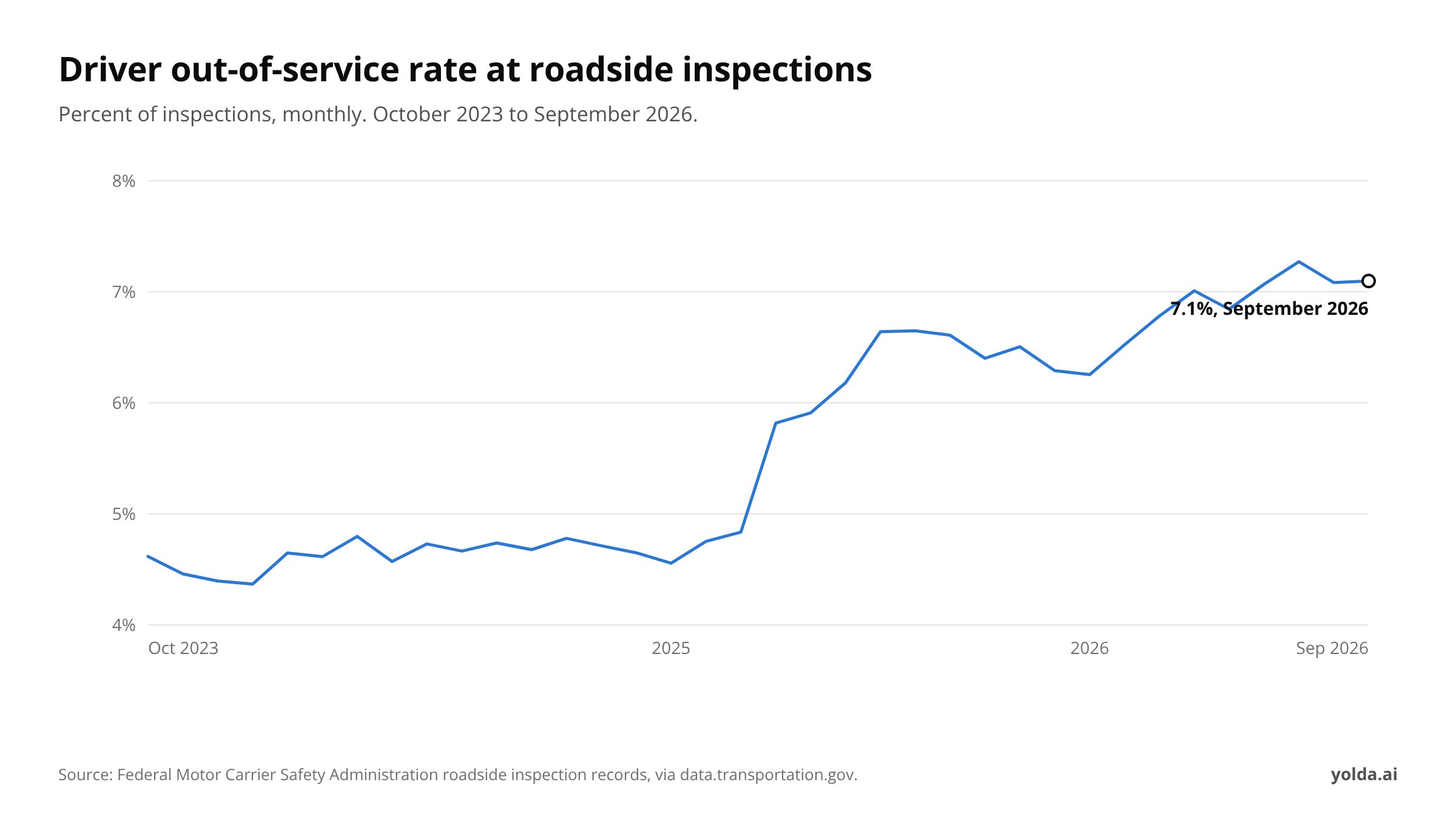
- The driver out-of-service rate at roadside inspections was 7.1% in September 2026, up 0.5 percentage points from a year earlier. Source: Federal Motor Carrier Safety Administration roadside inspection records, DOT open data.
Latest official data as of Oct 27, 2026.
What counts as a DOT drug test?
A DOT drug test is a urine screen that checks for a federally defined drug panel, done under strict chain-of-custody rules so the result holds up as evidence if challenged. The FMCSA requires it for anyone operating a commercial motor vehicle that needs a CDL — that includes most trucks and buses over 26,001 pounds, combinations over that weight, or vehicles carrying placarded hazardous materials.
The test isn't like a quick cup test at a walk-in clinic. It follows procedures set out in 49 CFR Part 40, administered by a certified collector, sent to a certified lab, and reviewed by a Medical Review Officer before the result becomes official. That review step matters — a driver taking a legitimate prescription gets a chance to explain it before a result is marked positive.
The standard panel tests for:
- Marijuana (THC)
- Cocaine
- Amphetamines and methamphetamines
- Opioids
- Phencyclidine (PCP)
Who actually has to take one?
Anyone in a "safety-sensitive function" under DOT rules has to take one — this covers CDL drivers, but FMCSA's testing authority also reaches mechanics who test-drive commercial vehicles and dispatchers in some roles tied to vehicle operation. The core group, though, is drivers: if you need a CDL to do the job, you're in the testing pool.
This applies whether the driver is full-time, part-time, or a lease operator running under someone else's authority. It doesn't matter if the company has one truck or five hundred. A sole owner-operator with their own authority still has to participate in a DOT-compliant random testing pool, usually through a third-party consortium, because FMCSA doesn't allow a company to test only itself with no outside check.
Don't skip this: a positive test or a refusal to test is not a private HR matter. FMCSA requires it to be reported to the Drug and Alcohol Clearinghouse, and a driver with an unresolved violation there is legally barred from safety-sensitive duty for any carrier until they finish the return-to-duty process.
When does testing happen? The five required situations
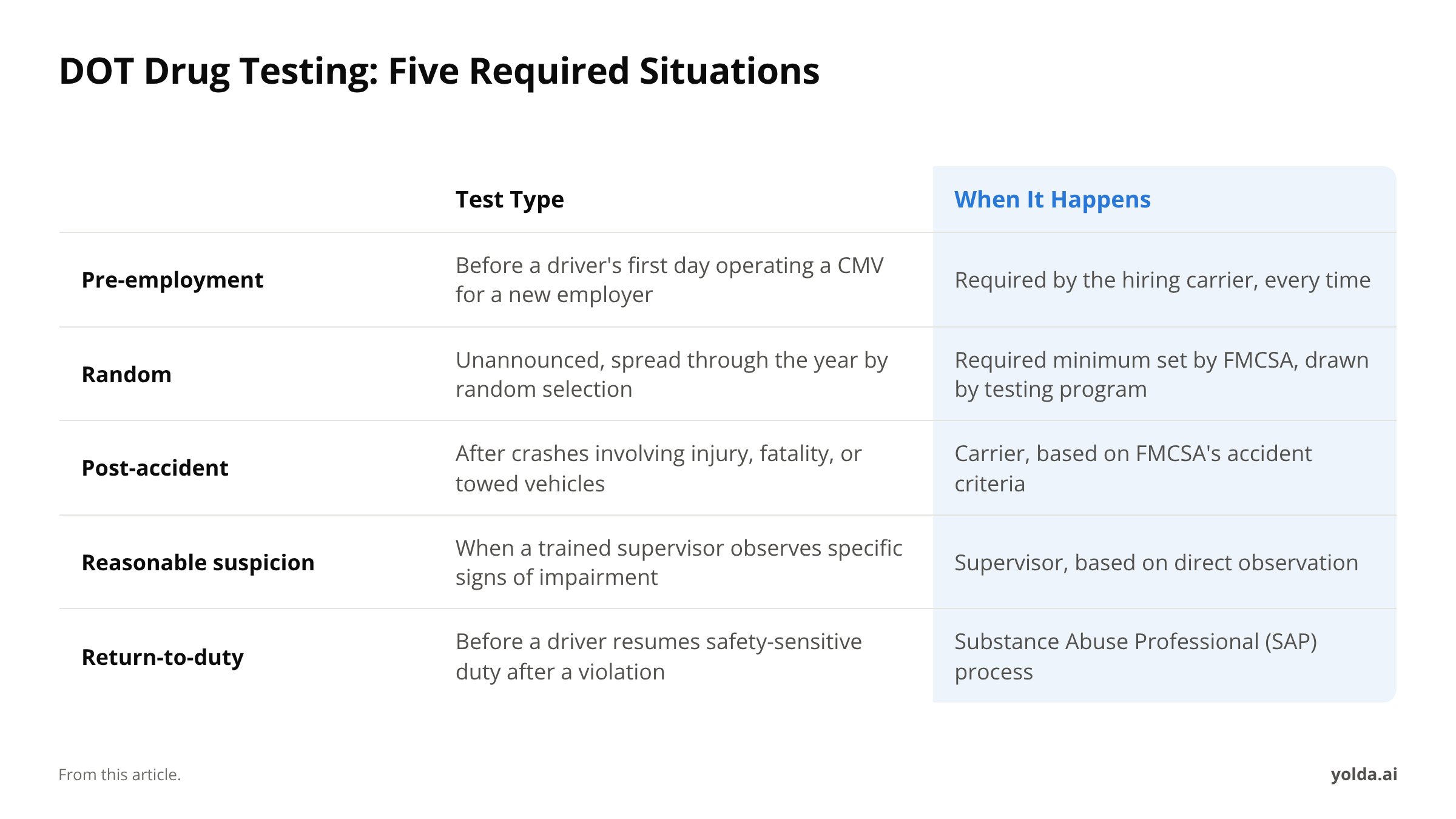
DOT testing isn't a once-a-year physical — it happens at five specific points, each with its own trigger.
| Test type | When it happens | Who decides |
|---|---|---|
| Pre-employment | Before a driver's first day operating a CMV for a new employer | Required by the hiring carrier, every time |
| Random | Unannounced, spread through the year by a random selection method | Required minimum selection rate set by FMCSA, drawn by the testing program |
| Post-accident | After certain qualifying crashes involving injury, fatality, or towed vehicles | Carrier, based on FMCSA's accident criteria |
| Reasonable suspicion | When a trained supervisor observes specific signs of impairment | Supervisor, based on direct observation |
| Return-to-duty | Before a driver resumes safety-sensitive duty after a violation | Substance Abuse Professional (SAP) process |
Pre-employment happens before a new hire ever turns a wheel for the company. A carrier can't let a driver haul a single load first and test later — the negative result has to be in hand first.
Random testing is the one that surprises drivers most, because there's no warning and no pattern. FMCSA sets a minimum annual percentage of the driver pool that must be tested, and carriers (or their consortium) pull names using a method that gives every driver an equal chance each time, regardless of whether they were tested last month.
Post-accident testing applies only when a crash meets specific FMCSA criteria — generally involving a fatality, a citation plus an injury requiring medical treatment away from the scene, or a citation plus a vehicle towed from the scene. Not every fender-bender triggers it; the criteria are specific, and carriers should confirm against FMCSA's definitions rather than testing reflexively or skipping it when it's actually required.
Reasonable suspicion relies on trained observation, not a hunch. A supervisor has to document specific, contemporaneous signs — slurred speech, odor, erratic behavior — and that training is itself a DOT requirement, not optional judgment.
Return-to-duty testing comes at the end of a mandatory process after a violation, which we'll cover next.
What happens after a positive result or a refusal?
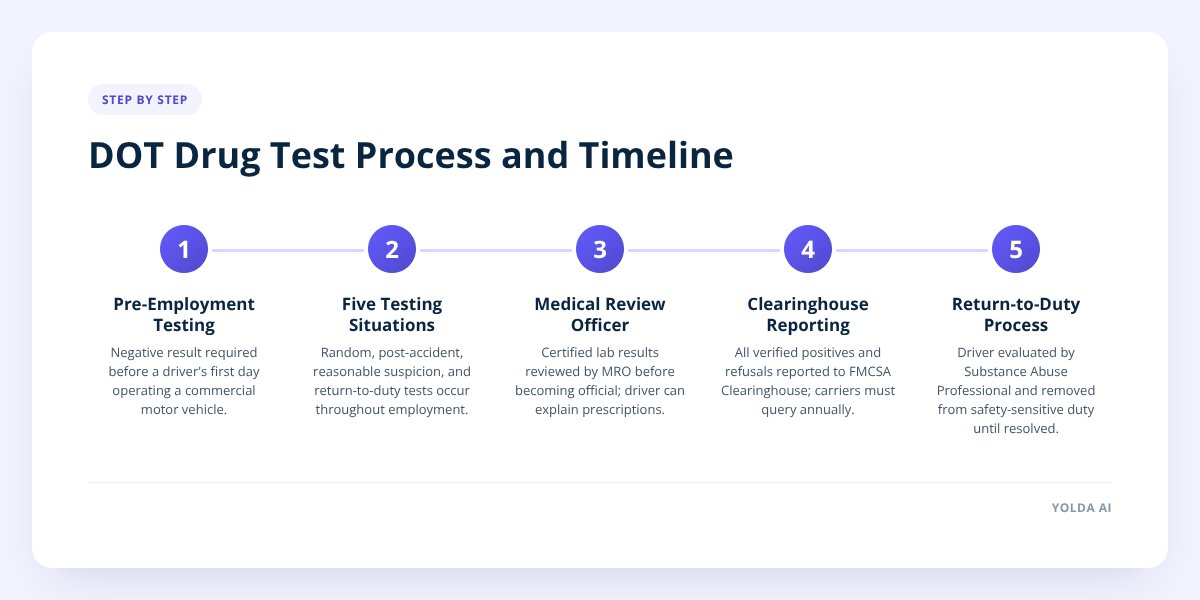
A verified positive test or a refusal doesn't just mean a bad day — it means the driver is removed from all safety-sensitive functions immediately, for every employer, until they complete a federally defined return-to-duty process. That process starts with an evaluation by a Substance Abuse Professional (SAP), a credentialed evaluator who determines what treatment or education the driver needs before testing can resume.
The sequence looks like this:
- Driver is removed from safety-sensitive duty the moment the violation is confirmed.
- Driver completes a SAP evaluation, which recommends a treatment or education plan.
- Driver completes that plan and the SAP confirms compliance.
- Driver takes a return-to-duty test, observed directly, with a negative result required.
- Driver is subject to a follow-up testing plan — at least six tests in the first year — set by the SAP.
Until every step is finished and documented, no carrier can legally put that driver back behind the wheel, and the FMCSA Clearinghouse will show the violation as unresolved to any carrier that checks.
What is the FMCSA Clearinghouse, and why does it matter to hiring?
The FMCSA Drug and Alcohol Clearinghouse is a national database that tracks every DOT drug and alcohol violation for every CDL holder, and carriers are legally required to query it before hiring and at least annually for current drivers. Before the Clearinghouse existed, a driver with a positive test at one carrier could often just apply somewhere else and the new employer would never know unless they called around. The database closed that gap.
For a hiring carrier, this means two separate obligations:
- Run a full query on any driver before letting them perform a safety-sensitive function.
- Run a limited annual query on every current driver, at least once every twelve months.
A driver who shows up in the Clearinghouse with an unresolved violation can't legally be put on the road, no matter how good the interview went. We covered how these restrictions interact with hiring decisions in how FMCSA out-of-service orders affect hiring and compliance, and the same logic applies to a driver still working through the return-to-duty process.
Keeping track of which drivers need a Clearinghouse query, when their last one happened, and whether any flags came back isn't a one-time task — it's an ongoing part of a driver qualification file that also needs to track CDL status, medical card expiration, and MVR history. We go deeper on what belongs in that file in the driver qualification file guide. Carriers running this manually on a spreadsheet often find out about a problem only when a roadside inspection or an audit surfaces it — FMCSA's own roadside inspection data shows the driver out-of-service rate sitting at 7.1% as of September 2026, and a lapsed or unresolved drug and alcohol record is exactly the kind of thing that shows up in that number.
This is the point where a dedicated compliance system earns its keep. Yolda's safety and compliance tools watch CDL, medical card, registration, insurance, and inspection dates automatically and alert a fleet before something lapses — the same kind of date-tracking discipline that keeps a Clearinghouse query from falling through the cracks between hiring and the next annual check. See how it works on the DOT compliance and safety page.
How does this fit into a fleet's broader compliance routine?
Drug testing is one piece of a larger compliance calendar, not a standalone task that lives in a filing cabinet. A fleet that treats pre-employment testing, random selection, and annual Clearinghouse queries as separate one-off chores tends to miss deadlines, because each has a different trigger and a different frequency.
Building all of it — DQ file renewals, medical card expirations, testing windows, Clearinghouse checks — into one running schedule is the more reliable approach. We laid out exactly how to do that in how to build a DOT compliance calendar for your fleet, which covers the recurring dates a safety manager actually needs to track across a full year.
If a driver is also coming up on a medical card renewal around the same time as a random test cycle, it helps to know what triggers that expiration too — we broke that down separately in DOT medical card: what it is and when it expires.
Ready to stop tracking drug testing deadlines and Clearinghouse queries by hand? Yolda is built for DOT-regulated fleets of any size, from a single truck to a thousand, with compliance tracking built into the same platform as dispatch, settlements, and hiring. Book a demo or start a free trial to see it running against your own fleet's dates.
Checklist: Staying ahead of DOT drug testing requirements
- Confirm every CDL driver is enrolled in a compliant random testing pool before their first day.
- Run a full Clearinghouse query on any new hire before they perform a safety-sensitive function.
- Schedule an annual limited Clearinghouse query for every current driver.
- Train supervisors to document reasonable-suspicion observations the moment they happen.
- Review FMCSA's post-accident criteria so you test when required and skip it when not.
- Remove any driver with a positive result or refusal from safety-sensitive duty immediately.
- Connect drivers in the return-to-duty process with a qualified Substance Abuse Professional.
- Track each driver's follow-up testing schedule after a return-to-duty violation.

