
Quick answer: A DOT medical card, officially a Medical Examiner's Certificate, proves a commercial driver meets federal health standards to operate safely under the Federal Motor Carrier Safety Administration. Most drivers must renew it every 24 months, though some need renewal every 12 months or sooner based on a health condition. Once it expires, the driver is not legally qualified to drive — and the carrier is responsible for keeping them off the road until a new certificate is on file.
Key takeaways
- A DOT medical card, issued after an exam by a certified medical examiner, is valid for up to 24 months under FMCSA rules, but examiners can issue shorter certificates — 12 months, 6 months, even 3 months — for conditions like high blood pressure or diabetes that need monitoring.
- Driving with an expired medical card makes a driver medically unqualified under 49 CFR 391.41, and a roadside inspection that catches it typically places the driver out of service on the spot.
- Carriers must keep a current certificate in each driver's qualification file per 49 CFR 391.51, and missing or expired certificates are one of the most common findings in FMCSA compliance reviews.
- Yolda tracks medical card expiry dates automatically alongside CDL, registration, and insurance dates, flagging them before they lapse.
What exactly is a DOT medical card?
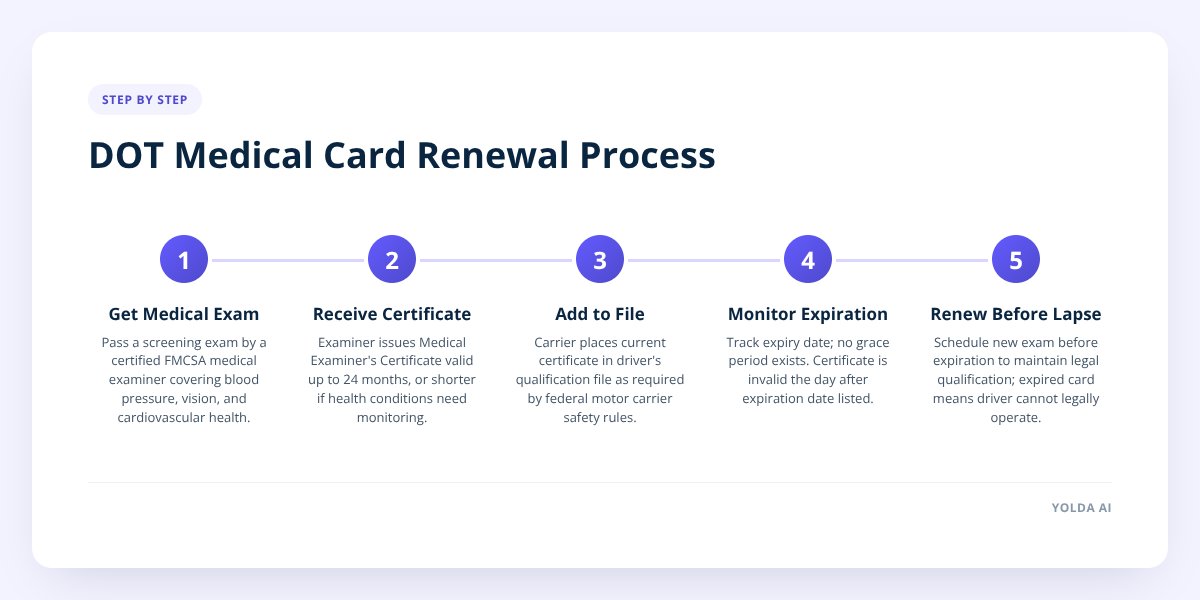
A DOT medical card is the paper or digital certificate a driver gets after passing a physical exam confirming they're fit to operate a commercial motor vehicle. The official name is the Medical Examiner's Certificate, often shortened to MEC, and it's issued by a provider listed on the National Registry of Certified Medical Examiners, a database the FMCSA maintains specifically for this purpose.
The exam checks things like blood pressure, vision, hearing, and general cardiovascular and neurological health. It's not a deep physical — it's a screening meant to catch conditions that could cause a driver to lose control of a truck, like uncontrolled seizures, severe sleep apnea, or blood pressure high enough to risk a stroke behind the wheel.
Once a driver passes, the examiner records the results in the FMCSA's electronic system and gives the driver a certificate. That certificate, or proof that it's on file, becomes part of the driver's qualification file, the folder every motor carrier must keep for every CDL driver it employs under 49 CFR 391.51.
Who actually needs one?
Any driver operating a commercial motor vehicle in interstate commerce needs a current medical card — this isn't limited to drivers hauling freight across state lines in an 18-wheeler. The threshold is about the vehicle and the kind of commerce, not just whether the driver holds a CDL.
Generally, you need a medical certificate if you drive a vehicle that:
- Has a gross vehicle weight rating, gross combination weight rating, gross vehicle weight, or gross combination weight of 10,001 pounds or more, used in interstate commerce
- Is designed or used to transport 16 or more passengers, including the driver, regardless of pay
- Is used to transport hazardous materials in a quantity requiring placarding
That last point matters for owner-operators and smaller fleets who assume medical cards are only a "big truck" requirement. A driver running a non-CDL box truck or a hot shot rig in interstate commerce can still need one, depending on weight. We cover the related weight thresholds for CDL classification in how to start a box truck business and what is hot shot trucking, since drivers frequently confuse "do I need a CDL" with "do I need a medical card" — they're governed by different rules and don't always line up.
Intrastate-only drivers sometimes fall under state rules instead of federal ones, and those vary. If a driver never crosses a state line, the carrier should confirm the applicable state's medical certification requirement rather than assume federal rules apply.
How long does a DOT medical card actually last?
Up to 24 months, but the medical examiner decides the exact length based on the driver's health, and plenty of drivers get less. Here's how the FMCSA structures it:
| Situation | Typical certificate length |
|---|---|
| Driver in good health, no flagged conditions | Up to 24 months |
| Controlled high blood pressure | Often 12 months |
| Diabetes managed with insulin or medication | Often 12 months, sometimes shorter |
| Certain cardiac or sleep apnea monitoring cases | 3 to 6 months, examiner's discretion |
| Vision or hearing requiring a waiver | Varies by waiver terms |
The examiner writes the expiration date directly on the certificate and enters it into the National Registry. There's no grace period built into the rule — the certificate is valid through its listed date and not one day longer.
Don't skip this: a driver is not legally qualified to operate a commercial motor vehicle on the day after their medical card expires, even if nothing else about their health has changed. There's no buffer, and "I forgot to schedule the exam" is not a recognized exception under 49 CFR 391.41.
What happens when a driver's medical card expires?
The driver becomes medically unqualified to drive, immediately, and must stop operating until a new certificate is issued. This isn't a paperwork technicality — FMCSA regulation 49 CFR 391.41 is explicit that a person is not qualified to drive a commercial motor vehicle unless they're medically certified, and an expired certificate means they're not certified.
For the driver, the practical consequences show up fast:
- Roadside inspections. If a driver is stopped for a Level 1, 2, or 3 inspection and the medical card has lapsed, the inspector can place the driver out of service immediately, per FMCSA inspection procedures.
- No legal driving in the meantime. The driver can't legally operate until they complete a new exam and the certificate is on file — there's no way to "cover" an expired card temporarily.
- A gap on record. An out-of-service violation or a lapse discovered during a file review becomes part of the driver's record and can affect future hiring or insurance underwriting.
For the carrier, the exposure is bigger than one driver's inconvenience:
- CSA score impact. A driver operating on an expired medical card and getting caught in an inspection generates a violation that affects the carrier's CSA scores under FMCSA's Compliance, Safety, Accountability program, specifically in the Driver Fitness category.
- Compliance review risk. Missing or expired medical certificates are a frequent finding in FMCSA audits, and a pattern of lapses across multiple drivers can suggest a systemic qualification file problem — the kind of thing that draws closer scrutiny.
- Liability if there's a crash. If a driver with an expired certificate is involved in an accident, the carrier's defense gets considerably harder, since it can look like the carrier wasn't actively managing driver qualification.
The carrier's obligation here isn't passive. Under 49 CFR 391.51, the motor carrier must maintain a qualification file containing a current medical certificate for each driver — "current" being the key word. A carrier that lets a card lapse without catching it has failed that requirement, regardless of whether the driver mentioned it.
How should a fleet actually track these dates?
The honest answer: a spreadsheet works until it doesn't, and the gap usually opens up during a busy dispatch week when nobody's looking at expiration dates. Medical cards aren't the only date a safety manager is tracking — CDL expirations, registration renewals, insurance certificates, and annual inspections all compete for the same attention, and they don't expire on a predictable shared schedule.
A practical system needs three things: a single place where every driver's dates live, an alert that fires before the deadline rather than after, and a way to confirm the new certificate actually made it into the file once the driver renews. We go deeper on building that kind of system in how to build a DOT compliance calendar for your fleet.
This is also where manual tracking tends to fail at scale. A fleet with five drivers can keep medical card dates in someone's head. A fleet with fifty can't, and the risk of a missed renewal climbs with every truck added. Yolda tracks CDL, medical card, registration, insurance, and inspection dates automatically and sends alerts before one lapses, so a safety manager isn't relying on memory or a shared spreadsheet to catch an expiration before it becomes a roadside out-of-service order. You can see how that compliance tracking works on the safety and compliance page.
What should a driver do before the expiration date hits?
Schedule the renewal exam at least a few weeks before the current certificate expires, not the week of. Finding a certified examiner, getting an appointment, and — if a health condition is being monitored — potentially needing follow-up documentation all take time, and none of it compresses well under deadline pressure.
A simple pre-renewal routine:
- Check the expiration date printed on the current medical card now, not when it's close.
- Find a medical examiner listed on the FMCSA's National Registry of Certified Medical Examiners.
- Schedule the exam at least two to three weeks ahead of the expiration date.
- Bring a list of current medications and any relevant medical history to the exam.
- Confirm with dispatch or the safety department once the new certificate is issued, so the qualification file gets updated right away.
- Ask the carrier to confirm the new date is logged in whatever system tracks compliance deadlines.
For carriers, the equivalent routine is making sure every driver's date is visible somewhere central, with enough lead time built into the alert that there's room to reschedule if the first available exam slot is two weeks out.
Keeping drivers on the road legally is the whole point of a system like Yolda — one place to manage dispatch, compliance dates, settlements, and the driver app without juggling five disconnected tools. If a compliance gap like an expired medical card has slipped through before, it's worth seeing how automated date tracking closes that gap. Book a demo at yolda.ai/demo or start a free trial at yolda.ai/signup.
Checklist: renewing a DOT medical card before it expires
- Check the expiration date on the current certificate today.
- Search the FMCSA National Registry for a certified medical examiner near you.
- Book the exam appointment at least two to three weeks before expiration.
- Gather a current medication list and relevant medical records for the exam.
- Complete the exam and receive the new certificate.
- Submit the new certificate to your carrier's safety or compliance office immediately.
- Confirm the new expiration date is logged in the driver qualification file.
- Verify the old, expired certificate is removed from active driving records.


