
Quick answer: A freight broker is a licensed middleman who finds loads for carriers and finds carriers for shippers, without ever touching the freight itself. The shipper pays the broker, the broker keeps a cut — usually somewhere between 10% and 25% of the load, though this varies widely by lane and broker — and pays the carrier the rest based on the rate confirmation both sides sign. Brokers are not dispatchers: a broker works for the shipper's freight, a dispatcher works for your truck.
Key takeaways
- Freight brokers must hold Federal Motor Carrier Safety Administration (FMCSA) broker authority and carry a $75,000 surety bond or trust fund, per 49 CFR 387.307.
- The broker's cut, often called the "spread," is not disclosed to the carrier under standard industry practice — you see your rate, not the shipper's rate.
- A rate confirmation is a binding contract the moment both parties sign it; mismatches between it and the bill of lading cause most broker-carrier payment disputes.
- A dispatcher works for you and your trucks; a broker works for the freight and has no obligation to get you the best rate on your next load.
What does a freight broker actually do?
A freight broker connects a shipper who has freight to move with a carrier who has a truck and open capacity, and handles the paperwork and payment in between. The shipper never talks to the carrier directly in most broker-arranged freight — the broker is the point of contact for both sides.
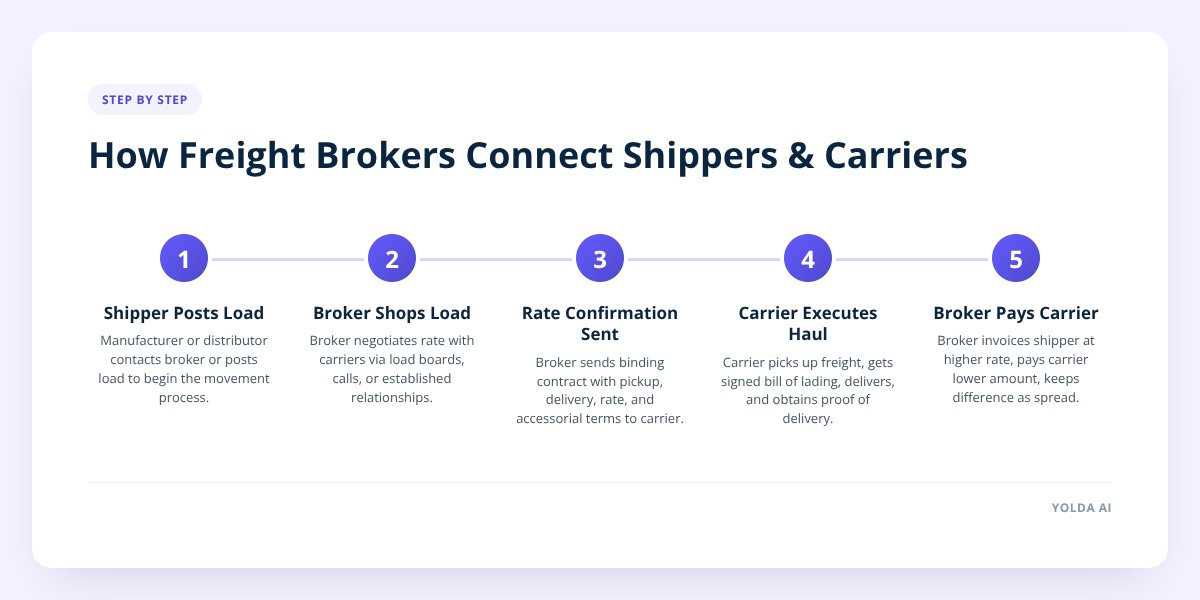
Here's the typical flow on a single load:
- A shipper (a manufacturer, distributor, or retailer) has a load ready and posts it or calls a broker they work with.
- The broker shops that load to carriers — through a load board, a phone call, or an established relationship — and negotiates a rate.
- Once a carrier agrees, the broker sends a rate confirmation spelling out pickup and delivery details, the agreed rate, and any accessorial terms.
- The carrier hauls the load, gets a signed bill of lading at pickup and a proof of delivery at drop-off.
- The carrier invoices the broker (or sends the paperwork for the broker to invoice), and the broker pays the carrier per the rate confirmation's payment terms.
- The broker separately invoices the shipper for a higher amount and keeps the difference.
The broker never owns a truck and never touches the freight. According to the FMCSA, a broker "arranges for the transportation of property by an authorized motor carrier for compensation" — the legal definition hinges entirely on that arranging role, not on any physical handling of goods.
How does a freight broker get paid?
The broker gets paid by the shipper, then pays the carrier a lower amount, keeping the difference as their fee. That difference is called the spread, and it's the broker's main business model — there's usually no separate "broker fee" line item you'll ever see as a carrier.
A rough example: a shipper agrees to pay a broker $3,000 to move a load from Chicago to Atlanta. The broker posts that load to carriers at $2,400. A carrier takes it, hauls it, and gets paid $2,400. The broker keeps $600 — a 20% spread in this case.
You as the carrier almost never see the shipper-side number. You only know your own rate, which is why comparing rates across brokers and lanes matters more than trying to guess anyone's margin. This is also why relationships with brokers who pay fair and pay fast tend to matter more over time than chasing the single highest-posted rate.
Payment terms vary broker to broker:
| Payment option | Typical timing | Trade-off |
|---|---|---|
| Standard terms | 30–45 days after delivery | No fee, but ties up cash flow |
| Quick pay | 24–48 hours after paperwork submitted | Usually a 1–4% discount off the rate |
| Factoring (carrier-side) | 24–48 hours, broker pays as normal | Carrier sells the invoice to a factoring company for a fee |
Quick pay programs are run by the broker directly. Factoring is a separate arrangement the carrier sets up with a third-party factoring company — the broker just pays the factor instead of paying you.
Freight broker vs. dispatcher: what's the real difference?
A freight broker works for the shipper's freight; a dispatcher works for your trucking company. That's the one-sentence version, but it matters because it changes who's looking out for your interests.
- A freight broker's job is to move a specific load for a specific shipper at the best price the market allows. They have no ongoing obligation to find you your next load, and they're not thinking about your empty miles home or your weekly revenue target.
- A dispatcher's job is to keep your trucks loaded and running profitably over time. A good dispatcher — whether an employee, a contracted dispatch service, or you doing it yourself — is working across multiple brokers and shippers to string together lanes that make sense for your equipment and your drivers.
A dispatcher is often the one dealing with brokers on your behalf: finding loads on load boards, negotiating rates, booking the freight, and then handing the rate confirmation to you or your back office to execute. Some owner-operators are their own dispatcher. Larger fleets usually have a dedicated dispatch function, whether in-house or an outsourced dispatch service.
This distinction gets confusing because some people use "broker" and "dispatcher" loosely in conversation, but they are legally and functionally different roles. A dispatch service working on your behalf does not need FMCSA broker authority, because they're not arranging transportation for a shipper — they're representing your carrier operation.
If your dispatch process still runs on phone calls, texts, and a whiteboard, it gets harder to track which loads came from which broker, what each one actually paid, and whether a lane is worth running again. A system like Yolda's dispatch tool handles this by reading a rate confirmation the moment it comes in — pulling the rate, stops, and reference numbers into a load draft automatically, so a dispatcher just reviews and approves instead of retyping everything by hand.
What is a rate confirmation, and why does it matter so much?
A rate confirmation (often called a "rate con") is the document a broker sends once a load is booked, and it's the single most important piece of paper in the whole transaction. It spells out exactly what was agreed to — and once both sides sign it, it functions as a binding contract.
A standard rate confirmation includes:
- Pickup and delivery addresses, dates, and time windows
- The agreed rate, broken into base rate and any accessorials (fuel surcharge, detention, layover)
- Reference numbers (PO numbers, load numbers, broker's internal ID)
- Equipment type required (dry van, reefer, flatbed, etc.)
- Weight, commodity, and any special handling instructions
- Payment terms and who to send the invoice to
- Broker's contact information and MC number
Don't skip this: read every line of the rate confirmation before you sign and before you dispatch a truck to pick up. Verbal agreements on rate or detention terms don't hold up if they contradict what's written on the signed rate con — the document is what gets referenced if there's a payment dispute later.
A common and avoidable mistake is dispatching a driver based on a phone call rate, then discovering the written rate confirmation that shows up an hour later lists a different number or different accessorial terms. Always confirm the written document matches what you agreed to verbally before the truck rolls.
If you want to see what a complete one looks like before you're staring at a real one for the first time, Yolda has a free rate confirmation template you can use as a reference.
Do you need a broker, or can you book freight directly with shippers?
Both are legitimate ways to find freight, and most carriers use a mix of both over time. Direct shipper relationships (sometimes called "direct freight") cut out the broker's spread entirely, but they take longer to build and usually require more consistent capacity than a single truck can offer.
- Working with brokers gets you access to a much larger volume of available freight, especially useful for owner-operators and small fleets filling gaps in their schedule or covering lanes they don't run often.
- Direct shipper relationships typically pay better per load since there's no broker spread, but shippers generally want proven reliability and often prefer carriers who can commit to regular volume.
- A mix of both is how most established carriers operate — direct freight for their core lanes, brokered freight to fill in around it.
None of this changes the fact that every load, broker or direct, still needs the same paperwork trail: a signed agreement, a bill of lading, a proof of delivery, and a clean invoice. A messy paper trail is just as costly on a direct-shipper load as it is on a brokered one — it's the thing that turns a profitable load into a collections headache either way.
Keeping broker relationships organized — which ones pay fast, which lanes are actually profitable after the spread and your costs, which rate confirmations are still outstanding — gets hard fast once you're running more than a truck or two off spreadsheets and texts. Yolda is built to run that whole operation from one place: book a demo to see how rate confirmations turn into organized, trackable loads instead of a pile of PDFs.
Checklist: working a brokered load from booking to payment
- Confirm the broker's MC number and authority status before booking a new relationship.
- Get the rate, accessorials, and payment terms in writing before dispatching a driver.
- Compare the written rate confirmation against the verbal agreement line by line.
- Collect a signed bill of lading at pickup and a proof of delivery at drop-off.
- Submit your invoice and paperwork promptly to avoid payment delays.
- Track which broker you booked through, the agreed rate, and the payment due date.
- Note which brokers consistently pay on time versus which routinely run late.
- Flag any discrepancy between the rate confirmation and your invoice before you send it.


