
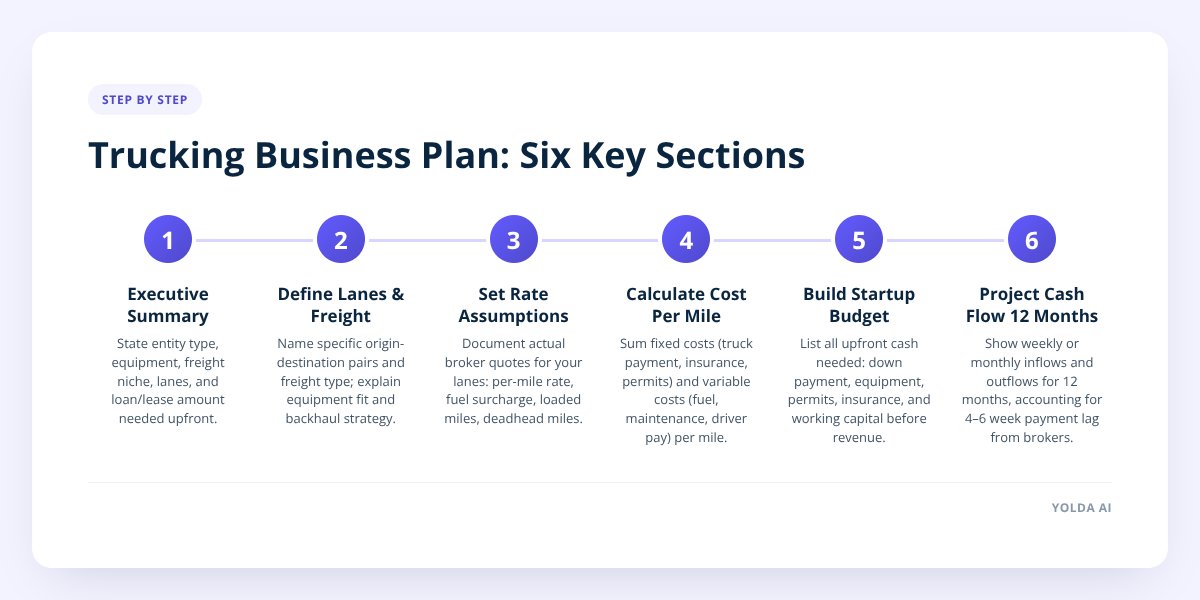
Quick answer: A trucking company business plan needs six working parts — executive summary, target lanes and freight type, rate assumptions, cost per mile, a startup budget, and a cash flow projection that covers the gap before your first invoices get paid. Lenders and leasing companies read the cost-per-mile and cash flow sections hardest, because those two numbers show whether you can survive a slow first quarter, not just whether the idea sounds reasonable. Skip the generic filler and build each section around real numbers from your own lanes and quotes.
Key takeaways
- A trucking business plan lives or dies on two numbers: your all-in cost per mile and how many weeks of expenses you can cover before your first factoring or broker payment lands.
- Most freight brokers pay on 30-day terms unless you use factoring, so plan for at least four to six weeks of cash outlay before revenue arrives, longer if you don't factor.
- Lenders and equipment lessors typically want 12 months of projected cash flow, not just a one-page summary, according to standard SBA loan application guidance.
- This is a planning template, not a step-by-step startup guide — for authority, insurance, and registration steps, see how to start a trucking company.
What goes in the executive summary
The executive summary answers one question: what is this business, and why will it make money. Keep it to half a page and write it last, after you've worked out the numbers in the rest of the plan.
A strong executive summary for a trucking company states:
- Entity type and authority status — LLC or corporation, and whether your MC/USDOT authority is active or pending
- Equipment — how many trucks and trailers, owned or leased, and what type (dry van, reefer, flatbed, box truck)
- Freight niche — what you haul and for whom (dedicated lanes, spot market, a specific shipper)
- Lanes — the regions or corridors you plan to run
- The ask — if this plan supports a loan or lease application, state the amount and what it funds
If you're writing this plan to open a bank account, apply for a truck loan, or bring on a partner, say that up front. Lenders skim the executive summary first and decide in about thirty seconds whether to keep reading the rest of the document.
How do you define your lanes and freight type in a business plan?
You define lanes by naming the actual origin-destination pairs or regions you intend to run, plus the freight type, not just "regional" or "over the road." A lender or broker partner wants to see that you've thought about specific freight, because that's what determines your rates, your deadhead, and your fuel burn.
For example, instead of writing "we will run freight in the Midwest," write something closer to: "dry van loads between Chicago, IL and Indianapolis, IN and Columbus, OH, targeting dedicated or recurring lane freight with 1–2 regional brokers and direct shippers."
This section should also cover:
- Equipment fit — does your trailer type match the freight you're targeting (reefer for produce, flatbed for steel, box truck for last-mile)
- Backhaul plan — how you'll avoid running empty on the return leg, since deadhead miles cost the same fuel and wear without paying a rate
- Seasonality — if your freight type has slow months (produce in winter, construction materials in freeze season), say so and plan cash flow around it
If you're still deciding between freight types or entity structures entirely, the broader overview in how to start a trucking company walks through authority, insurance, and registration — this plan assumes you're past that and building the financial case.
What rate assumptions should you use?
Use real rates you've actually been quoted or can document from brokers and load boards in your target lanes — never a rate you hope to get. Pull a handful of actual rate confirmations or broker quotes for your specific lanes and freight type, and average them conservatively.
If you don't have rate history yet, call two or three brokers who work your target lanes and ask what they're currently paying for that freight type. Write down the per-mile rate, not a lump sum, so it's comparable across loads of different lengths.
Document for each lane:
- All-in rate per mile (what the broker or shipper pays, loaded miles only)
- Fuel surcharge, if quoted separately from the base rate
- Typical loaded miles per load for that lane
- Expected deadhead miles getting to pickup or after delivery
Don't skip this: a rate that looks good per load can still lose money once you factor in deadhead, fuel, and the wait time between loads. Run your numbers against your cost per mile, not against the rate alone, before you commit a truck to a lane.
Once you have a rate confirmation in hand, knowing exactly what should be on it — and what to double-check before you sign — matters just as much as the number itself; see what's in a rate confirmation and what to check first.
How do you calculate cost per mile for the plan?
Your cost per mile is every dollar it costs to run a truck one mile, divided across fixed costs (truck payment, insurance, permits) and variable costs (fuel, maintenance, tires, driver pay). This is the single number lenders scrutinize hardest, because it tells them whether your rate assumptions above actually produce a profit.
Cost per mile has two buckets:
| Cost type | Examples | Changes with miles driven? |
|---|---|---|
| Fixed | Truck/trailer payment, insurance premiums, permits, ELD subscription | No — same cost whether you drive 500 or 5,000 miles |
| Variable | Fuel, driver pay (if per-mile), maintenance, tires, tolls | Yes — scales directly with miles run |
Add both buckets together and divide by your projected monthly miles to get a true all-in cost per mile. Most new operators underestimate maintenance and overestimate how many miles they'll actually run in the first few months, so build in a cushion on both sides.
Rather than build this spreadsheet from scratch, run your numbers through Yolda's free cost per mile calculator — it's a faster way to land on a defensible number for the plan than guessing at line items one by one. Whatever number you get, compare it against the rate assumptions from the section above. If your cost per mile is close to or above your average rate per mile, the lane doesn't work and the plan needs a different lane, different equipment, or a different rate target before you present it to a lender.
What belongs in the startup budget?
The startup budget lists every one-time and first-month cost required to put a truck on the road, separate from your ongoing cost per mile. Lenders want this itemized, not summarized as "startup costs: $X," because they're checking whether you've actually accounted for everything.
A reasonably complete startup budget includes:
- Truck and trailer — down payment or purchase price, or first lease payment
- Authority and registration — USDOT/MC application fees, IRP and IFTA registration, state permits
- Insurance — first premium payment or deposit for primary liability, cargo, and physical damage coverage
- ELD and compliance tools — device cost and first month's subscription
- Factoring setup, if you plan to use it, including any application or reserve requirements
- Fuel reserve — enough diesel budget to run the first week or two before any revenue lands
- Working capital buffer — cash set aside specifically to cover the gap addressed in the next section
Don't guess at exact dollar figures for your region's insurance premiums, permit fees, or fuel costs — get current quotes from your insurance agent, your state's IRP/IFTA office, and local diesel prices, and put those real numbers in the plan. A lender can usually tell when a startup budget was copied from a template versus built from actual quotes.
How much cash do you need before the first payment arrives?
You typically need enough cash to cover four to six weeks of operating expenses before your first freight payment lands, longer if you're not using factoring. This gap is the single most common reason new trucking companies run into trouble in their first ninety days, and it's the section most lenders read right after cost per mile.
Here's why the gap exists: you deliver a load, submit the paperwork, and then wait. Most brokers pay on standard 30-day terms unless you've arranged factoring, where a factoring company advances most of the invoice value within a day or two for a fee. Either way, your truck payment, insurance, fuel, and driver pay (if you have one) don't wait for that invoice to clear.
Your cash flow projection should show, month by month for at least the first 12 months:
- Projected loads and revenue based on your lane and rate assumptions
- Fixed costs due that month regardless of how much you ran
- Variable costs tied to actual projected miles
- Payment timing — when you expect each invoice to actually convert to cash, not when you billed it
- Running cash balance — the number that tells you if you'll be short in month two even though month four looks fine
This is also where your bookkeeping system earns its keep once you're operational — matching invoices to actual payments received, flagging a load that's gone 45 days without payment, and keeping a real-time view of your cash position rather than finding out at month-end. Yolda's accounting tools handle invoicing and the books side of this so the plan's projections and your actual numbers stay connected after you're running loads, not just on paper before you start.
If the 12-month projection shows a cash shortfall in any month, that's not a flaw in the plan — it's the plan doing its job. Either adjust your startup budget to cover that gap, reduce planned truck count in month one, or build in a factoring relationship from day one instead of waiting for a payment crunch to force it.
Getting the plan in front of a lender
Once the numbers are built, keep the written plan itself short — most lenders and leasing companies read a trucking plan in under ten minutes, and a tight eight-to-twelve page document with clear numbers beats a thirty-page narrative every time. Lead with the executive summary and the cash flow table; those two sections usually decide whether they read the rest closely.
If you haven't yet worked through authority, insurance, and the registration sequence that this plan assumes is already underway, Yolda's guide to how to start a trucking company covers that ground step by step. This plan is meant to sit alongside it, not repeat it — use that post for the startup sequence and this one for the numbers a lender will actually press you on.
When you're ready to put the dispatch, invoicing, and settlement side of the business on one system instead of spreadsheets, book a demo or start a free trial to see how it fits a fleet your size.
Checklist: Build your trucking business plan
- Write a half-page executive summary stating entity type, equipment, freight niche, and your ask.
- Name your target lanes by actual origin-destination pairs, not general regions.
- Call two or three brokers in your lanes to confirm current per-mile rates before writing them down.
- Calculate your all-in cost per mile using the cost per mile calculator.
- Compare your cost per mile against your rate assumptions for every lane — cut any lane that doesn't clear it.
- Itemize every startup cost with real quotes, not estimates, from insurance, permit, and ELD providers.
- Build a 12-month cash flow table showing projected revenue, costs, and payment timing month by month.
- Flag any month where the running cash balance goes negative and adjust the budget or financing plan.


