
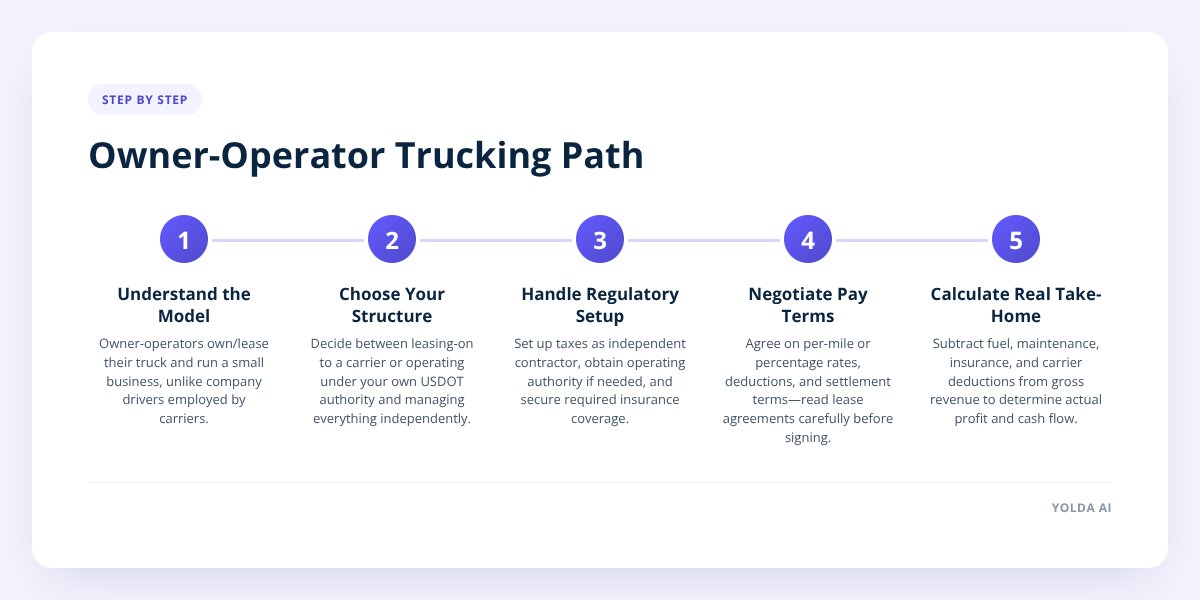
Quick answer: An owner-operator is a truck driver who owns or leases the truck they drive, rather than driving a truck their employer owns. The core difference from a company driver is risk and control: a company driver gets a paycheck with taxes withheld and has little say in pay structure, while an owner-operator runs a small business, covers truck costs like fuel and maintenance, and either leases on to a carrier or hauls under their own authority. Pay, taxes, and deductions all work differently depending on which path you choose.
Key takeaways
- A company driver is a W-2 employee; an owner-operator is either a 1099 independent contractor (leased on) or a self-employed carrier (own authority).
- Leasing on to a carrier means that carrier's dispatch, insurance, and often its fuel and maintenance programs apply — you're paid a percentage of the load or per mile, minus agreed deductions.
- Running under your own authority means you hold your own USDOT number and operating authority and handle your own insurance, billing, and compliance from scratch.
- Settlement math — gross pay minus fuel, insurance, truck payment, and other deductions — determines real take-home pay far more than the per-mile or percentage rate alone.
What does "owner-operator" actually mean?
An owner-operator owns (or is buying, or is leasing) the truck they drive for a living, instead of driving a truck that belongs to a trucking company. That one fact changes almost everything else about the job.
A company driver shows up, drives the assigned truck, and gets a regular paycheck. The carrier owns the truck, pays for fuel, maintenance, insurance, and the truck payment, and takes on the financial risk if freight rates drop or a lane goes slow.
An owner-operator takes on that risk personally. They're running a small trucking business — even if it's a business of one truck and one driver — and the truck's expenses come out of their own pocket before they see a dollar of profit.
That's why owner-operators are generally classified as independent contractors rather than employees. The Internal Revenue Service treats independent contractor income differently from wages: no taxes withheld from each check, quarterly estimated tax payments expected, and self-employment tax on net earnings. Anyone making this move should talk to a tax professional before their first settlement check arrives, because the tax picture is genuinely different from a W-2 job.
Leased-on vs. own authority: what's the real difference?
The split among owner-operators comes down to whether they lease their truck and services to a carrier, or operate under their own federal operating authority. Each path has a very different day-to-day reality.
Leased-on owner-operators sign a lease agreement with a motor carrier. They drive their own truck, but they haul loads the carrier dispatches, under the carrier's USDOT authority and insurance. In exchange, the carrier typically pays a percentage of the load revenue or a per-mile rate, and deducts agreed costs — things like trailer rental, cargo insurance, or a base plate program — according to the terms of the lease.
Own-authority owner-operators hold their own USDOT number and operating authority issued by the Federal Motor Carrier Safety Administration (FMCSA). They find their own freight (often through load boards or direct broker relationships), carry their own primary liability and cargo insurance, bill their own customers, and file their own IFTA fuel tax returns.
| Leased-on owner-operator | Own-authority owner-operator | |
|---|---|---|
| Operates under | Carrier's USDOT authority | Their own USDOT authority |
| Finds freight | Carrier's dispatch | Own effort — load boards, brokers, direct customers |
| Insurance | Usually carried by the carrier, cost may be deducted | Owner-operator buys and manages it directly |
| Pay structure | Percentage of load or per mile, set by lease | Whatever the owner-operator negotiates per load |
| Admin burden | Lower — carrier handles billing, compliance paperwork | Higher — owner handles invoicing, IFTA, safety files |
| Startup complexity | Faster to get rolling | Requires authority, insurance, and setup first |
Neither path is automatically better. Leasing on trades some independence for a lower administrative load and often a faster start. Own authority trades more paperwork and upfront cost for full control over which loads to run and what to charge.
Don't skip this: Before signing any lease agreement, read exactly what gets deducted from your settlement and when — fuel surcharge handling, trailer costs, insurance, and any escrow fund. Lease terms vary by carrier, and the agreement itself, not a verbal promise, is what governs your pay.
How does an owner-operator actually get paid?
An owner-operator's settlement is built from gross revenue on the loads they ran, minus every deduction the lease or their own business expenses require — and that math is the real determinant of take-home pay, not the headline rate. A $3.00-per-mile rate sounds strong until fuel, a trailer fee, and insurance come out.
A simplified example for a leased-on owner-operator running 2,200 miles in a week at $2.90 per mile:
- Gross revenue: $6,380
- Fuel (owner-operator's own cost, not a carrier deduction): roughly $1,800–2,200 depending on diesel prices and truck MPG
- Carrier deductions (trailer rental, cargo insurance, dispatch fee per the lease): a few hundred dollars, varies by agreement
- Truck payment, maintenance reserve, personal insurance: ongoing fixed costs, not per-load
What's left after all of that is closer to the real number an owner-operator should compare to a company driver's paycheck — not the gross. Company drivers skip almost all of this; their paycheck is simpler because the carrier already absorbed those costs into the pay rate it offers.
This is also where the math gets genuinely complicated, because deductions differ by carrier, by lease, and by week (fuel surcharge adjustments, accessorial pay, escrow contributions). We cover the actual settlement formulas — line by line, with worked numbers — in Owner-Operator vs. Company Driver Settlement Calculations, which goes deeper on the math than this post does. This post is about the structure of the relationship; that one is about the arithmetic.
Who pays for what — a side-by-side breakdown
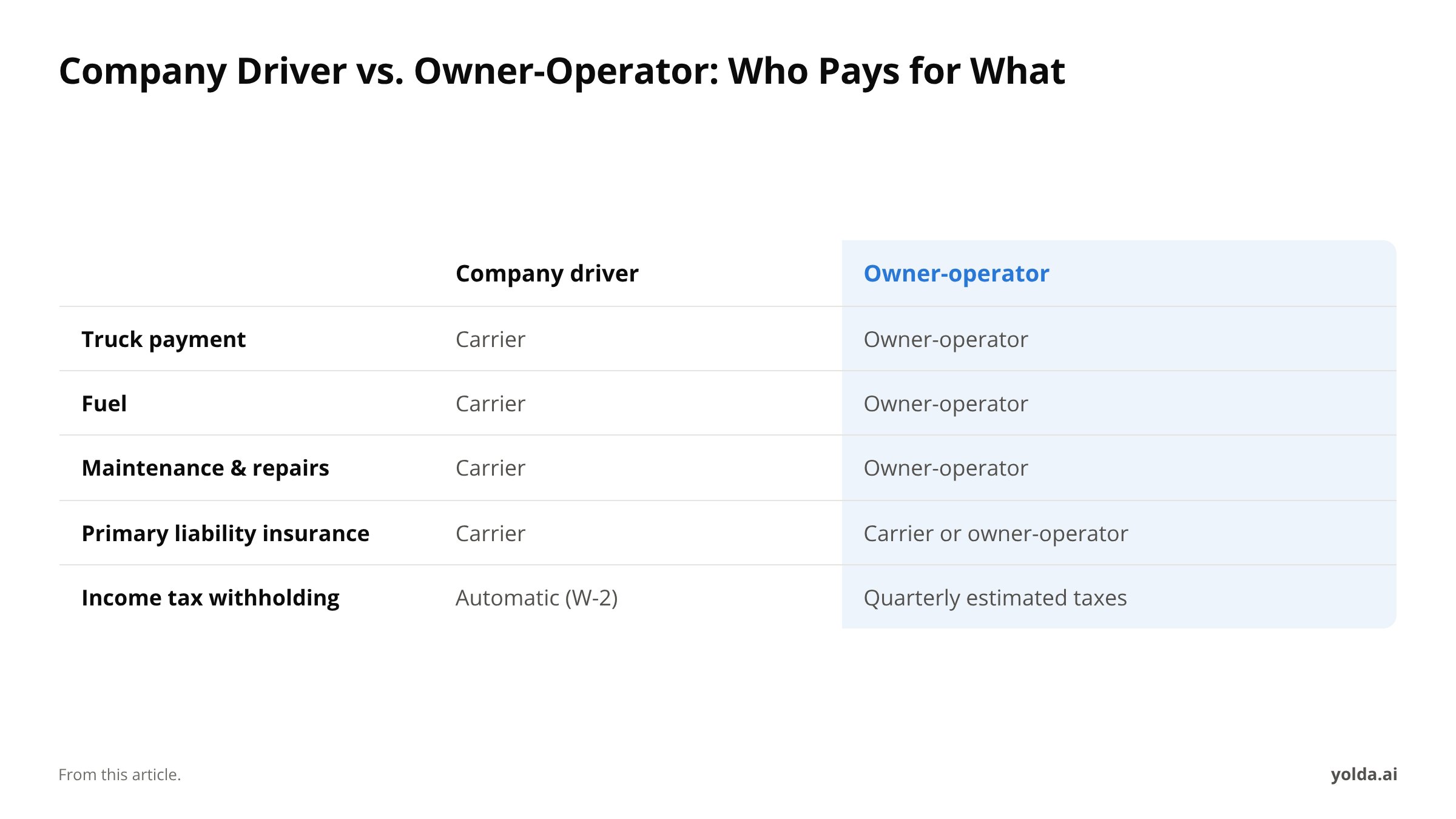
The clearest way to see the difference between a company driver and an owner-operator is to look at who's financially responsible for each cost.
| Cost | Company driver | Leased-on owner-operator | Own-authority owner-operator |
|---|---|---|---|
| Truck payment | Carrier | Owner-operator | Owner-operator |
| Fuel | Carrier | Owner-operator | Owner-operator |
| Maintenance & repairs | Carrier | Owner-operator | Owner-operator |
| Primary liability insurance | Carrier | Carrier (often deducted from pay) | Owner-operator |
| Cargo insurance | Carrier | Often carrier, per lease | Owner-operator |
| IFTA fuel tax filing | Carrier | Often carrier | Owner-operator |
| Finding freight | Carrier's dispatch | Carrier's dispatch | Owner-operator |
| Income tax withholding | Automatic (W-2) | None — quarterly estimated taxes | None — quarterly estimated taxes |
Notice how much shifts onto the owner-operator even in the leased-on column, and how much more shifts again under their own authority. That's the tradeoff in a single table: control and upside in exchange for cost and paperwork.
Is becoming an owner-operator worth it?
It can be, but only if the numbers work after every real cost is counted — not just the per-mile rate advertised in a recruiting ad. Owner-operators can out-earn company drivers significantly in strong freight markets, and they get to choose their lanes, their schedule, and in the own-authority case, their customers. But they also absorb the downside when freight rates soften, fuel costs spike, or the truck needs an unexpected repair.
A few questions worth answering honestly before making the switch:
- Can you cover 2–3 months of truck payments and insurance from savings if freight is slow?
- Do you have a maintenance reserve, or will a transmission repair wipe out a month's profit?
- Have you priced out insurance as an individual, not through a carrier's group rate?
- Do you understand the lease agreement's deduction schedule line by line, not just the headline pay rate?
- Are you prepared to file quarterly estimated taxes instead of having them withheld automatically?
If the answer to most of these is "not yet," leasing on with a reputable carrier is usually the lower-risk entry point into owner-operator life, with own authority as a step to consider once there's more of a financial cushion.
Whichever path a driver chooses, the carrier side of that relationship — whether it's a one-truck operation or a fleet onboarding its first owner-operators — needs clean, auditable settlement records. Yolda's driver settlement software builds a weekly settlement statement directly from the loads a driver ran, with deductions itemized so both the carrier and the driver can see exactly how gross pay turned into the final number — and a person on the carrier's team reviews and approves every statement before it goes out. If you're building the carrier side of this relationship from scratch, our guide to starting a trucking company covers the broader setup; this post goes deeper on the owner-operator relationship specifically.
Whether you're weighing leasing on versus going it alone, or you're a carrier trying to make settlements transparent enough that owner-operators stick around, Yolda runs dispatch, settlements, and compliance on one platform. Book a demo to see how it handles owner-operator pay specifically, or start a free trial today.
Checklist: Deciding between leasing on and own authority
- Calculate your real weekly take-home using actual fuel and maintenance costs, not estimates.
- Request a sample settlement statement from any carrier before signing a lease.
- Read the lease's deduction schedule line by line — fuel surcharge, trailer rental, escrow.
- Price individual insurance coverage if considering own authority, before applying for authority.
- Build a maintenance reserve fund covering at least one major repair.
- Confirm with a tax professional how quarterly estimated taxes will work for your situation.
- Compare at least two carriers' lease terms if leasing on, not just the first offer.
- Review FMCSA's requirements for obtaining operating authority if going the own-authority route.


