
Quick answer: A deduction is defensible when it's written into a signed pay agreement before the load runs, backed by a receipt or invoice, and shown to the driver as its own line item on the settlement — not folded into a vague "misc" charge. Fuel surcharges, agreed equipment costs, lumper fees, tolls, and DOT compliance holds can all be deducted legally if they're documented this way. Deductions that cut into minimum wage, change rates after the fact, or come as a surprise are the ones that trigger wage claims and Department of Labor complaints.
Key takeaways
- A deduction needs three things to hold up: a signed written agreement, a receipt or source document, and a line-item appearance on the settlement — missing any one of these turns a normal deduction into a legal risk.
- Federal wage law generally does not allow deductions that bring a driver's effective pay below minimum wage for hours worked, even for independent contractors in some states — confirm your state's rule with an employment attorney before finalizing a deduction policy.
- Retroactive rate cuts and undisclosed markups on fuel, parts, or supplies are the two deduction practices most likely to draw a legal complaint, according to patterns described in FMCSA and Department of Labor guidance on carrier-driver pay disputes.
- Itemizing every deduction by load, not just by category, is the single biggest driver of fewer settlement disputes — drivers can't argue with a number they can trace back to a specific run.
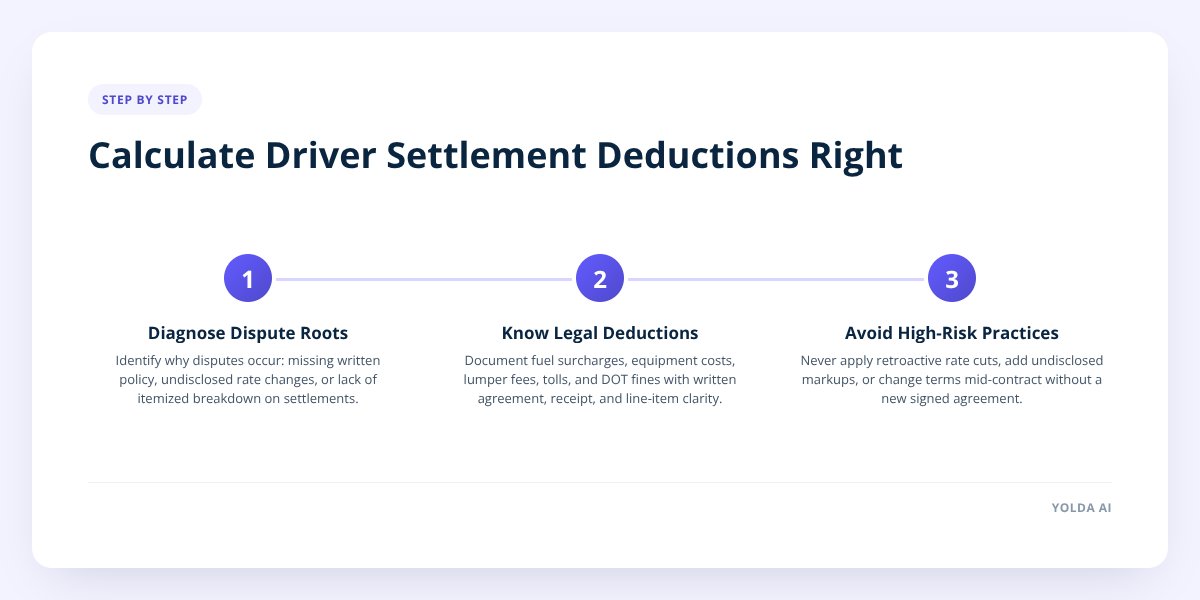
Step 1: Figure Out Why Your Settlement Disputes Keep Happening
Most settlement disputes trace back to one root cause: the driver didn't see the deduction coming. A driver who gets a settlement with a $340 "equipment" line and no explanation will call dispatch, and if dispatch can't explain it either, the call escalates.
This usually happens for one of three reasons:
- The deduction policy only exists verbally. Someone told the driver about equipment costs during onboarding, but it's not in writing anywhere the driver can check later.
- The deduction amount changed without notice. A fuel surcharge formula shifted, or a lumper fee came in higher than expected, and nobody flagged it before the settlement ran.
- The settlement shows a total, not a breakdown. The driver sees "deductions: $512" with no load reference, no receipt, and no way to verify it.
None of these are really about the deduction itself — they're about communication. A $200 tire replacement charge rarely upsets a driver who signed off on it in writing and can see the invoice. The same $200 charge, appearing unexplained on a Friday settlement, upsets almost everyone.
Step 2: Know Which Deductions Are Legal and Defensible
Several categories of deductions are standard across the industry and hold up well, provided they're documented and agreed to in advance.
| Deduction type | Defensible when | Common pitfall |
|---|---|---|
| Fuel surcharges | Tied to a published index or formula in the pay agreement | Formula not disclosed or changed without notice |
| Equipment costs | Agreed in writing before purchase, itemized with receipts | Verbal agreement only, no paper trail |
| Lumper fees | Backed by a lumper receipt, passed through at cost | Marked up above the receipt amount |
| Tolls | Actual toll amounts from a toll transponder or receipt | Estimated instead of actual charges |
| DOT fines and compliance holds | Tied to a specific violation, driver at fault, documented | Deducted before the violation is confirmed |
| Workers' comp premiums | Disclosed rate in the contractor agreement, consistent monthly | Rate changes without written notice |
Fuel surcharges deserve extra care because they move constantly and drivers notice fast when fuel costs spike. If your settlement math hasn't kept up with fuel swings, the post Managing Driver Settlements Through Fuel Swings walks through how to keep the surcharge formula consistent even when diesel prices jump week to week.
Equipment deductions are the ones carriers most often get wrong — not because the deduction is illegal, but because the agreement is missing. If a driver buys a GPS mount, a dolly, or a set of chains through the company, that cost is deductible only if the driver signed something saying so before the purchase. A verbal "yeah, that's fine, we'll take it out of your check" is not enough paperwork to survive a wage claim.
DOT compliance holds are a separate animal. If a driver gets an out-of-service violation that resulted in a fine, or caused a load delay with a real cost, that cost can be passed through — but only once the violation is confirmed, not the moment it's reported. Deducting before confirmation, and then having to reverse it, is one of the fastest ways to lose a driver's trust.
Step 3: Know Which Deductions Put You at Risk
Three practices show up again and again in driver wage disputes, and all three are avoidable.
Don't skip this: retroactive rate cuts — changing a per-mile rate or deduction amount after a load has already run — are one of the most common triggers for wage claims described in Department of Labor guidance on carrier pay practices. If a rate changes, it applies to loads going forward, never backward.
The three riskiest patterns:
- Unilateral rate cuts. Lowering a driver's per-mile rate or changing a deduction formula without a new signed agreement, especially mid-contract.
- Company store markups. Charging drivers more than cost for fuel, parts, or supplies purchased through the company, without disclosing the markup.
- Retroactive charges. Applying a new fee or rate to loads that already settled, instead of starting it with the next load.
Each of these turns a routine business decision into a potential wage claim because the driver didn't agree to the terms under which they were paid. If you need to change a rate because fuel costs moved against you, the right move is a new written notice before the next load — not an adjustment buried in this week's settlement. How to Recalculate Driver Settlements When Fuel Prices Drop covers how to handle rate changes in the other direction, when fuel costs fall and drivers expect their take-home to reflect it.
Step 4: Document Every Deduction While the Load Is Still Fresh
The best time to document a deduction is the day it happens, not the day the settlement runs. Waiting until settlement day means reconstructing receipts, remembering which load a lumper fee belonged to, and hoping nothing got lost.
A workable real-time documentation habit looks like this:
- Attach the receipt to the load, not to a folder. A toll receipt, lumper invoice, or repair bill should live with the specific load it belongs to, so anyone reviewing the settlement later can trace it in one click.
- Log the agreement reference alongside the charge. Note which section of the driver's pay agreement authorizes the deduction, so there's no ambiguity about whether it was agreed to.
- Record the date the driver was notified, separate from the date the charge was deducted. This matters most for DOT holds and equipment costs, where timing disputes are common.
- Keep a running per-driver ledger, not just a per-settlement snapshot, so you can show a pattern of consistent treatment if a dispute ever escalates to a labor complaint.
Doing this manually in spreadsheets is where most back offices fall behind — a fuel receipt gets photographed but never linked to the load, or a lumper fee gets entered under the wrong week. This is the point where purpose-built driver settlement software earns its keep: documents, receipts, and pay agreements attached directly to the load they belong to, so nothing has to be reconstructed later. Yolda's driver settlement tool turns delivered loads directly into itemized weekly statements, with every deduction, reimbursement, and bonus routed through a company approval queue before it ever reaches a driver's pay — nothing calculated or paid without a human sign-off first.
Step 5: Make the Settlement Itself the Explanation
A settlement that needs a phone call to explain has already failed at its job. The fix is itemization by load, not by category — every deduction should trace back to one specific run, with the amount, the reason, and the supporting document all visible in the same place.
Three habits make this stick month to month:
- Publish the deduction policy in writing, once, and keep it current. Every driver should be able to pull up the same document and see exactly what can be deducted and under what conditions.
- Itemize every settlement by load. A single "deductions" total invites disputes; five line items each tied to a load number invites none.
- Explain changes before they appear on a check. If the fuel surcharge formula updates, or a new equipment agreement takes effect, tell drivers in advance — a push notification, a message, or a posted notice — not after the fact.
Carriers that get this right tend to see fewer disputes and less turnover, because drivers stop treating settlement day as a guessing game. We covered the retention side of this in Fix Driver Turnover With Transparent Settlement Reporting, which looks at how settlement clarity affects whether drivers stay past their first few months.
What to Do Next
Start by pulling your last three months of settlements and checking whether every deduction on them maps to a signed agreement and a receipt. Gaps you find there are gaps a driver — or a labor investigator — could find too.
If your back office is still assembling settlements from spreadsheets and scattered receipts, Yolda builds the settlement straight from the load data already in the system, with every deduction reviewed and approved before it reaches a driver. Book a demo to see how it handles a real week of settlements, or start a free trial to try it against your own driver roster.
Checklist: Calculating Defensible Driver Settlement Deductions
- Confirm every deduction type has a matching clause in the signed driver pay agreement.
- Attach a receipt or invoice to each deductible charge before it reaches settlement.
- Verify DOT holds and fines are confirmed, not just reported, before deducting.
- Apply any new rate or fee to future loads only — never retroactively.
- Itemize each settlement by load number, not by category total.
- Notify drivers of policy or formula changes before the next settlement runs.
- Keep a per-driver ledger showing consistent treatment across pay periods.
- Review your deduction policy against current state wage law at least once a year.

