
Quick answer: An owner-operator running under their own authority typically needs five coverages: primary liability, cargo insurance, physical damage, non-trucking/bobtail liability, and occupational accident or workers' comp coverage. The Federal Motor Carrier Safety Administration sets minimum primary liability limits — $750,000 for most freight, with higher minimums for hazmat and other specified cargo — but shippers and brokers routinely require more than the legal floor. Cost depends on your authority's age, your driving record, your equipment, and your freight type more than almost anything else.
Key takeaways
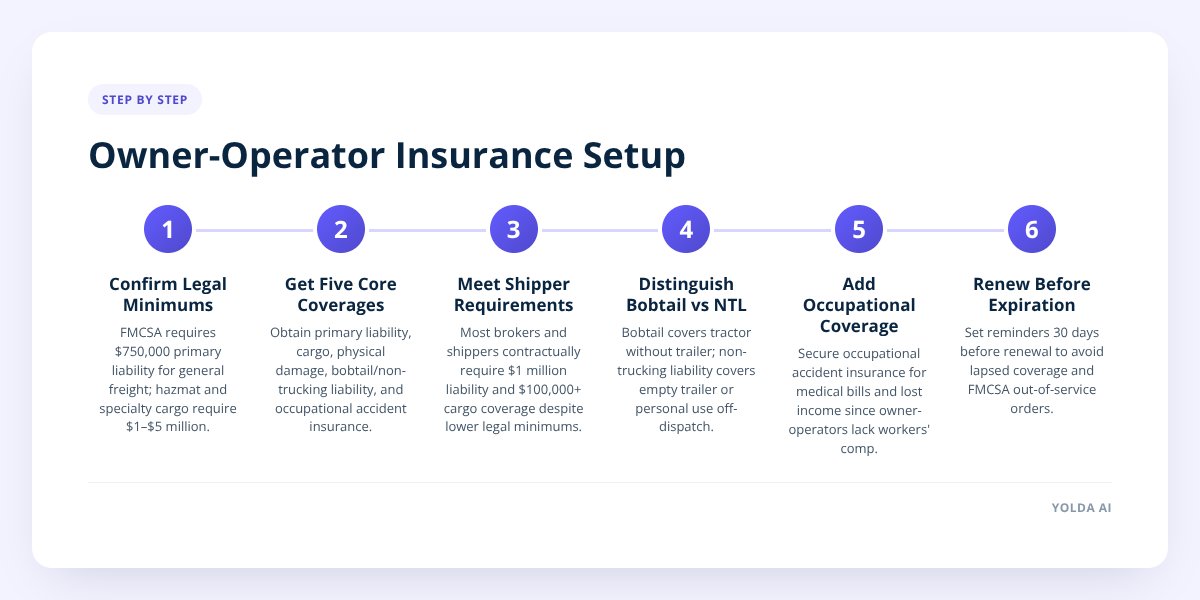
- FMCSA's minimum financial responsibility for motor carriers hauling non-hazardous general freight is $750,000 in primary liability coverage, per 49 CFR 387.9 — but most brokers and shippers contractually require $1 million.
- Cargo insurance isn't federally mandated for most freight, but almost no broker will tender a load without proof of it, typically in the $100,000 range.
- Bobtail and non-trucking liability cover different trips: bobtail is driving the tractor alone under your own authority; non-trucking liability is personal use or under another carrier's dispatch.
- Occupational accident coverage is optional for an owner-operator with no employees, but it's the only thing standing between a serious injury and a medical bill you pay out of pocket — owner-operators aren't covered by state workers' comp in most states unless they opt in.
By the numbers
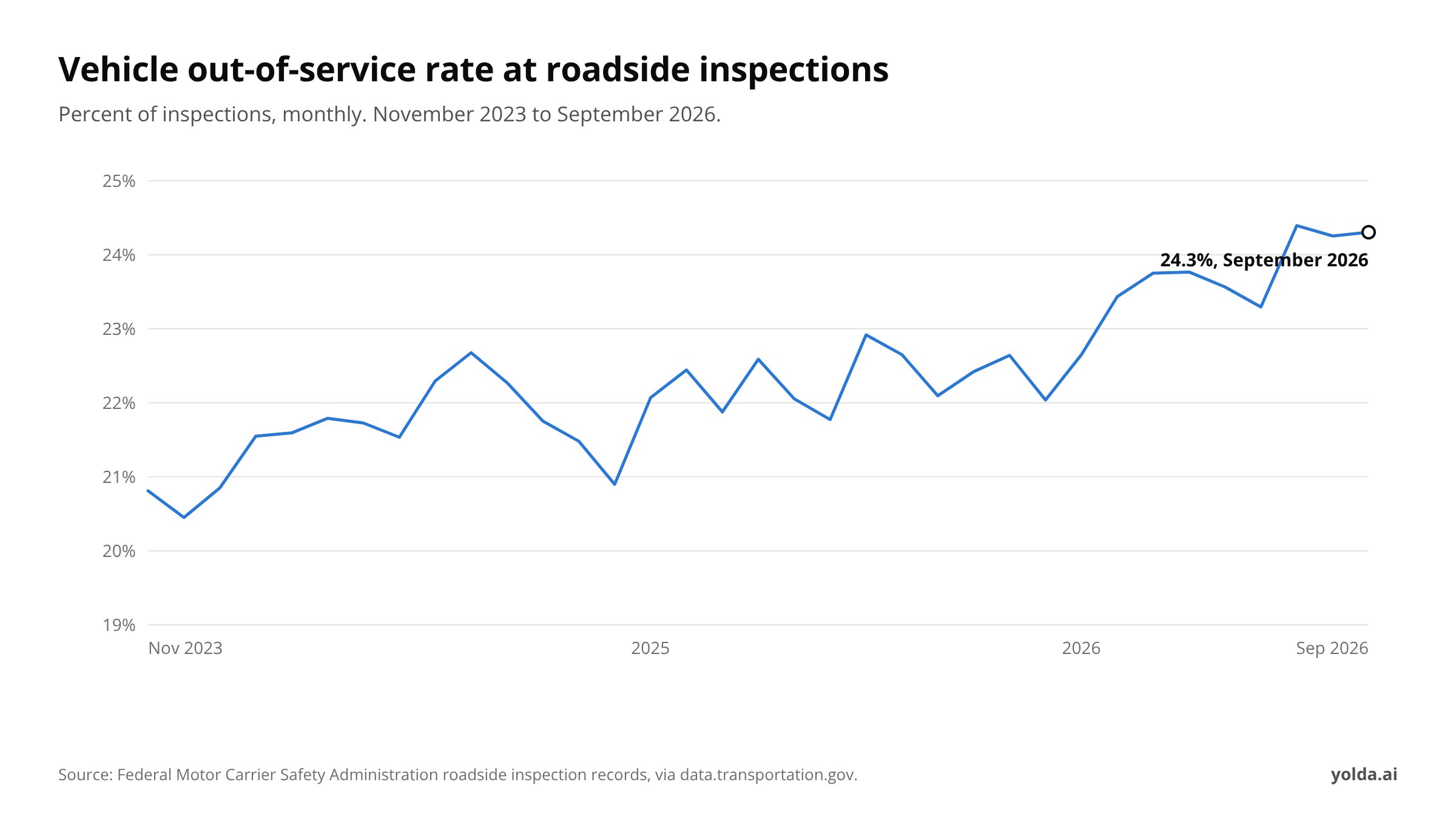
- The vehicle out-of-service rate at roadside inspections was 24.3% in September 2026, up 2.2 percentage points from a year earlier. Source: Federal Motor Carrier Safety Administration roadside inspection records, DOT open data.
Latest official data as of Nov 7, 2026.
What insurance does an owner-operator actually need?
An owner-operator with their own operating authority needs five distinct policies, and each one covers a different risk — they are not interchangeable, and a gap in one isn't filled by having the others.
- Primary liability — covers damage or injury you cause to other people, vehicles, or property while hauling a load under your authority.
- Cargo insurance — covers the freight itself if it's damaged, lost, or stolen while in your care.
- Physical damage coverage — covers your own truck and trailer against collision, fire, theft, and weather.
- Non-trucking liability / bobtail insurance — covers you when you're driving the truck but not under dispatch or hauling a loaded trailer.
- Occupational accident coverage — covers your own medical bills and lost income if you're hurt on the job, since you're not an employee covered by workers' comp.
If you're leased to a carrier instead of running under your own authority, that carrier's policies may cover primary liability while you're dispatched — but you'll still likely need your own non-trucking liability and physical damage coverage, and you should get the exact split of responsibility in writing before you sign the lease. We cover the broader distinction in What Is an Owner-Operator in Trucking?, and the step-by-step process of setting up a carrier is in how to start a trucking company. This post goes deeper on insurance specifically.
How much primary liability coverage does FMCSA actually require?
FMCSA requires motor carriers hauling non-hazardous general freight in vehicles over 10,001 pounds to carry a minimum of $750,000 in combined bodily injury and property damage liability coverage, under 49 CFR 387.9. That's the legal floor, not a recommendation, and it applies whether you're running one truck or a fleet.
The minimum goes up for specific categories:
| Cargo type | FMCSA minimum liability |
|---|---|
| General freight (non-hazardous) | $750,000 |
| Oil, hazardous substances in bulk | $1,000,000 |
| Certain hazardous materials (explosives, poison gas, etc.) | $5,000,000 |
| Household goods (interstate movers) | $750,000–$5,000,000 depending on vehicle |
Confirm current figures directly with FMCSA before you bind a policy, since these thresholds are set in federal regulation and change only through formal rulemaking. In practice, the legal minimum rarely matters to your day-to-day business — most freight brokers and shippers write $1 million in liability coverage into their contracts as a condition of hauling for them, regardless of what the law technically requires. If your policy is written at the $750,000 floor, you may find yourself turned away from loads that a $1 million policy would have qualified you for.
Don't skip this: a lapse in your liability policy — even for a few days between carriers — can trigger an FMCSA out-of-service order and wipe out your operating authority until you get reinstated. Set a calendar reminder 30 days before renewal, not the week of.
What's the difference between bobtail and non-trucking liability?
Bobtail insurance and non-trucking liability (NTL) both cover the tractor when it's not pulling a loaded trailer under dispatch, but they apply to different situations and insurers don't always use the terms interchangeably.
- Bobtail insurance typically covers the truck when you're driving it without a trailer attached at all — heading to pick up a load, returning from a drop, or running to the shop.
- Non-trucking liability typically covers the truck when you have a trailer attached (even your own, empty) but you're not under dispatch — personal errands, driving home, or deadheading between jobs that aren't tied to a specific load.
Here's where owner-operators get caught: your primary liability policy from your own authority, or the one your leased carrier provides, generally only applies while you're dispatched and under a load. The moment you're off-duty and driving the truck for any other reason, that coverage doesn't apply — which is exactly the gap bobtail and NTL are built to close.
If you lease to a carrier, ask them directly which of these two coverages (if either) they provide, and get the answer in writing in your lease agreement. Many leased owner-operators assume they're covered when they're not, and find out only after an accident.
Why does cargo insurance matter even though it's not federally required?
Cargo insurance isn't mandated by FMCSA for most general freight, but it functions as a required coverage in practice because almost no broker or shipper will tender a load without proof of it. A standard cargo policy for a dry van or reefer operation typically runs around $100,000 in coverage, though the right amount depends on the value of what you typically haul.
A few things to check on any cargo policy before you sign:
- Commodity exclusions. Many standard policies exclude or cap coverage on high-value items like electronics, alcohol, or pharmaceuticals — read the exclusions list, not just the coverage limit.
- Reefer breakdown coverage. If you run refrigerated freight, confirm your policy covers spoilage from mechanical breakdown, not just collision or theft.
- Deductible per occurrence. A $2,500 deductible on a $100,000 policy means you're paying the first $2,500 of any claim yourself — factor that into your rate negotiations.
- Theft from an unattended vehicle. Some policies reduce or deny coverage if cargo is stolen while the truck is parked and unattended for an extended period — know the fine print before you plan an overnight stop.
What drives the cost of owner-operator insurance?
Your premium is driven far more by your risk profile than by the coverage limits you choose, and the same five policies can cost two different owner-operators very different amounts for reasons that have nothing to do with the policy itself.
The factors that move the needle most:
| Factor | Why it matters |
|---|---|
| Authority age | New authorities (under 2–3 years) are statistically higher risk to insurers and often pay more |
| Driving record (MVR) | Moving violations and at-fault accidents raise rates directly |
| CSA/safety scores | A history of roadside violations signals risk to underwriters |
| Equipment age and type | Older trucks and certain trailer types (tankers, flatbeds) can cost more to insure |
| Freight hauled | High-value or hazardous freight raises cargo and liability exposure |
| Radius of operation | Long-haul, multi-state operations generally carry different risk than regional or local runs |
| Claims history | Prior claims — yours or the truck's previous owner's — follow the risk profile |
Notice that the vehicle out-of-service rate at roadside inspections was 24.3% in September 2026, up 2.2 percentage points from a year earlier, according to Federal Motor Carrier Safety Administration roadside inspection records. That trend matters to your insurance cost indirectly: insurers increasingly weight a carrier's inspection and out-of-service history when underwriting, so a clean DVIR record and well-maintained equipment aren't just a safety requirement — they're a cost lever. Keeping ahead of CDL, medical card, and inspection expirations is exactly what Yolda's safety and compliance tools are built to track, with automatic alerts before a date lapses rather than after an inspector catches it.
Does an owner-operator need occupational accident coverage?
Yes, if you have no employees and no state workers' comp coverage, occupational accident insurance is the only thing that pays your medical bills and replaces lost income if you're hurt on the job. Most states don't require an owner-operator to carry workers' comp on themselves — only on employees — which means a solo owner-operator without occupational accident coverage is personally exposed to the full cost of an injury.
Occupational accident policies typically cover:
- Medical expenses from an on-the-job injury
- Disability income while you can't drive
- Accidental death and dismemberment benefits
- Survivor benefits in some policies
If you lease to a carrier, ask whether they require occupational accident coverage as a condition of the lease — many do, and some offer a group plan option. If you run under your own authority with no employees, this coverage is your responsibility alone, and it's worth pricing out before you ever get behind the wheel, not after an injury.
Getting the paperwork right once you're insured
Once your policies are in place, the operational side of compliance doesn't stop — your insurance renewal date is one more deadline sitting alongside your CDL, medical card, and vehicle registration, and missing any of them can take your truck off the road. A platform built for this, like Yolda, tracks all of those dates automatically and sends alerts before something lapses, instead of leaving it to a sticky note on the dash.
If you're still building out the rest of your operation — authority, equipment, your first loads — the full roadmap is in how to start a trucking company. Ready to see how automated compliance tracking fits into your operation? Book a demo or start a free trial.
Checklist: Setting up owner-operator insurance
- Confirm your primary liability limit meets or exceeds $750,000 — check if your target brokers require $1 million instead.
- Request a certificate of cargo insurance and read the commodity exclusions list before binding.
- Clarify in writing whether bobtail, non-trucking liability, or both are covered under your policy or your lease carrier's.
- Price occupational accident coverage if you have no employees and no workers' comp election.
- Ask your insurer how equipment age, CSA score, and authority age are factored into your quote.
- Set a renewal reminder at least 30 days before any policy expires.
- Review your physical damage deductible against your cash reserves before choosing a limit.
- Verify reefer breakdown and unattended-vehicle theft terms if they apply to your freight.


