
Quick answer: When diesel prices fall, you recalculate driver settlements by pulling your current regional fuel price, comparing it to the fuel surcharge baseline in each driver's pay agreement, applying the agreed formula (usually cents-per-mile tied to a published index), and re-running settlements before the next pay date — not mid-cycle. The key is timing the change to a clear boundary and showing drivers the math, so a lower fuel surcharge doesn't look like a pay cut.
Key takeaways
- Fuel surcharges are built on a baseline price; when the current price drops below it, the surcharge shrinks or disappears — this is contractual, not a company decision.
- Recalculate at defined boundaries (weekly settlement cutoff, start of a new load, or a contractual review window), never mid-settlement, to avoid disputed pay.
- The U.S. Energy Information Administration publishes weekly average diesel prices that most carrier fuel surcharge tables reference — confirm which source your pay agreements cite.
- Settlement errors tied to fuel miscalculation are a leading cause of driver disputes; showing the formula and the source number heads off most of them.
Why does a fuel price drop change the settlement at all?
It changes the settlement because most driver pay includes a variable component tied to fuel cost, and that component moves in both directions. A typical owner-operator or company driver pay agreement has two parts: a base rate (per mile or per load, fixed regardless of fuel cost) and a fuel surcharge (a variable add-on meant to offset diesel expense above some baseline price).
The surcharge exists because base rates are usually set assuming a certain fuel cost. When diesel climbs, the surcharge rises to cover the gap. When diesel falls, the surcharge shrinks — sometimes to zero — because the driver is no longer absorbing extra fuel cost at the pump.
Here's a simple worked example. Say a driver's pay agreement sets:
- Base rate: $0.58 per mile
- Fuel baseline: $3.50 per gallon
- Surcharge formula: $0.01 per mile for every $0.10 diesel rises above baseline
If diesel is at $4.10 per gallon, that's $0.60 above baseline, so the surcharge adds $0.06 per mile — total pay of $0.64 per mile. If diesel then drops to $3.70, the gap shrinks to $0.20, the surcharge falls to $0.02 per mile, and total pay drops to $0.60 per mile.
Nothing underhanded happened. The formula did exactly what it was built to do. But a driver who doesn't see the math behind that $0.04-per-mile drop will assume the company just cut their rate — which is why the recalculation process matters as much as the formula itself.
Don't skip this: Never apply a new fuel number retroactively to miles a driver has already run under the old rate. Recalculate forward from a clear cutoff date, not backward into a completed trip.
When should you actually recalculate?
Recalculate at a fixed boundary your drivers already know about — never in the middle of an open settlement period. There are three common timing approaches, and each fits a different kind of fleet.
| Timing model | How it works | Best for |
|---|---|---|
| Real-time (per-load) | Fuel surcharge is locked to the price on the day the load is dispatched or picked up | Fleets running spot freight with short-haul turnarounds |
| Weekly settlement cutoff | Surcharge recalculated once per settlement week, using an average price for that week | Most fleets paying drivers on a weekly cycle |
| Contractual review window | Surcharge reviewed and reset every 2–4 weeks per a clause in the pay agreement | Fleets with longer-haul dedicated lanes or contracted freight |
Whichever model you use, the rule is the same: the driver should be able to predict, from their contract, exactly when a price change will show up in their pay. A driver who gets surprised by a mid-week fuel adjustment they didn't agree to is a driver who starts questioning every number on the statement after that.
If your pay agreements don't specify a timing model at all, that's worth fixing before the next price swing — not during one. We covered how to build that structure in How to Structure Driver Pay During Fuel Price Swings.
Step-by-step: how to run the recalculation
Follow these steps in order, every time diesel moves enough to cross your fuel surcharge threshold.
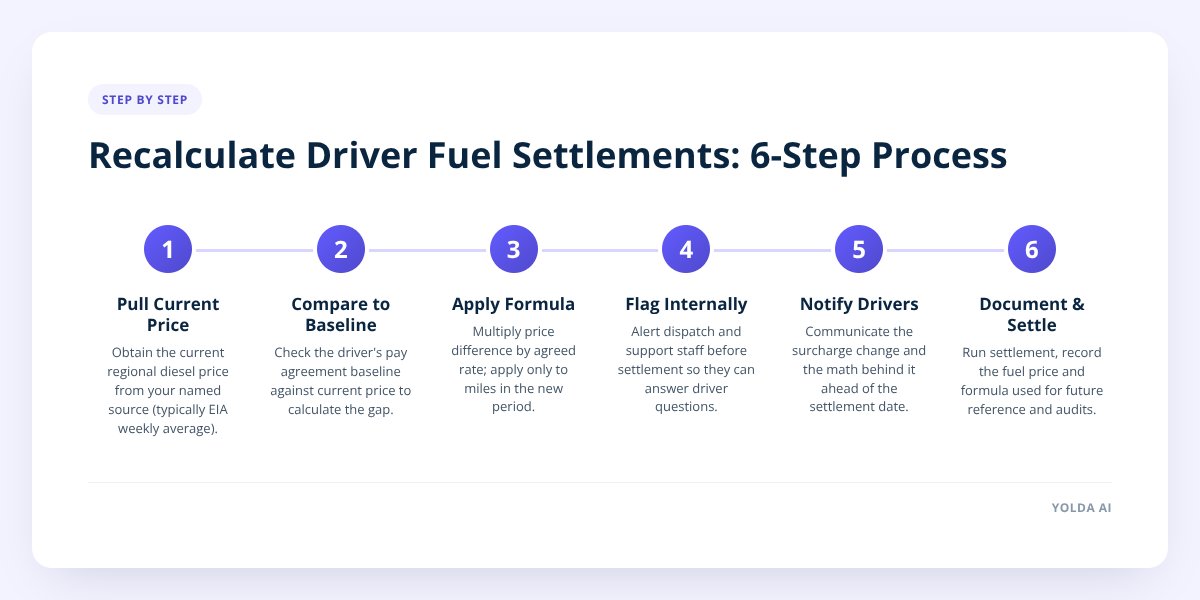
- Pull the current fuel price from your named source. Most carrier fuel surcharge tables reference the U.S. Energy Information Administration's weekly average on-highway diesel price, broken out by region (EIA publishes separate figures for regions like the Midwest, Gulf Coast, and West Coast). Use the same source and region every time — switching sources mid-stream is how numbers stop matching.
- Compare it to the baseline in the driver's pay agreement. Confirm the baseline hasn't already been updated by a prior cycle's recalculation. This is the step most settlement errors trace back to — someone applies this week's formula to last month's baseline.
- Apply the agreed formula. Multiply the price difference by the agreed rate (cents per mile per cents of fuel movement), and apply it only to miles run within the new period, not retroactively.
- Flag the change before the settlement runs. Don't let drivers discover a lower surcharge only when they open their pay statement. Flag it internally first so dispatch and driver-facing staff are ready to answer questions.
- Communicate the change to drivers ahead of the settlement date. Covered in detail below — this step is what protects trust.
- Run the settlement and document the fuel number used. Keep a record of which price, which date, and which formula applied, in case the driver asks for the math later.
A missed or late step 2 is the single most common cause of settlement disputes tied to fuel pricing — it's worth a second look before every recalculation, not just a glance.
How do you tell drivers pay is going down without losing their trust?
You tell them by showing the math before they see the number, not after. A driver who understands why their per-mile pay dropped from $0.64 to $0.60 is far less likely to feel cheated than one who just sees a smaller number on Friday.
A few practices make this easier:
- Give advance notice, even a short one. A message a day or two before the settlement posts — "diesel averaged $3.70 this week, down from $4.10, so the fuel surcharge adjusts from $0.06/mile to $0.02/mile" — turns a surprise into an expected update.
- Show the formula, not just the result. Drivers don't need a finance lecture, but they do need to see baseline price, current price, and the per-mile math laid out plainly.
- Use the same channel every time. If drivers get fuel updates by text one month and buried in a PDF the next, they'll stop trusting any of it.
- Name the public source behind the number. Pointing to the EIA's published weekly diesel average gives drivers something they can independently check, which does more for trust than any internal explanation.
This matters just as much on the way up. We've written separately about the trust side of rising fuel costs in Managing Driver Settlements Through Fuel Swings — the same transparency habits apply whether the number is going up or down.
What tools catch a recalculation before it's overdue?
Software that watches fuel price data and your settlement schedule together, so a drop doesn't sit unnoticed for weeks. Doing this by spreadsheet means someone has to remember to check the EIA number every week, cross-reference it against every driver's individual baseline, and manually edit each pay line — and on a fleet of any size, that's exactly where errors creep in.
This is the specific gap Yolda's driver settlement tool is built to close. It generates each driver's weekly settlement statement directly from the loads they ran, with pay agreements and deductions already attached, so a fuel surcharge change gets applied consistently across every driver on the same formula — not re-typed load by load. Every settlement still goes through a human approval step before it's sent, so nothing calculates and pays itself without a review.
If your fleet is still catching fuel swings after the fact instead of ahead of the settlement date, that's a timing problem more than a math problem — and it's the same one we laid out tools for in Track Fuel Costs and Recalculate Driver Pay Mid-Contract.
Ready to stop re-keying fuel numbers into every driver's statement by hand? Yolda's driver settlement software builds the recalculation into the weekly statement itself — book a demo to see it against your current fuel surcharge formula.
Checklist: recalculate a driver settlement after a fuel price drop
- Pull this week's diesel price from your named source and region.
- Confirm the baseline price on file matches what was used last cycle.
- Apply the pay agreement's formula to miles run in the new period only.
- Flag the change to dispatch and settlement staff before the pay date.
- Send drivers the new number with the math shown, ahead of settlement day.
- Run the settlement and record the price, date, and formula used.
- File the documentation in case a driver requests a breakdown later.

