
Quick answer: The most fuel-resistant pay structure is a base mileage or percentage rate plus a separate fuel surcharge line that adjusts on a published diesel index — not a flat all-in rate that absorbs fuel risk silently. Set your surcharge trigger at a clear price band (for example, every $0.10/gallon move from a baseline), update it weekly or biweekly using the U.S. Energy Information Administration's diesel price data, and put the formula in writing before the swing happens, not during it.
Key takeaways
- A flat mileage rate with no fuel adjustment shifts all diesel risk onto the carrier; a straight percentage-of-revenue model shifts it onto the driver — both break down when diesel moves fast.
- The U.S. Energy Information Administration publishes a weekly national and regional on-highway diesel price that most fuel surcharge tables are built on.
- A $0.50/gallon jump on a truck averaging 6.5 miles per gallon adds roughly $0.077 per mile in fuel cost alone — enough to erase margin on a thin-margin lane if it's not priced in.
- Surcharge triggers set in $0.05–$0.10/gallon bands avoid both constant recalculation and dangerous lag between the diesel move and the pay adjustment.
Step 1: Understand why your current pay model is exposed
Every standard driver pay model has a fuel blind spot, and knowing which one yours has is the first step to fixing it.
- Fixed mileage rate (a flat cents-per-mile rate regardless of fuel cost) is predictable for drivers but puts 100% of fuel risk on the carrier. If diesel jumps mid-quarter, your margin shrinks on every loaded mile until you renegotiate rates — which can take months.
- Percentage of revenue (driver paid a cut of the linehaul rate) flexes with freight rates but not with fuel cost directly. Drivers often resent it because their take-home swings with market rates they don't control, and it does nothing to protect the carrier's fuel margin either.
- Hourly pay sidesteps fuel exposure almost entirely since it's tied to time, not miles or revenue — but it only fits specific operations like local or regional drayage, not over-the-road linehaul where miles drive the economics.
None of these three, used alone, actually tracks the cost that's moving: diesel. That's the gap a fuel surcharge is built to close.
Don't skip this: If your driver settlements don't separate base pay from a fuel line item, you can't tell whether a bad week was caused by freight rates, driver performance, or fuel — and you can't fix what you can't isolate.
Step 2: Choose the base pay structure that pairs best with a fuel surcharge
A base-plus-surcharge hybrid outperforms any single-rate model because it lets each piece do one job. The base rate (mileage or percentage) compensates the driver for the work; the surcharge compensates for fuel cost that neither party controls.
| Base pay model | Fuel sensitivity alone | Best paired with |
|---|---|---|
| Fixed mileage rate | High carrier exposure | Fuel surcharge tied to a diesel index |
| Percentage of revenue | Moderate, indirect | Fuel surcharge or fuel-adjusted percentage |
| Hourly | Low exposure, limited fit | Rarely needs a surcharge |
| Mileage + fuel surcharge | Low, shared fairly | This is the hybrid |
The hybrid works because it isolates variables. A driver on cents-per-mile plus surcharge knows their base rate won't move because of something happening at the pump — and the carrier knows the surcharge line, not the base rate, absorbs the diesel swing. We've laid out the full mechanics of this shift in Structuring Driver Pay When Diesel Prices Spike.
Step 3: Set fuel adjustment triggers without recalculating every day
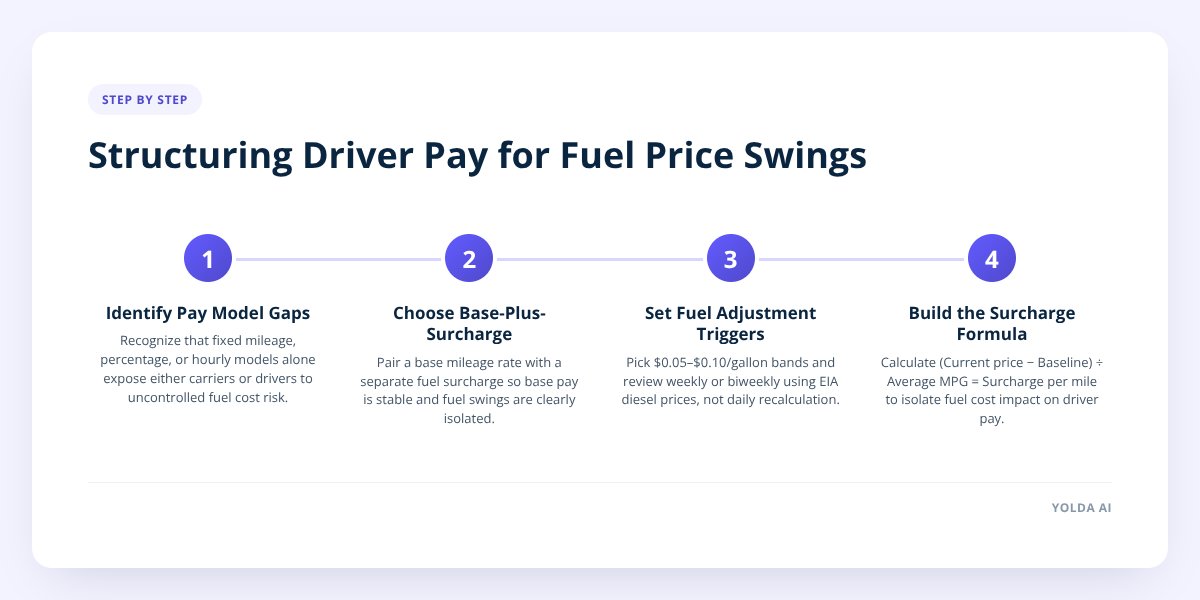
Pick a trigger band, not a daily recalculation, and most fleets land on adjusting pay every time diesel moves $0.05 to $0.10 per gallon from an agreed baseline. Recalculating pay every time the price ticks a penny creates administrative chaos and driver confusion; waiting a full quarter to adjust leaves drivers or the carrier exposed for months.
A workable trigger structure looks like this:
- Set a baseline price at contract signing — for example, the current national average diesel price from the U.S. Energy Information Administration.
- Define a band width (commonly $0.05 or $0.10/gallon) — the surcharge only recalculates when the published price crosses into a new band.
- Choose a review cadence — weekly or biweekly is standard, matched to your settlement cycle so drivers see the adjustment on their next statement, not weeks later.
- Pick a published reference price — the EIA's weekly on-highway diesel price (national or your specific PADD region) is the most common public anchor because it's free, updated regularly, and not controlled by either party.
- Document rounding rules so there's no dispute — round to the nearest cent or nearest band, and state it in the pay agreement.
Regional indexing matters more than it sounds. The EIA publishes diesel prices by Petroleum Administration for Defense District (PADD), and a carrier running lanes through California will see consistently different pricing than one running the Midwest. Anchor your surcharge to the region where most of your miles run, or build separate surcharge tables for distinct lanes.
Step 4: Build (or borrow) the formula that does the math for you
A fuel surcharge formula needs four inputs: baseline price, current price, truck fuel efficiency, and miles run. The general shape most carriers use is:
(Current diesel price − Baseline price) ÷ Average MPG = Surcharge per mile
This is also the backbone of any trucking cost per mile calculator worth using — it isolates the fuel variable so you can see its effect on margin separately from insurance, maintenance, tires, and driver pay. We walk through the full cost-per-mile build, line by line, in Calculate Trucking Cost Per Mile.
A few things that formula depends on getting right:
- Average MPG must be realistic per truck, not fleet-wide. A 2019 sleeper averaging 6.2 MPG and a newer tractor averaging 7.4 MPG produce meaningfully different surcharges on the same price move.
- Empty miles dilute the math. If your surcharge is paid only on loaded miles but the truck burns fuel empty too, the formula undercounts actual fuel cost — decide up front whether deadhead miles get a reduced surcharge or none.
- Idling and reefer fuel aren't covered by a per-mile surcharge at all. If you run temperature-controlled freight, that fuel burn needs its own line item, separate from the linehaul surcharge.
Doing this by hand in a spreadsheet works until you have more than a few trucks or more than one lane — at that point, tracking baseline prices, current prices, and per-truck MPG across a growing roster turns into its own part-time job, and errors creep in fast. This is the exact point where manual settlement tracking breaks down. Yolda's driver settlement software builds driver pay — including fuel-adjusted line items — directly from the loads a driver ran, so the surcharge math isn't a side calculation someone has to remember to run before every settlement goes out.
Step 5: Run the real math on a mid-quarter diesel swing
Here's how a $0.50/gallon jump plays out on an actual settlement, using a truck averaging 6.5 miles per gallon:
$0.50 ÷ 6.5 MPG = $0.077 per mile in added fuel cost.
On a truck running 2,400 miles a week, that's $184.80 a week in fuel cost that didn't exist before the price moved. Over a 13-week quarter, if the price holds at the new level, that's $2,402.40 — money that either comes out of carrier margin, driver pay, or gets passed through to the customer, depending on who's contractually on the hook.
Sample contract language that handles this cleanly:
"Base linehaul rate is $0.58 per loaded mile. A fuel surcharge applies when the EIA Midwest on-highway diesel price moves $0.10 or more from the $3.90/gallon baseline set at contract start. Surcharge per mile = (current price − baseline) ÷ 6.5 MPG, rounded to the nearest $0.01, recalculated weekly and reflected in the following settlement cycle."
That single clause does three things: it names the public reference price, it sets a trigger band so you're not recalculating daily, and it states the formula so there's no argument about the number when diesel moves. For the fuller worked example with multiple price points across a quarter, see Recalculating Cost Per Mile When Diesel Prices Spike.
Step 6: Keep IFTA and settlements in sync when fuel prices move
A fuel surcharge adjustment doesn't change your IFTA fuel-tax obligation, but the two are easy to mix up if your systems aren't connected. IFTA reporting is based on fuel purchased and miles run per jurisdiction — it's a tax calculation, not a pay calculation — while your surcharge is a driver pay adjustment tied to a price index. They use different inputs but often the same source data (fuel receipts, miles, MPG), which is why keeping them in separate spreadsheets tends to produce mismatched numbers at quarter-end.
If your fuel prices are swinging enough mid-quarter to justify a pay adjustment, it's worth checking whether your IFTA filing approach can keep up too — we cover that directly in How to File IFTA When Fuel Prices Swing Mid-Quarter.
Yolda's platform handles IFTA fuel-tax calculation and driver settlements in the same system, using the same underlying load and mileage data, so a fuel price update doesn't have to be entered twice in two different places.
What to do next
Pick one lane or one truck and run the formula on this quarter's actual diesel move before you roll a surcharge clause into every contract. Confirm the math holds up against your real MPG and real miles, then write the trigger band and reference price into your next settlement agreement in plain language, the way the sample clause above does.
Ready to stop tracking fuel surcharges by hand? Yolda builds fuel-adjusted driver settlements straight from the loads your drivers run, with IFTA reporting on the same platform. Book a demo or start a free trial to see it on your own lanes.
Checklist: Structure driver pay for fuel price volatility
- Identify which base pay model you currently use and name its fuel blind spot.
- Set a baseline diesel price using the EIA's published on-highway rate for your region.
- Choose a trigger band — $0.05 or $0.10/gallon is standard — before you need one mid-contract.
- Pick your settlement cadence for surcharge updates, weekly or biweekly.
- Write the surcharge formula into the pay agreement in plain, specific language.
- Decide how deadhead miles and reefer fuel are treated separately from the linehaul surcharge.
- Run the formula against last quarter's actual diesel swing to sanity-check the numbers.
- Confirm your IFTA fuel-tax data and your settlement fuel data come from the same source.

