
Quick answer: Cost per mile (CPM) equals every dollar you spend running your fleet — fuel, driver pay, maintenance, insurance, permits, overhead — divided by total miles driven in the same period. The catch is that fuel is the one variable that moves weekly or even daily, so a static spreadsheet number goes stale fast. The fix is separating your fixed costs from your variable fuel cost, then updating only the fuel side against current diesel prices instead of recalculating the whole formula from scratch.
Key takeaways
- CPM has two halves: fixed costs (insurance, truck payments, permits) that barely move month to month, and variable costs (fuel, tires, some maintenance) that swing with usage and price.
- The U.S. Energy Information Administration publishes weekly average diesel prices by region — use that as your fuel-price input instead of guessing from the last fill-up.
- A fleet averaging 6.5 miles per gallon feels a $0.30 jump in diesel prices as roughly $0.046 more per mile — small per mile, but it adds up fast across a truck running 100,000 miles a year.
- Rolling weekly or monthly averages smooth out day-to-day price noise and give you a CPM number stable enough to actually set rates against.
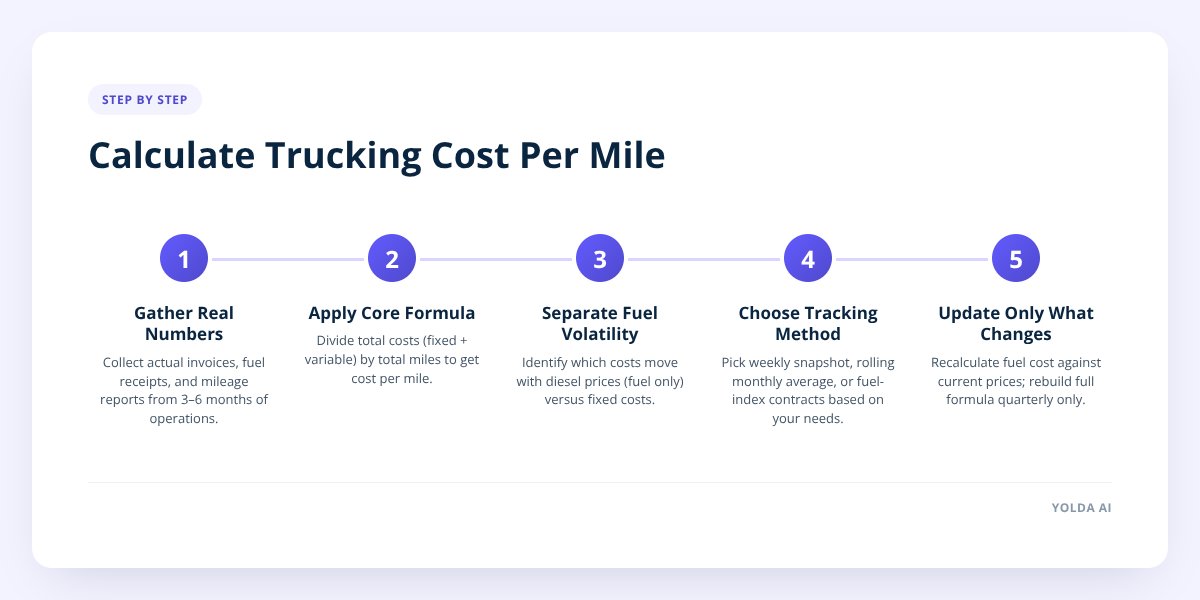
Step 1: Gather your real numbers before you build the formula
You can't calculate an accurate CPM with guesses. Pull actual figures from the last three to six months of operations — invoices, fuel receipts, ELD mileage reports, and payroll records.
You need two buckets of numbers:
- Fixed costs (don't change with miles driven): truck and trailer payments, insurance premiums, permits and licensing, office overhead, software subscriptions.
- Variable costs (scale with miles driven): fuel, tires, routine maintenance, tolls, driver pay if it's mileage-based.
Add up each bucket over a set period — a month works well — and note total miles driven by the truck or fleet in that same period. Without a clean, consistent time window, the math below won't mean anything.
Step 2: Apply the core CPM formula
The basic formula is: Total Costs ÷ Total Miles = Cost Per Mile. Here's what that looks like with real numbers for a single truck running one month.
| Cost category | Monthly amount |
|---|---|
| Truck/trailer payment | $2,200 |
| Insurance | $900 |
| Permits & licensing | $150 |
| Driver pay (fixed base) | $3,800 |
| Fuel (10,000 miles ÷ 6.5 mpg × $3.85/gal) | $5,923 |
| Maintenance & tires | $1,100 |
| Tolls | $300 |
| Total | $14,373 |
At 10,000 miles for the month, that's $14,373 ÷ 10,000 = $1.44 per mile. Break that into fixed CPM ($7,050 fixed ÷ 10,000 = $0.71) and variable CPM ($7,323 variable ÷ 10,000 = $0.73). This split matters because it tells you exactly which half of your CPM moves when diesel prices change — and which half doesn't.
Step 3: Separate what fuel volatility actually touches
Fuel volatility only hits your variable CPM — your fixed costs stay put no matter what diesel does. That's the single most important thing to understand about recalculating CPM without redoing the whole formula every time prices move.
Here's what moves and what doesn't when diesel prices swing:
| Cost type | Reacts to fuel price swings? | Example |
|---|---|---|
| Fuel | Yes, directly | Cost per gallon × gallons burned |
| Fuel surcharge revenue | Yes, if you have surcharge clauses | Offsets fuel cost increases |
| Driver pay (per-mile) | No | Set by contract, not fuel price |
| Insurance | No | Fixed premium regardless of diesel cost |
| Truck payment | No | Fixed loan or lease amount |
| Maintenance | Indirectly | Higher fuel prices can mean less discretionary maintenance spend |
| Tolls | No | Set by toll authority, not fuel |
Because only fuel (and any surcharge revenue tied to it) actually reacts, you don't need to rebuild your entire CPM model every time diesel moves $0.10. You just need to swap in a new fuel cost and recalculate the variable side — a process we walked through in more detail in How to Calculate Cost Per Mile When Diesel Keeps Swinging.
Don't skip this: Never average diesel prices over a period longer than a month for active rate-setting. The U.S. Energy Information Administration publishes weekly national and regional average diesel prices — a three-month average can mask a spike that's already eating your margin on loads you're quoting today.
Step 4: Choose a tracking method that matches how often your fuel cost actually changes
Pick a refresh cadence based on your fuel price exposure, not on habit. Three methods cover most fleets:
- Weekly snapshot. Pull the current regional diesel average from the EIA's weekly report every Monday, plug it into your variable CPM, and use that number for rate quotes that week. Best for owner-operators and small fleets running spot freight.
- Rolling monthly average. Average your actual fuel spend per gallon over the trailing 30 days and use that as your fuel input. This smooths out day-to-day noise and works well for fleets with steadier, contracted freight where you don't need to react to every price tick.
- Fuel-index contracts. If your rate agreements include a fuel surcharge tied to a published index (often the EIA's on-highway diesel price), your CPM fuel line adjusts automatically as the index moves, and the surcharge is meant to offset the increase on the revenue side.
A mixed approach is common: rolling monthly average for internal cost tracking, weekly snapshot for quoting new business, and index-based surcharges for existing contracts. Whichever you pick, keep it consistent — switching methods mid-quarter makes month-over-month comparisons meaningless.
Step 5: Rebuild the formula only when it actually needs rebuilding
Full CPM recalculation — redoing fixed costs, insurance, everything — only needs to happen quarterly or when a fixed cost actually changes, like a new truck payment or an insurance renewal. Between those events, you're only ever updating the fuel line.
That means your recalculation routine each week or month should be:
- Pull the current diesel price for your operating region from the EIA or your fuel card provider's reporting.
- Recalculate gallons burned using your fleet's actual average mpg, not a manufacturer estimate.
- Multiply gallons burned by the new price per gallon to get updated fuel cost.
- Swap that number into your variable cost total and re-divide by miles driven.
- Leave every fixed-cost line untouched unless something on that side genuinely changed.
This is exactly the drudgery that a spreadsheet handles poorly at scale — one truck is fine, twenty trucks with different mpg, routes, and fuel purchase points turns into a full-time job. This is where a trucking management software platform earns its keep: pairing dispatch and settlement data with fuel and mileage records so CPM updates from real numbers instead of a manual re-entry every time diesel moves. Yolda's IFTA fuel-tax reporting and driver settlement tools already track the mileage and fuel data your CPM formula needs, so the inputs are sitting in one place instead of scattered across fuel cards, ELD reports, and payroll.
Step 6: Use your updated CPM to check rates, not just track costs
Recalculating CPM is only useful if you act on the number — check every quoted rate against your current CPM before you accept the load, not after. A rate that cleared your margin threshold in January can lose money in September if diesel rose $0.40 a gallon and your rate didn't move with it.
Two practical checks worth running monthly:
- Compare your current variable CPM against the same month a year ago — if fuel-driven CPM has climbed faster than your rates have, you have a pricing gap to close with customers or surcharge clauses.
- Compare CPM across drivers or trucks with similar routes — a truck running noticeably higher fuel CPM than its peers may have a maintenance issue dragging down mpg, not just bad luck with fuel prices. We covered how this shows up in driver settlements in How Diesel Prices Change Your Cost Per Mile and Settlements.
What to do next
Start by pulling one month of real cost data and running the fixed/variable split above — most fleets find this alone clarifies where their margin actually goes. From there, pick one tracking cadence (weekly snapshot or rolling monthly average) and stick with it for at least a full quarter before comparing results.
If you're tracking CPM by hand across fuel cards, ELD reports, and payroll spreadsheets today, that manual reconciliation is usually the biggest source of stale numbers — not the math itself. Yolda brings dispatch, IFTA fuel-tax reporting, and driver settlements into one workspace so the mileage and fuel figures feeding your CPM come from the same place your loads and pay already live, cutting out the re-entry that makes recalculation feel like a chore.
Checklist: Calculating an accurate, fuel-adjusted CPM
- Gather three to six months of fixed and variable cost data from invoices and payroll.
- Split costs into fixed (insurance, truck payment, permits) and variable (fuel, tires, maintenance) buckets.
- Calculate baseline CPM using total costs divided by total miles for one period.
- Pull the current regional diesel average from the EIA's weekly reporting.
- Recalculate gallons burned using your fleet's actual average mpg.
- Update only the fuel line in your variable costs, leaving fixed costs untouched.
- Choose one tracking cadence — weekly snapshot, rolling monthly average, or index-based — and use it consistently.
- Compare updated CPM against quoted rates before accepting new loads.

